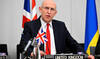
JERUSALEM: Israeli Prime Minister Benjamin Netanyahu said he will discuss with Russian President Vladimir Putin on Wednesday what he calls Iran’s “aggression” and attempts to expand its military presence in Syria.
Netanyahu along with Israeli security officials have repeatedly expressed concern over what they see as Iran moving to expand its presence in the Middle East.
Netanyahu will neet Putin at the Black Sea resort city of Sochi on Wednesday. Both Russia and Iran back Syrian President Bashar Assad’s regime in the war.
“I will raise the problem of Iran trying to establish a military presence in Syria,” Netanyahu said in a statement on Tuesday.
“This proves that Iran’s aggression has not diminished since the nuclear agreement, which has become a problem not only for Israel, but for all the countries of the Middle East and the entire world.”
The head of Israeli spy agency Mossad, Yossi Cohen, and Netanyahu’s newly named head of his national security council, Meir Ben-Shabbat, will join him on the trip.
Netanyahu opposes a southwest Syria cease-fire recently agreed by Russia and the US because he believes it would enable Iran to solidify its presence in the country, an Israeli official has said.
An Israeli intelligence official said in April his country fears an “Iranian crescent” may be forming in the Middle East because of Tehran’s influence in Syria and its connections with regional Shiite groups.
Beyond concerns over Iran, Netanyahu’s talks with Putin are also likely to involve coordination in Syria.
Russia and Israel have established a “hotline” to avoid accidental clashes in the country.
Israel has sought to avoid being dragged into the six-year Syrian conflict, but has acknowledged carrying out strikes to stop advanced weapons deliveries to Hezbollah, the Lebanese group with which it fought a devastating war in 2006.
Hezbollah also backs Assad’s regime in the Syrian war.


Netanyahu to discuss Iran’s ‘aggression’ with Putin

Netanyahu to discuss Iran’s ‘aggression’ with Putin


The art of war: fears for masterpieces on loan to Louvre Abu Dhabi
- UAE paid more than €1 billion to borrow priceless works, but experts in France want them back
PARIS: The Middle East war has raised fears for the safety of priceless masterpieces on loan from France to the Louvre Abu Dhabi, the museum’s only foreign branch.
The Abu Dhabi museum, which opened in 2017, has so far escaped damage from nearly 1,800 Iranian drone and missile strikes launched since the conflict erupted on Feb. 28.
However, concerns are mounting in France. “The works must be removed,” said Didier Selles, who helped broker the original agreement between France and the UAE.
French journal La Tribune de l’Art echoed that alarm. “The Louvre’s works in Abu Dhabi must be secured!” it said.
France’s culture ministry said French authorities were “in close and regular contact with the authorities of the UAE to ensure the protection of the works loaned by France.”
Under the agreement with the UAE, France agreed to provide expertise, lend works of art and organize exhibitions, in return for €1 billion, including €400 million for licensing the use of the Louvre name. The deal was extended in 2021 to 2047 for an additional €165 million.
Works on loan include paintings by Rembrandt and Chardin, Classical statues of Isis, Roman sarcophagi and Islamic masterpieces: such as the Pyxis of Al-Mughira.
A Louvre Abu Dhabi source said the museum was designed to protect collections from both security threats and natural disasters.