JEDDAH: Following a series of high-profile meetings with the Saudi leadership, which resulted in King Salman ordering the easing of border restrictions and offering to cover all costs for Qatari pilgrims who wish to embark on this year’s Hajj, the recently-launched Twitter account of Sheikh Abdullah bin Ali Al-Thani, a senior member of the Qatari royal family, became an instant hit among Arabs who voiced hope that he could achieve a full reconciliation between Doha and members of the Anti-Terror Quartet (ATQ), including Saudi Arabia, the UAE, Bahrain and Egypt.
Last night, Sheikh Abdullah used his first Twitter post to thank King Salman for ensuring that Qatari pilgrims can take part in this year’s Hajj.
Sheikh Abdullah is regarded as an influential mediator, both in Saudi Arabia and by scores the region, given that he is a member of the Qatari royal family. His grandfather was the third ruler of Qatar, Sheikh Abdullah bin Jassem Al-Thani, his father was the fourth ruler of Qatar, Sheikh Ali bin Abdullah Al-Thani, and his brother was the fifth ruler of Qatar, Sheikh Ahmed bin Ali Al-Thani. 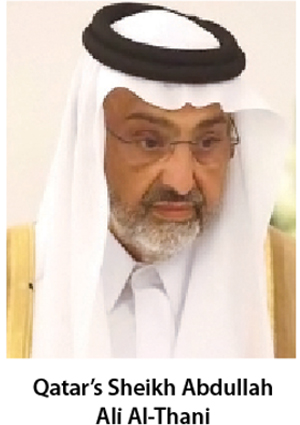
Sheikh Abdullah also tweeted that he requested that King Salman establish a hotline for Qataris who wish to visit relatives in Saudi Arabia.
“The king, as usual, approved my request and ordered the allocation of a special operations room to handle Qatari affairs run by a Saudi crew under my supervision, in light of the severed ties (between the two countries).”
He went on to share the hotline number, saying: “The special operations room for (the) Qatari people — from pilgrims (to) visitors and business owners — (is) 00966122367999.”
He added: “I call on all my brothers in Qatar, and those in need, to contact the number and their matters will be solved, God willing.”
He later addressed rumors that Qatari currency would no longer be allowed in Saudi Arabia, saying: “I asked my brother, the governor of the Saudi Arabian Monetary Agency (SAMA), about the accuracy of the suspension of the Qatari Riyal exchange for Qatari citizens and (he) denied the news.”
Meanwhile, many other users suggested he is a “sheikh of wisdom, voice of reason and a mediator for good.”
Others, mainly media personalities linked to Doha, have been skeptical of Sheikh Abdullah’s efforts and sought to ridicule his role and say that he does not represent the Qatari people or government.
For his part, Sheikh Abdullah went on to explain the intentions behind his mediation efforts, saying that he is working for the benefit and comfort of the Qatari people.
“The descendant of the rulers came looking for the interests of the brotherly Qatari people after the politically-adolescent approach adopted by the government of Qatar,” said one Twitter user.
Earlier, the Saudi king approved a plan to re-open the Salwa border crossing between Saudi Arabia and Qatar and also approved the dispatch of a private aircraft from Saudia’s fleet to Doha to fly Qatari pilgrims to Jeddah.
Qatari pilgrims were also allowed to pass through the border crossing for Hajj without electronic permits.
It has been nearly three months since the Anti-Terror Quartet severed ties with Doha over accusations of its support for terror and meddling in the internal affairs of its neighbors. Many world leaders and top diplomats, including the emir of Kuwait, have tried mediating but none have been successful in ending the rift.


![]()

‘Voice of reason’: Arab tweeps welcome Qatar’s Sheikh Abdullah as possible mediator to end rift with Doha
‘Voice of reason’: Arab tweeps welcome Qatar’s Sheikh Abdullah as possible mediator to end rift with Doha

Latest updates


© 2026 SAUDI RESEARCH & PUBLISHING COMPANY, All Rights Reserved And subject to Terms of Use Agreement.