MELBOURNE: A crisis engulfing Australia’s parliament has widened after a key independent senator became the seventh parliamentarian referred to the High Court to determine if his dual citizenship makes him ineligible to sit in parliament.
Senator Nick Xenophon’s announcement on Saturday that he holds dual British citizenship comes as the future of Prime Minister Malcolm Turnbull’s government hangs in the balance, with question marks surrounding the eligibility of key members of his government and crossbenchers threatening supply should it be stripped of its one-seat majority.
That majority was placed in jeopardy earlier this week after Deputy Prime Minister Barnaby Joyce said he may be ineligible for parliament due to New Zealand citizenship by descent.
His father was born in New Zealand. Joyce has since relinquished New Zealand citizenship, but is awaiting the High Court ruling, along with several other politicians who believe they may have dual citizenship.
The citizenship crisis, based on a 116-year-old law which demands an elected lawmaker only have Australian citizenship, has rocked the Australian parliament, ensnaring three government members, three Green party MPs and Xenophon.
Xenophon said on Saturday he had received advice overnight from the UK Home Office that, due to a “rare peculiarity,” they considered him a British overseas citizen.
The senator, who was born in Adelaide, Australia, said his father, Theodoros Xenophou, was born in Cyprus and left there in 1951. Cyprus remained a British colony until 1960 when it gained independence.
“The great irony here is that my father left Cyprus in order to escape British colonial rule,” the senator said.
Xenophon had renounced Greek citizenship, which he received from his mother, but had not been aware he held possible British citizenship.
On Friday a member of Xenophon’s eponymous party in the lower house of parliament, Rebekha Sharkie, became the latest crossbencher to withdraw her support for the government on matters of confidence and supply, telling Fairfax Media the prime minister was showing “disrespect to the Australian community” by not standing down the ministers referred to the High Court from their cabinet positions.
While the government does not currently need the support of crossbenchers in the lower house to hold office, should the court rule Deputy Prime Minister Joyce ineligible, it could only survive with the support of at least one non-government MP.
Only one lower house crossbencher has not withdrawn their support.
Business leaders in the country have warned the dual citizenship chaos risks damaging the country’s standing among foreign investors.


Seventh Australian senator referred to High Court as citizenship crisis deepens
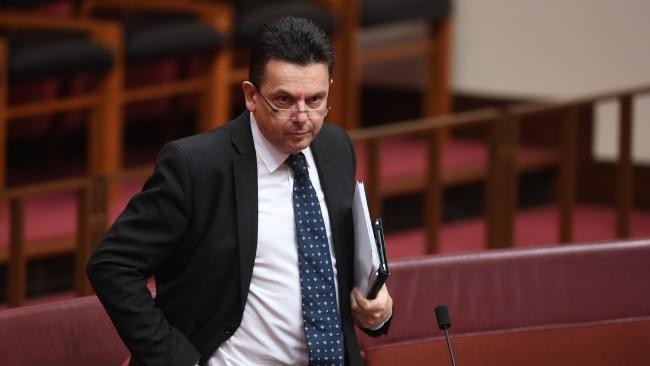
Seventh Australian senator referred to High Court as citizenship crisis deepens

EU looks to soften energy bill pressures for industry, document shows
- Brussels is looking for quick fixes after companies warned they cannot compete with rivals in China and the US
- The paper said the Commission would look at network charges
BRUSSELS: The European Union is examining energy taxes, network charges and carbon costs as possible areas for short-term measures to ease pressure on industries hit by high energy prices, a document seen by Reuters showed.
Brussels is looking for quick fixes after companies warned they cannot compete with rivals in China and the US — even before this week’s surge in oil and gas prices sparked by the US-Israeli war on Iran. European Commission President Ursula von der Leyen has pledged to present options for EU leaders to consider at a summit on 19 March.
A Commission paper prepared for a meeting of EU Commissioners on Friday showed the bloc is exploring short-term measures to help the hardest-hit regions and sectors, without undermining longer-term climate laws meant to shift Europe to a cheaper, low-carbon energy system.
“Any proposal for legislative change will not deliver immediately and a bridge solution may be needed to reduce energy prices in the next 2-5 years until the clean transition eases pressure on power prices as already seen in some regions,” said the document, seen by Reuters.
The paper said the Commission would look at network charges — which make up about 18 percent of industrial power bills — and national taxes and levies, as well as carbon costs, which account for around 11 percent of bills.
It noted that governments are underusing existing tools to cut companies’ energy bills, including state aid to offset carbon costs and contracts for difference that guarantee industrial consumers a stable power price. The document said that if energy supplies are disrupted further, Brussels must be ready to introduce measures to encourage consumers to use less energy, as it did in 2022 when Russia slashed gas deliveries.
A Commission spokesperson did not immediately respond to a request for comment.