A fourth suspect was arrested Friday over twin attacks in Spain that saw vehicles plough into pedestrians in Barcelona and the nearby seaside town of Cambrils, killing 14 and injuring over 100, police said.
“A fourth person has been detained in relation with the events that have taken place in the last few hours in Cambrils and Barcelona,” police in the Catalonia region tweeted.
They said the arrest was made in Ripoll — the same city in northern Catalonia where another suspect and Driss Oukabir, a Moroccan, have already been detained on suspicion of as-yet unspecified involvement in the attacks.
Police are searching for Driss Oukabir’s brother Moussa, but it was not known whether he was the latest person arrested.
Spain is reeling from the double attack on Thursday and Friday that saw drivers in Barcelona and Cambrils plough into pedestrians, following similar attacks in other European countries including France, Britain and Germany over the last year or so.
Police said they killed five “suspected terrorists” during the night and four suspects have now been arrested, although authorities had said the driver of the van in Barcelona remained at large.
The latest news comes after police shot and killed five people wearing fake bomb belts who staged a deadly car attack in a seaside resort in Spain’s Catalonia region Friday, just hours after a van plowed into pedestrians on a busy Barcelona promenade.
Daesh quickly claimed responsibility.
Amid heavy security, Barcelona tried to move forward Friday, with its iconic Las Ramblas promenade quietly reopening to the public and King Felipe VI and Prime Minister Mariano Rajoy joining thousands of residents and visitors in observing a minute of silence in the city’s main square.
“I am not afraid! I am not afraid!” the crowd chanted in Catalan amid applause.
But the dual attacks unnerved a country that hasn’t seen an Islamic extremist attack since 2004, when Al-Qaeda-inspired bombers killed 192 people in coordinated assaults on Madrid’s commuter trains. Unlike France, Britain, Sweden and Germany, Spain has largely been spared, thanks in part to a crackdown that has netted some 200 suspected jihadis in recent years.
Authorities were still reeling from the Barcelona attack when police in the popular seaside town of Cambrils, about 130 kilometers (80 miles) to the south, fatally shot five people near the town’s boardwalk who had plowed into a group of tourists and locals with their blue Audi 3. Catalonia’s interior minister, Joaquim Forn, told Onda Cero radio they were wearing fake bomb belts.
One woman died Friday from her injuries, Catalan police said on Twitter. Five others were injured.
Cambrils Mayor Cami Mendoza said the town had taken precautions after the Barcelona attack, but that the suspects had centered their assault on the narrow path to the boardwalk, which is usually packed with locals and tourists late into the evening.
“We were on a terrace, like many others,” said bystander Jose Antonio Saez. “We heard the crash and intense gun shots, then the dead bodies on the floor, shot by the police. They had what looked like explosive belts on.”
Others described scenes of panic, and found safety inside bars and restaurants until police had secured the area.
Local resident Markel Artabe said he was heading to the seafront to get an ice cream when he heard the shots.
“We began to run. We saw one person lying on the pavement with a shot in his head, then 20 to 30 meters farther on we saw two more people, who must have been terrorists as they had explosive belts around them. We were worried so we hid.”
The Cambrils attack came soon after a white van veered onto Barcelona’s picturesque Las Ramblas promenade and mowed down pedestrians, zig-zagging down the strip packed with locals and tourists from around the world. Catalonian authorities tweeted that the dead and injured in the two attacks were people of 34 different nationalities.
Forn told local radio RAC1 the Cambrils attack “follows the same trail. There is a connection.”
He told Onda Cero that the Cambrils and Barcelona attacks were being investigated together, as well as a Wednesday night explosion in the town of Alcanar in which one person was killed.
“We are not talking about a group of one or two people, but rather a numerous group,” he said.
Forn also suggested a possible connection to an incident Thursday in which the driver of a Ford Focus plowed through a police checkpoint leaving Barelona after the attack, injuring two police officers. The driver was killed. Police initially said there was no connection to the Barcelona carnage, but Forn said an investigation was under way.
“There is a possibility (of a connection), but it is not confirmed,” he said.
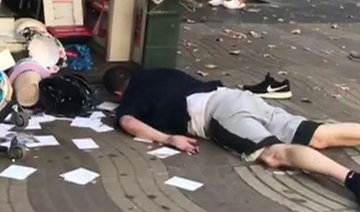
The Barcelona attack at the peak of Spain’s tourist season left victims sprawled across the street, spattered with blood and writhing in pain from broken limbs. Others were ushered inside shops by officers with their guns drawn or fled in panic, screaming and carrying young children in their arms.
“It was clearly a terror attack, intended to kill as many people as possible,” Josep Lluis Trapero, a senior police official for Spain’s Catalonia region told reporters late Thursday.
The Daesh group said in a statement on its Aamaq news agency that the attack was carried out by “soldiers of the Islamic State” in response to the extremist group’s calls for followers to target countries participating in the coalition trying to drive it from Syria and Iraq.
A third Barcelona suspect was arrested Friday in the northern town of Ripoll, where one of the two detained on Thursday had also been nabbed and where the investigation appeared to be focusing Friday. The third arrest was made in Alcanar, where the gas explosion in a house was being investigated.
“There could be more people in Ripoll connected to the group,” Forn told TV3 television, adding that police were focusing their investigation on identifying the five dead in Cambrils as well as the driver of the Barcelona van.
Spanish public broadcaster RTVE and other news outlets named one of the detained in the Barcelona attack as Driss Oukabir, a French citizen of Moroccan origin. RTVE reported that Oukabir went to police in Ripoll to report that his identity documents had been stolen. Various Spanish media said the IDs with his name were found in the attack van and that he claimed his brother might have stolen them.
Citing police sources, Spain’s RTVE as well as El Pais and TV3 identified the brother, Moussa Oukabir, as the suspected driver of the van. Forn declined to comment on questions about him Friday, citing the ongoing investigation.
Media outlets ran photographs of Driss Oukabir they said police had issued to identify one of the suspects. The regional police told The Associated Press that they had not distributed the photograph. They refused to say if he was one of the two detained.
The driver, however, remained at large.
“We don’t know if the driver is still in Barcelona or not, or what direction he fled in,” Forn, the Catalan interior minister, told SER Radio. “We had local police on the scene, but we were unable to shoot him, as the Ramblas were packed with people.”
Spanish Prime Minister Mariano Rajoy called the killings a “savage terrorist attack” and said Spaniards “are not just united in mourning, but especially in the firm determination to beat those who want to rob us of our values and our way of life.”
After the afternoon attack, Las Ramblas went into lockdown. Swarms of officers brandishing hand guns and automatic weapons launched a manhunt in the downtown district, ordering stores and cafes and public transport to shut down.
By Friday morning, the promenade had reopened to the public, albeit under heavy surveillance and an unusual quiet.
Newsstands were open selling papers and souvenirs near Plaza de Catalunya, but the iconic flower shops that line the promenade remained shuttered. Vendors who typically sell counterfeit sneakers and soccer jerseys displayed on white sheets were nowhere to be found.
“We all feel fine, right?” said Tara Lanza, a New York tourist who arrived in Barcelona even after hearing of the attack.
“It’s sad,” John Lanza said, as the family stood outside the gated La Boqueria market. “You can tell it’s obviously quieter than it usually is, but I think people are trying to get on with their lives.”
At noon Friday, a minute of silence honoring the victims was observed at the Placa Catalunya, near the top of the Ramblas where the van attack started. Rajoy declared three days of national mourning.
Since the Madrid train bombings, the only deadly attacks had been bombings claimed by the Basque separatist group ETA that killed five people over the past decade. It declared a cease-fire in 2011.
“Unfortunately, Spaniards know the absurd and irrational pain that terrorism causes. We have received blows like this in recent years, but we also that terrorists can be beaten,” Rajoy said.


![]()

Fourth man arrested in Spanish manhunt as Barcelona insists ‘I am not afraid’
Fourth man arrested in Spanish manhunt as Barcelona insists ‘I am not afraid’


Latest updates


© 2026 SAUDI RESEARCH & PUBLISHING COMPANY, All Rights Reserved And subject to Terms of Use Agreement.