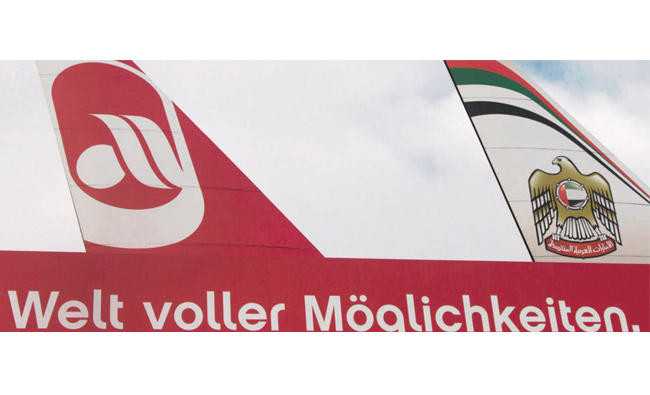
Etihad-linked bonds drop again after Air Berlin bankruptcy

Air Berlin recently filed for bankruptcy protection. (Reuters)
Updated 17 August 2017
Follow

Etihad-linked bonds drop again after Air Berlin bankruptcy

DUBAI: Etihad Airways’ bonds issued through a special purpose vehicle have dropped more than five points in the secondary market a day after Air Berlin, in which Etihad has a large minority stake, filed for bankruptcy protection.
In April, the “EA Partners” bonds dropped by almost 10 cents on the dollar after workers at the Italian carrier Alitalia — in which Etihad has a 49 percent stake — rejected the company’s latest turnaround plan, blocking it from accessing rescue financing.
An “internal debt assumption” agreement between Etihad and Alitalia — revealed through a Fitch note in the days following Alitalia entering special administration, but had been signed earlier — put a floor under the bonds, and they subsequently bounced back almost to par value.
But it is unclear if a similar agreement is in place for Air Berlin, and some of EA Partners’ creditors fear that after years of losses supporting the German carrier, Etihad might not cover the carrier’s portion of debt in the SPV bonds.
Etihad and Air Berlin declined to comment.
“Air Berlin adds to what has been a steady stream of bad news — whether related to Alitalia or Etihad itself,” said a Dubai-based portfolio manager, speaking on condition of anonymity because of commercial sensitivities.
Etihad is undertaking a strategic review which began last year and saw it offload its minority stake in a regional European carrier in July before announcing on Tuesday it was no longer willing to prop up Air Berlin.
“The added problems don’t necessarily mean help isn’t still on the way for the bond, but it does it make it more complicated. The bond’s credit enhancement has limits, and so does the appetite for bailouts,” the portfolio manager said.
Yields on the notes — a $700 million bond maturing in 2020 and a $500 million bond maturing in 2021 — jumped by more than 2 percentage points after Air Berlin’s bankruptcy announcement. The 2021 had a bid yield of 11.5 percent on Wednesday, up from 9.1 percent before the announcement. The 2020 notes were quoted at 12.3 percent on Wednesday, from 9.4 percent on Monday.
The EAP bonds include Etihad and several other airlines partially-owned by the Abu Dhabi carrier. The bond proceeds were used to enter into separate debt obligations with the entities involved, which included Etihad Airways, Etihad Airport Services, Alitalia, Air Berlin, and other airlines such as Air Serbia and Air Seychelles.
Air Berlin recently led for bankruptcy protection.


Oman’s Islamic banking assets rise to $24bn on credit growth 

Updated 5 sec ago
Follow

Oman’s Islamic banking assets rise to $24bn on credit growth 

JEDDAH: Oman’s Islamic banking assets climbed to about 9.2 billion Omani rials ($23.9 billion) by the end of October, underscoring steady expansion in the sultanate’s financial sector as credit growth remains robust. 

Assets held by Islamic banks and Islamic windows accounted for 19.5 percent of Oman’s total banking system, up 10.8 percent from a year earlier, the Oman News Agency reported. 

Oman’s banking sector performance reflects steady progress toward Vision 2040, which prioritizes economic diversification, private sector growth, and financial resilience. 

“As for the total financing provided by institutions engaged in this activity, it also rose by 10.4 percent, reaching around 7.4 billion Omani rials,” the ONA reported, adding that deposits with Islamic banks and Islamic windows grew 11.9 percent to roughly 7.3 billion rials by the end of October. 

Rising credit flows, particularly to non-financial corporates and households, are fueling the development of small and medium-sized enterprises and domestic investment in Oman, supporting efforts to reduce reliance on hydrocarbons and build a more diversified economy. 

“Total deposits held with ODCs registered a Y-o-Y significant growth of 7 percent to reach 33.3 billion rials at the end of August 2025. Total private sector deposits increased by 7.5 percent to OMR 22.4 billion,” the Central Bank of Oman said in a statement issued in October. 

The broader banking sector also saw solid credit growth in 2025. By the end of August, total credit across commercial banks increased by 8.6 percent year on year to 34.1 billion rials, driven mainly by lending to non-financial corporates and households, which accounted for 46.7 percent and 44.7 percent of total credit, respectively. 

Private sector lending alone rose by 6.5 percent, supporting SME activity and domestic investment. 

Meanwhile, aggregate deposits at conventional banks climbed 5.5 percent to 26.1 billion rials at the end of August, with private sector deposits accounting for 67 percent, or 17.5 billion rials, of the total. 

Islamic banking entities mirrored this momentum, with total financing reaching 7.3 billion rials and deposits standing at 7.2 billion rials by the end of August, underscoring steady expansion throughout 2025. 

Islamic banking in Oman was introduced after the Central Bank of Oman issued preliminary licensing guidelines in May 2011, allowing full-fledged Islamic banks and Islamic windows to operate alongside conventional institutions. 

The framework was formalized in December 2012 through a Royal Decree amending the Banking Law, mandating Shariah supervisory boards and authorizing the central bank to establish a High Shariah Supervisory Authority.