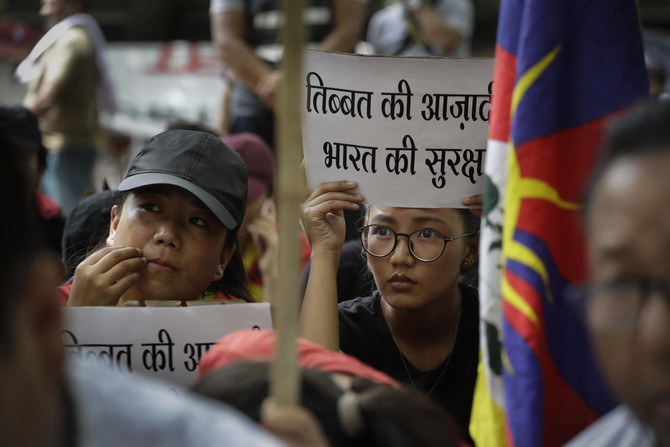
SRINAGAR, India: Indian and Chinese soldiers yelled and hurled stones at one another in the high Himalayas in Indian-controlled Kashmir, Indian officials said Wednesday after the altercation that escalates tensions between two nations already engaged in a lengthy border standoff elsewhere.
The Chinese soldiers hurled stones while attempting to enter Ladakh region near Pangong Lake on Tuesday but were confronted by Indian soldiers, said a top police officer. The officer said Indian soldiers retaliated but neither side used guns.
China did not immediately comment.
An Indian intelligence officer said the confrontation occurred after Indian soldiers intercepted a Chinese patrol that veered into Indian-held territory after apparently it lost its way due to bad weather.
The officer said soon the soldiers began shouting at each other and later threw stones. He said some soldiers from both sides received minor injuries.
After nearly 30 minutes of facing off, the two sides retreated to their positions, he said.
An Indian military officer said the skirmish was brief but violent and for the first time stones were used.
All the officers spoke on condition of anonymity because of the sensitivity of the issue.
Soldiers from the two countries are already locked in a bitter but non-violent standoff in Doklam, an area disputed between China and India’s ally Bhutan, where New Delhi sent its soldiers in June to stop China from constructing a strategic road.
China demands that Indian troops withdraw unilaterally from the Doklam standoff before any talks can be held, while New Delhi says each side should stand down. China and India fought a border war in 1962 and much of their frontier remains unsettled despite several rounds of official-level talks.
The website of New Delhi-based English weekly India Today quoted a report by the Indian military intelligence which said the use of stones was unprecedented and appeared intended to heighten tension without using lethal weapons. The report said the worst that has happened earlier was an isolated slap or pushing between soldiers from the two sides.
India’s worries over Chinese repeated border crossings into Kashmir’s Ladakh region has seen massive Indian army built up in the cold desert in recent years.
The disputed Himalayan territory of Kashmir is divided between nuclear-armed India, Pakistan and China. The part held by China is contiguous to Tibet.

China, India soldiers hurl stones at one another in Kashmir
UK Starmer calls for ‘calm discussion’ to avert trade war with US over Greenland
LONDON: British Prime Minister Keir Starmer called on Monday for calm discussion to avert a possible trade war with the United States over Greenland, appealing to President Donald Trump to respect alliances such as NATO rather than undermine them.
All but ruling out retaliatory levies against the United States if Trump carried out his threat to impose tariffs on imports from Britain and seven other countries unless the US was allowed to buy Greenland, Starmer sought to de-escalate the war of words.
He used an early morning
press conference
to set out what he described as the values underpinning his approach toward Trump, which has been criticized by opposition politicians for being too weak, by saying “pragmatic does not mean being passive.”
STARMER SAYS TARIFFS SHOULD NOT BE USED AGAINST ALLIES
After telling Trump that his threatened tariffs were wrong on Sunday, Starmer doubled down to say he would use “the full strength of government” to try to stop the US decision, one, he said, that could only hurt already stretched households.
“Tariffs should not be used against allies in this way,” Starmer said, adding that he was not looking to escalate a tariff war at this point.
“A tariff war is in nobody’s interests, and we have not got to that stage. And my focus, therefore, is making sure we don’t get to that stage.”
Trump threatened tariffs on imports from the eight countries which sent small numbers of military personnel to Greenland last week, following Trump’s repeated statements he wanted to take over Denmark’s vast Arctic island to ensure US security.
Starmer said he
told Trump
on Sunday those forces were “clearly there to assess and work on risk from the Russians.” He said he hoped that there was now “real clarity” about that.
The British prime minister signalled his approach would differ from that of the European Union, which has discussed options to respond, including a
package of tariffs
on 93 billion euros ($107.7 billion) of US imports.
Instead, he said, Britain should work to nurture a relationship with the United States that was crucial for UK security, intelligence and defense, while disagreeing with the tariff threat and working diplomatically to avert it.
Starmer said the threats risked causing a “downward spiral” for Britain, in terms of trade and the weakening of alliances.
“I do not want to see that happen,” he said, but he added: “That doesn’t mean that we put to one side our principles and our values. Quite the contrary, we’re very clear about what they are.”
Starmer has built a solid relationship with Trump and in May last year he became the first leader to secure a deal to lower some tariffs.
Asked if he thought Trump was genuinely considering
military action, Starmer said: “I don’t, actually. I think that this can be resolved and should be resolved through calm discussion.”
All but ruling out retaliatory levies against the United States if Trump carried out his threat to impose tariffs on imports from Britain and seven other countries unless the US was allowed to buy Greenland, Starmer sought to de-escalate the war of words.
He used an early morning
press conference
to set out what he described as the values underpinning his approach toward Trump, which has been criticized by opposition politicians for being too weak, by saying “pragmatic does not mean being passive.”
STARMER SAYS TARIFFS SHOULD NOT BE USED AGAINST ALLIES
After telling Trump that his threatened tariffs were wrong on Sunday, Starmer doubled down to say he would use “the full strength of government” to try to stop the US decision, one, he said, that could only hurt already stretched households.
“Tariffs should not be used against allies in this way,” Starmer said, adding that he was not looking to escalate a tariff war at this point.
“A tariff war is in nobody’s interests, and we have not got to that stage. And my focus, therefore, is making sure we don’t get to that stage.”
Trump threatened tariffs on imports from the eight countries which sent small numbers of military personnel to Greenland last week, following Trump’s repeated statements he wanted to take over Denmark’s vast Arctic island to ensure US security.
Starmer said he
told Trump
on Sunday those forces were “clearly there to assess and work on risk from the Russians.” He said he hoped that there was now “real clarity” about that.
The British prime minister signalled his approach would differ from that of the European Union, which has discussed options to respond, including a
package of tariffs
on 93 billion euros ($107.7 billion) of US imports.
Instead, he said, Britain should work to nurture a relationship with the United States that was crucial for UK security, intelligence and defense, while disagreeing with the tariff threat and working diplomatically to avert it.
Starmer said the threats risked causing a “downward spiral” for Britain, in terms of trade and the weakening of alliances.
“I do not want to see that happen,” he said, but he added: “That doesn’t mean that we put to one side our principles and our values. Quite the contrary, we’re very clear about what they are.”
Starmer has built a solid relationship with Trump and in May last year he became the first leader to secure a deal to lower some tariffs.
Asked if he thought Trump was genuinely considering
military action, Starmer said: “I don’t, actually. I think that this can be resolved and should be resolved through calm discussion.”
© 2026 SAUDI RESEARCH & PUBLISHING COMPANY, All Rights Reserved And subject to Terms of Use Agreement.