Mutawafas in Hajj: Keeping their ancestors’ traditions

Updated 16 August 2017
Follow

Mutawafas in Hajj: Keeping their ancestors’ traditions

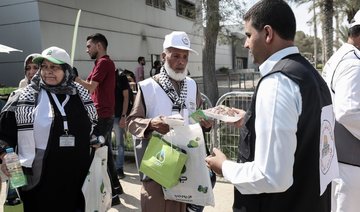
MAKKAH: Women working in Tawafah are continuing their ancestors’ profession dating back more than eight centuries.
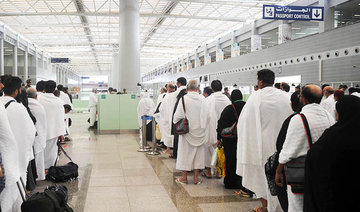
Their main task is to serve and care for pilgrims in Makkah from arrival until departure.
“I have worked in the National Tawafah Establishment of South Asia for years, and we feel that it’s a profession of honor,” Nojood Jmal Aleel told Arab News
“It’s a job that’s affiliated with the human spirit, because it deals with diversity of nationalities in which pilgrims and worshippers are seeking only mercy and forgiveness,” she said.
“Our families brought us up to respect the Tawafah profession. Moreover, it’s fundamental to pilgrims’ visit to Makkah as it helps them complete their journey without trepidation,” she added.
“We work on a specific schedule, and we’re notified about the time the pilgrim arrives to facilitate receiving him. We closely follow the stages of his journey, getting a visa, (taking care of any) requests he asks for, until he feels reassured that he’ll perform the holy rituals to the fullest.”
Aleel said the profession is handed down from one generation to the next. Mutawafs have to speak multiple languages to be able to meet the needs of pilgrims from various countries.
Mutawafa Asia Matar said people in the profession have to attend workshops. “My father… taught me that this profession is holy,” she said. “He always encouraged me to take care of pilgrims because they’re guests of God.”
Mutawafa Dr. Wafaa Mokhadar said the profession is limited to Saudi women living in Makkah, who must obtain permits from relevant authorities.
Mutawafa Shadia Jannabi said the profession has benefitted from modern technology such as translation programs and mapping apps on smartphones.

Nebras to host 120 recovering drug abusers for Hajj
The National Narcotics Control Committee (Nebras) and the General Directorate for Drug Control will host 120 recovering drug abusers who will perform Hajj this year.
Abdulilah bin Mohammed Al-Sharif, Nebras secretary-general, said the pilgrims come from various regions of the Kingdom and have stopped using drugs.
There is a supervisory committee for the Nebras program, and a group of specialized doctors will accompany the pilgrims to Makkah and the holy places, he added.
— With input from Rodolfo C. Estimo Jr.

‘Echoes of Movement’ exhibition explores Italy–Saudi artistic dialogue

Updated 6 sec ago
Follow

‘Echoes of Movement’ exhibition explores Italy–Saudi artistic dialogue

RIYADH: Italian Ambassador to Saudi Arabia Carlo Baldocci recently inaugurated the exhibition “Echoes of Movement: Dialogues between Italy and Saudi Arabia,” presented within the framework of the Diriyah Biennale, the Kingdom’s leading contemporary art event and one of the most significant cultural platforms in the international art scene.

The exhibition, which runs until Feb. 12, is conceived as a space for cultural dialogue between Italy and Saudi Arabia, bringing contemporary artistic practices into conversation through the theme of movement, understood not only as physical displacement, but also as symbolic, historical and cultural crossing. Movement thus becomes a metaphor for travel, exchange and transformation — elements that have long shaped relations between peoples, territories and civilizations, particularly in the Mediterranean and Middle Eastern contexts.

The exhibition reflects on journeying as a shared human condition, evoking dynamics of migration, encounter, and mutual influence that have profoundly shaped cultural histories and continue to define the present. In this sense, “Echoes of Movement” positions itself as a space for reflection on the circulation of ideas, forms and imaginaries, highlighting art’s capacity to serve as a universal language that transcends geographical and temporal boundaries.

The exhibition features works by Mimmo Paladino and Davide Rivalta, two leading figures in contemporary Italian art. Eleven lithographs by Mimmo Paladino offer a poetic, contemporary interpretation of the medieval treatise by Emperor Frederick II, “De arte venandi cum avibus” — a foundational work of European scientific and symbolic thought, conceived in a historical context shaped by dialogue among different cultures.

The text has been extensively studied by Prof. Anna Laura Trombetti of the University of Bologna, whose research inspired the exhibition. Through his distinctive symbolic and expressive language, Paladino reinterprets the treatise from a contemporary perspective, bringing historical memory into dialogue with present-day sensibilities.

Alongside the graphic works, the exhibition is enriched by a monumental sculpture by Davide Rivalta, whose sculptural practice — marked by strong evocative tension and direct engagement with space — amplifies the sense of movement and presence, inviting visitors into a physical and conceptual encounter with the artwork.

The exhibition was realized through a fruitful collaboration with Black Engineering, an Italian company renowned for its excellence in designing and producing major cultural and artistic events at the international level. Its portfolio includes high-profile projects such as the Islamic Arts Biennale in Jeddah, the Diriyah Biennale, the construction of the iconic Maraya building in AlUla, and the production and curation of numerous art festivals, as well as the teaser for the Salone del Mobile Milano in Riyadh.

Equally significant was the contribution of Particle, an Italian company specializing in advanced digital experiences, which developed a digital pathway for the exhibition. This enhances accessibility to the content and extends its availability beyond the show’s physical duration, strengthening the project’s innovative dimension and long-term impact.