

At least 94 dead in monsoon disasters in Nepal and India

1 / 4
Nepali residents look at the water in a flooded area in the Birgunj Parsa district, some 200 km south of Katmandu, on Monday. (AFP / Manish Paudel)
2 / 4
Indian army personnel and rescue workers search for survivors amid the rubble after a landslide in Mandi district, Himachal Pradesh, India, on Monday. (REUTERS)
3 / 4
Nepali residents helping each other to cross flooded area at Birgunj Parsa district, some 200 km south of Katmandu, on Sunday. (AFP)
4 / 4
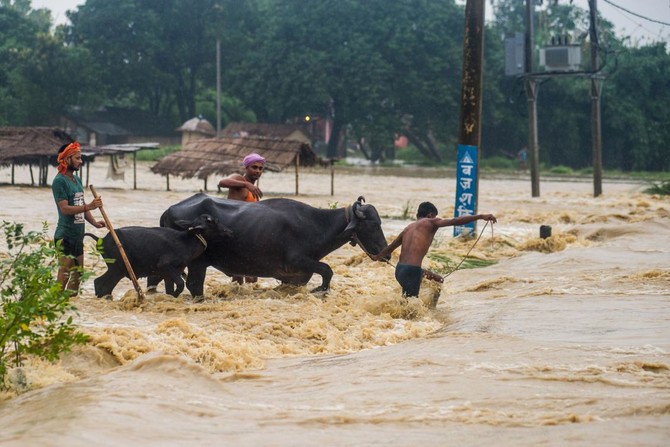
Nepali residents move their buffalos across a flooded area at Birgunj Parsa district, some 200 km south of Katmandu, on Sunday. (AFP)
Updated 14 August 2017
Follow

At least 94 dead in monsoon disasters in Nepal and India

KATMANDU: Monsoon floods and landslides have killed at least 94 people across Nepal and India but officials fear that figure could rise sharply as rescuers search for dozens believed lost under mud and in submerged villages.
Authorities Sunday upgraded the death toll from flash flooding across landlocked Nepal to 49 as the water kept rising, forcing thousands to flee for higher ground.
“Another 17 are missing. Search and rescue works are underway but the water levels have not declined yet,” said Shankar Hari Acharya, the chief of Nepal’s national emergency center.
The Red Cross estimated a higher death toll of 53, with dozens more missing and injured, and thousands of homes destroyed.
In neighboring India, a massive landslide in the mountainous north swept two passenger buses off a hillside and into a deep gorge, killing 45 people, an official said.
The coaches had stopped for a tea break around midnight Saturday in Himachal Pradesh when tons of rock and mud cascaded down a mountainside.
Forty-five bodies have been recovered from the accident site in the Himalayan state, said Sandeep Kadam, a senior official at the scene, late Sunday.
But more were still missing somewhere at the bottom of the ravine, with soldiers and rescuers working into the night to reach those beneath the mud and rock.
“Around 200 meters of national highway washed away with two buses and more than 50 feared buried,” said Indian army spokesman Col. Aman Anand, who was helping coordinate rescue efforts.

Monsoon season
Indian Prime Minister Narendra Modi extended his condolences and prayers for those affected by the accident.
“Pained by the loss of lives due to landslide-related accidents in HP’s Mandi district,” he posted on Twitter, using the acronym for Himachal Pradesh state.
The disaster followed days of heavy rain, which loosens the soil on steep hillsides and threatens villages at the foot of mountains every monsoon season.
Hundreds have died across India in torrential rain, floods and landslides since the onset of the wet season in April.
In Nepal the toll from this year’s monsoon — which typically lasts from late June until the end of August — has already eclipsed last year, with more than 100 people confirmed dead.
Last weekend in the central lowlands, four girls from the same family drowned when they fell into a flooded roadside ditch.
Nepal’s weather department warned that heavy rain was expected to continue for another day, following days of torrential downpours.
“There isn’t a house without water,” said Raghu Ram Mehta, a resident of the southern district of Sunsari which has suffered nine deaths, the highest of any district.

“Hundreds of families are taking shelter in local schools.”
Footage aired on Nepali TV showed villagers wading through waist-high water with their belongings and using boats to reach higher ground.
Families perched on trees with young children overnight as flood waters swept away homes in a village in the southern district of Chitwan, local media reported.
In the popular jungle safari resort of Sauraha in Chitwan, hotels were forced to shift their guests to higher floors as water rushed in.
A hotel owner said they used elephants to transport tourists to the nearest open highway and airport to help them return to the capital Katmandu.
Biratnagar airport in the eastern district of Morang was closed after being submerged in a meter of water, according to authorities at the international terminal.
“I have already instructed authorities concerned to rescue flood victims, move them to safer locations and immediately provide relief to them,” Prime Minister Sher Bahadur Deuba said in a video recording Saturday.

Israel says Netanyahu will meet with Trump on Wednesday about Iran talks

Updated 2 sec ago
Follow

Israel says Netanyahu will meet with Trump on Wednesday about Iran talks

  • Israeli Prime Minister Benjamin Netanyahu will meet with US President Donald Trump in Washington on Wednesday about the US talks with Iran
JERUSALEM: Israeli Prime Minister Benjamin Netanyahu will meet with US President Donald Trump in Washington on Wednesday about American talks with Iran, his office said Saturday, while Iran’s foreign minister threatened US military bases in the region a day after the discussions.
“The prime minister believes that all negotiations must include limiting the ballistic missiles, and ending support for the Iranian axis,” Netanyahu’s office said in a brief statement, referring to Tehran’s support for militant groups, including Hezbollah in Lebanon and Hamas in the Palestinian territories. Trump and Netanyahu last met in December.
There was no immediate White House comment.
The US and the Islamic Republic of Iran held indirect talks on Friday in Oman that appeared to return to the starting point on how to approach discussions over Tehran’s nuclear program.
Trump called the talks “very good” and said more were planned for early next week. Washington was represented by Middle East special envoy Steve Witkoff and Jared Kushner, Trump’s son-in-law.
Trump has repeatedly threatened to use force to compel Iran to reach a deal on its nuclear program after sending the aircraft carrier USS Abraham Lincoln and other warships to the region amid Tehran’s crackdown on nationwide protests that killed thousands.
Gulf Arab nations fear an attack could spark a regional war, with memories fresh of the 12-day Israel-Iran war in June.
For the first time in negotiations with Iran, the US on Friday brought its top military commander in the Middle East to the table. US Navy Adm. Brad Cooper, head of the military’s Central Command, then visited the USS Abraham Lincoln on Saturday with Witkoff and Kushner, the command said in a statement.
Iranian Foreign Minister Abbas Araghchi told journalists Friday that “nuclear talks and the resolution of the main issues must take place in a calm atmosphere, without tension and without threats.” He said that diplomats would return to their capitals, signaling that this round of negotiations was over.
On Saturday, Araghchi told the Al Jazeera satellite news network that if the US attacks Iran, his country doesn’t have the ability to strike the US “and therefore has to attack or retaliate against US bases in the region.”
He said there is “very, very deep distrust” after what happened during the previous talks, when the US bombed Iranian nuclear sites during last year’s Israel-Iran war.
Araghchi also said the “missile issue” and other defense matters are “in no way negotiable, neither now nor at any time in the future.”
Tehran has maintained that these talks will be only on its nuclear program.
However, Al Jazeera reported that diplomats from Egypt, Turkiye and Qatar offered Iran a proposal in which Tehran would halt enrichment for three years, send its highly enriched uranium out of the country and pledge to “not initiate the use of ballistic missiles.”
US Secretary of State Marco Rubio said Wednesday that the talks needed to include all those issues.
Israel, a close US ally, believes Iran is pursuing a nuclear weapon and wants its program scrapped, though Iran has insisted that its atomic plans are for peaceful purposes. Israel also wants a halt to Iran’s ballistic missile program and its support for militant groups in the region.
Araghchi, speaking at a forum in Qatar on Saturday, accused Israel of destabilizing the region, saying that it “breaches sovereignties, it assassinates official dignitaries, it conducts terrorist operations, it expands its reach in multiple theaters.” He criticized Israel’s treatment of Palestinians and called for “comprehensive and targeted sanctions against Israel, including an immediate arms embargo.”