Trump to request possible probe of China trade practices

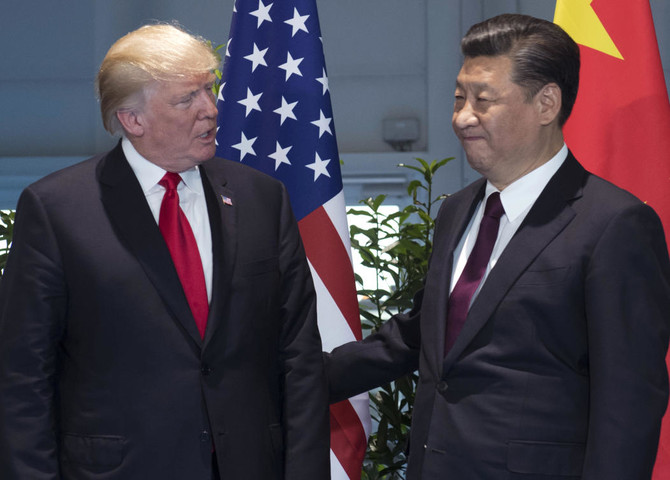
In this July 8, 2017, file photo, U.S. President Donald Trump, left, and China's President Xi Jinping arrive for a meeting on the sidelines of the G-20 Summit in Hamburg, Germany. Trump is planning to sign an executive action asking the U.S. Trade Representative to consider investigating China for the theft of U.S. technology and intellectual property. He is taking the step even as he seeks China’s help with the ongoing crisis with North Korea. (AP)
Updated 13 August 2017
Follow

Trump to request possible probe of China trade practices

BEDMINSTER, NEW JERSEY: Even as he seeks Beijing’s help on North Korea, President Donald Trump plans to sign an executive order asking his trade office to consider investigating China for the alleged theft of American technology and intellectual property, an administration official said Saturday.
That step is expected Monday but won’t come as a surprise to the Beijing government. There is no deadline for deciding if any investigation is necessary. Such an investigation easily could last a year.
In a phone call Friday, Trump praised Chinese President Xi Jinping for backing the recent UN vote to impose tougher sanctions on North Korea, and the leaders reaffirmed their commitment to a nuclear-free Korean Peninsula. But Trump also told Xi about the move toward a possible inquiry into China’s trade practices, according to two US officials familiar with that conversation. They were not authorized to publicly discuss the private call and spoke on condition of anonymity.
Trump wants government officials to look at Chinese practices that force American companies to share their intellectual property in order to gain access to the world’s second largest economy. Many US businesses must create joint ventures with Chinese companies and turn over valuable technology assets, a practice that Washington says stifles US economic growth.
Trump’s action amounts to a request that his trade representative determine whether an investigation is needed under the Trade Act of 1974. If an investigation begins, the US government could seek remedies either through the World Trade Organization or outside of it.
China’s foreign and commerce ministries did not immediately respond to faxed requests for comment Sunday.
While Beijing has promised to open more industries to foreign companies, it also has issued new rules on electric car manufacturing, data security, Internet censorship and other fields.
Trump, who is on a working vacation at his New Jersey golf club, said Friday that he planned to be in Washington on Monday “for a very important meeting’” and “we’re going to have a pretty big press conference.” It was not immediately clear whether he was talking about trade was the subject.
The administration official who confirmed that Trump would sign the order contended it was unrelated to the showdown with North Korea. The official spoke on condition of anonymity to discuss the order before Trump’s formal announcement.
As the crisis has unfolded, Trump has alternated praising China for its help and chiding it for not ratcheting up pressure on its Asian neighbor.
“I think China can do a lot more,” Trump told reporters Thursday. “And I think China will do a lot more.”
Trump has escalated his harsh criticism of North Korea for days, tweeting Friday that the US had military options “locked and loaded.” Xi, in his phone conversation with Trump, urged calm.
“At present, relevant parties should exercise restraint and avoid words and actions that would escalate tensions on the Korean Peninsula,” Xi said, according to the statement provided by China’s government.
Trump, in the past, has tied trade policy to national security. In April, he said he wouldn’t label China a currency manipulator, in return for help in dealing with North Korea. This past week, Trump said he could soften his views on trade if China stepped up its assistance, leading to speculation that the investigation could be a negotiating tactic.
The forced sharing of intellectual property with Chinese firms has been a long-standing concern of the US business community.
A 2013 report by a commission co-chaired by Jon Huntsman, ambassador to China under President Barack Obama and Trump’s nominee to be Russian envoy, pegged the losses from US intellectual property theft at hundreds of billions of dollars annually that cost the US economy millions of jobs.
Trump has requested similar inquiries on trade, but the reports haven’t been delivered on deadline. Trump made addressing the US trade deficit with China a centerpiece of his campaign last year and has suggested raising tariffs on goods from China.
At the end of March, Trump asked the Commerce Department to prepare a report on the causes of the trade deficit, country by country and product by product, in 90 days. The report has yet to be released.
Similarly, the president also asked for a review about whether steel and aluminum imports were jeopardizing national security. Commerce Secretary Wilbur Ross had hoped to finish the review by June, but parts of it remain in the final stages of interagency review.


US House of Representatives passes war powers resolution backing Trump’s attacks on Iran

Updated 8 sec ago
Follow

US House of Representatives passes war powers resolution backing Trump’s attacks on Iran

WASHINGTON: The House narrowly rejected a war powers resolution Thursday to halt President Donald Trump’s attacks on Iran, an early sign of unease in Congress over the rapidly widening conflict that is reordering US priorities at home and abroad.
It’s the second vote in as many days, after the Senate defeated a similar measure. Lawmakers are confronting the sudden reality of representing wary Americans in wartime and all that entails — with lives lost, dollars spent and alliances tested by a president’s unilateral decision to go to war with Iran.
While the tally in the House, 212-219, was expected to be tight, the outcome provided a clarifying snapshot of political support for, and opposition to, the US-Israel military operation and Trump’s rationale for bypassing Congress, which alone has the power to declare war. At the Capitol, the conflict has quickly carried echoes of the long wars in Afghanistan and Iraq, and many Sept. 11-era veterans now serve in Congress.
“Donald Trump is not a king, and if he believes the war with Iran is in our national interest, then he must come to Congress and make the case,” said Rep. Gregory Meeks, the top Democrat on the House Foreign Affairs Committee.
House Speaker Mike Johnson warned that it would be “dangerous” to limit the president’s authority while the US military is already in conflict.
“We are not at war,” said Johnson, R-Louisiana, a close ally of Trump, contradicting others. He said the operation is limited in scope and duration, and the “mission is nearly accomplished.”
Republicans largely back Trump, and most Democrats oppose the war
Trump’s Republican Party, which narrowly controls the House and Senate, largely sees the conflict with Iran not as the start of a new war, but the end of a government that has long menaced the West. The operation has killed Iran’s Supreme Leader Ayatollah Ali Khamenei, which some view as an opportunity for regime change, though others warn of a chaotic power vacuum.
Republican Rep. Brian Mast of Florida, chairman of the House Foreign Affairs Committee, publicly thanked Trump for taking action against Iran, saying the president is using his own constitutional authority to defend the US against the “imminent threat” the country posed.
Mast, an Army veteran who worked as a bomb disposal expert in Afghanistan, said the war powers resolution was effectively asking “that the president do nothing.”
For Democrats, Trump’s attack on Iran, influenced by Israeli Prime Minister Benjamin Netanyahu, is a war of choice that is testing the balance of powers in the Constitution.
“The framers weren’t fooling around,” said Rep. Jamie Raskin, D-Md., arguing that the Constitution is clear that only Congress can decide matters of war. “It’s up to us.”
Crossover coalitions emerged among those in Congress. Two Republicans joined most Democrats in voting for the war powers resolution, while four Democrats joined Republicans to reject it.
The war powers resolution, if signed into law, would have immediately halted Trump’s ability to conduct the war unless Congress approved the military action. The president would likely veto it.
Trump officials provide shifting rationale for war
Trump has scrambled to win support for the nearly week-old conflict as Americans of all political persuasions take stock. Administration officials spent hours behind closed doors on Capitol Hill this week trying to reassure lawmakers that they have the situation under control.
Six US military members were killed over the weekend in a drone strike in Kuwait, and Trump has said more Americans could die. Thousands of Americans abroad have scrambled for flights, many lighting up phone lines at congressional offices as they sought help trying to flee the Middle East.
Trump said Thursday he must be involved in choosing Iran’s new leader. Yet Johnson, R-Louisiana, said this week that America has enough problems at home and is not about to be in the “nation-building business.”
Defense Secretary Pete Hegseth said that the war could extend eight weeks, twice as long as the president first estimated. Trump has left open the possibility of sending US troops into what has largely been a bombing campaign. More than 1,230 people in Iran have died.
The administration said the goal is to destroy Iran’s ballistic missiles that it believes are shielding its nuclear program. It has also said Israel was ready to act, and American bases would face retaliation if the US did not strike Iran first. The US said Wednesday it torpedoed an Iranian warship near Sri Lanka.
“This administration can’t even give us a straight answer of as to why we launched this preemptive war,” said Rep. Thomas Massie, the Republican from Kentucky, an outlier in his party.
Massie and Rep. Ro Khanna, D-Calif., who had teamed up to force the release the Jeffrey Epstein files, also pushed the war powers resolution to the floor, past objections from Johnson’s GOP leadership. Republican Rep. Warren Davidson of Ohio, a former Army Ranger, also voted for it. Democratic Reps. Henry Cuellar of Texas, Jared Golden of Maine, Greg Landsman of Ohio and Juan Vargas of California voted against.
“Congress must stand with the president to finally close, once and for all, this dark chapter of history,” said Rep. Michael McCaul, R-Texas.
Rep. Yassamin Ansari, D-Arizona, said that as the daughter of Iranian immigrants who fled their homeland, she opposes the regime but is concerned that a democratic transition for the people of Iran never seems to a priority for Trump or the officials who briefed Congress.
“War carries profound and deadly consequences for our troops, for the American people and for the entire world,” she said. “It’s the most serious decision that a nation can make.”
Other Democrats have proposed an alternative resolution that would allow the president to continue the war for 30 days before he must seek congressional approval. The House also approved a separate measure affirming that Iran is the largest state sponsor of terrorism.
Senators sit in their desks for solemn vote
In the Senate, Republican leaders have successfully, though narrowly, defeated a series of war powers resolutions pertaining to several other conflicts during Trump’s second term. This one, however, was different.
Underscoring the gravity Wednesday, Democratic senators sat at their desks as the voting got underway.
Senate Democratic leader Chuck Schumer of New York said that every senator will pick a side. “Do you stand with the American people who are exhausted with forever wars in the Middle East?” he asked. Or with Trump and Hegseth “as they bumble us headfirst into another war?”
Sen. John Barrasso, second in Senate Republican leadership, said, “Democrats would rather obstruct Donald Trump than obliterate Iran’s national nuclear program.”
The legislation failed on a 47-53 tally mostly along party lines, with Sen. Rand Paul, R-Kentucky, in favor and Sen. John Fetterman, D-Pennsylvania, against.