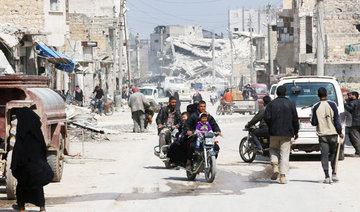
ANKARA: Amid speculation about a fresh wave of refugees into Turkey through its 150 km border with Syria’s northwestern province of Idlib, Ankara is making its national stance clear: The maintenance of national security is a key priority.
On Friday, Turkish Prime Minister Binali Yildirim said that Turkey is taking necessary measures on this specific part of the border, across which lies an area of Syria where radicals connected to a former Al-Qaeda offshoot have gained control. Turkey also recently restricted the passage of non-humanitarian goods at the Bab Al-Hawa border crossing into Idlib.
Turkey currently holds some 3 million Syrian refugees, making Ankara the world’s largest host of refugees. The refugee camps are also providing aid along the border. The Turkish Red Crescent has already helped the refugees by distributing clothing and toiletries in Idlib, and in June began a housing project there that is expected to cover about 1,000 properties.
Turkey earlier this year completed the construction of a 700 km wall along the Syria border, controlled by a sensor system, cameras and drones.
Dr. Bora Bayraktar of the International Relations Department at Istanbul Kultur University said considering the US-led international coalition’s impending bombing campaign in the region and the possibility that the regime forces may counteract this move, civilians in Idlib may be obliged to move toward the Turkish border.
“However, Turkey doesn’t seem to welcome such a massive refugee influx for now. Ankara wants to manage the crisis on the other side of the border through diplomatic channels,” Bayraktar told Arab News.
Turkey’s President Recep Tayyip Erdogan on Friday told reporters that Turkey’s National Intelligence Organization is holding negotiations with Russia and Iran about the swift resolution of the Idlib issue.
According to Bayraktar, resolving this issue with local partners diplomatically is the best solution for now.
“Turkey is already hosting a great number of refugees and (upholding its) financial, social and humanitarian responsibilities. On the other hand, it is building walls along its border with Syria, along with increased border security measures,” Bayraktar said.
“There is a risky jihadist presence in Idlib and it will be very difficult to differentiate (between) civilians and jihadists during a possible passage through Turkish gates. Even PYD militia (members of the Kurdish Democratic Union Party) may infiltrate into the country,” he added.
However, Metin Corabatir, former spokesman for the UN refugee agency UNHCR in Turkey and president of the Research Center on Asylum and Migration in Ankara, thinks that if there is a refugee influx toward Turkey due to a possible bombing campaign, it will be against international norms to reject them.
“Since the beginning of the conflict, Turkey adopted an open-door policy, and since 2014 it has a necessary legislative framework to regulate such refugee waves with the aim of managing the refugee issue in a systematic way,” Corabatir told Arab News.
Corabatir noted that if refugees from Idlib come across the border in large numbers, Turkey will be obliged to establish registration facilities, before directing people to refugee camps in Turkey. “If armed groups are also present among these refugee groups, they should be treated separately, be disarmed and be subject to necessary international norms if they are war criminals.”
Ayselin Yildiz, an expert on immigration at Izmir’s Yasar University, noted however that the 22 refugee camps in Turkey’s 10 provinces are already full. “Turkey was planning to extend its hosting capacity in case of a mass flow from Aleppo or Idlib last year, so there were some preparations, however, they might be limited,” Yildiz told Arab News.
“In case of such a huge flow, Turkey would certainly need urgent and concrete cooperation, assistance of international society and organizations.”
Yildiz thinks that Turkey would probably not reject people on the border, not just because of its international obligations but also due to its humanitarian approach. “We do not know whether these people will prefer to remain in Turkey or trigger another flow toward Europe,” she added.


![]()

Turkey tightens border security ahead of possible new wave of Syrian refugees
Turkey tightens border security ahead of possible new wave of Syrian refugees


Latest updates



© 2026 SAUDI RESEARCH & PUBLISHING COMPANY, All Rights Reserved And subject to Terms of Use Agreement.