DETROIT: Around the world, support is growing for electric cars. Automakers are delivering more electric models with longer range and lower prices, such as the Chevrolet Bolt and the Tesla Model 3. China has set aggressive targets for electric vehicle sales to curb pollution; some European countries aim to be all-electric by 2040 or sooner.
Those lofty ambitions face numerous challenges, including one practical consideration for consumers: If they buy electric cars, where will they charge them?
The distribution of public charging stations is wildly uneven around the globe. Places with lots of support from governments or utilities, like China, the Netherlands and California, have thousands of public charging outlets. Buyers of Tesla’s luxury models have access to a company-funded Supercharger network.
But in many places, public charging remains scarce. That is a problem for people who need to drive further than the 200 miles or so that most electric cars can travel.
“Do we have what we need? The answer at the moment is, ‘No’,” said Graham Evans, an analyst with IHS Markit.
Take Norway, which has publicly funded charging and generous incentives for electric car buyers. Architect Nils Henningstad drives past 20 to 30 charging stations each day on his 22-mile (35-kilometer) commute to Oslo. He works for the city and can charge his Nissan Leaf at work; his fiancee charges her Tesla SUV at home or at one of the world’s largest Tesla Supercharger stations, 20 miles away.
It is a very different landscape in New Berlin, Wisconsin, where Jeff Solie relies on the charging system he rigged up in his garage to charge two Tesla sedans and a Volt. Solie and his wife do not have chargers at their offices, and the nearest Tesla Superchargers are 45 miles (72 kilometers) away.
“If I can’t charge at home, there’s no way for me to have electric cars as my primary source of transportation,” said Solie, who works for the media company E.W. Scripps.
The uneven distribution of chargers worries many potential electric vehicle owners. It is one reason electric vehicles make up less than 1 percent of cars on the road.
“You have to prove to the consumer that they can drive across the country, even though they probably won’t,” said Pasquale Romano, the CEO of ChargePoint, one of the largest charging station providers in North America and Europe.
He says workplaces should have around 2.5 chargers for every employee and retail stores need one for every 20 electric cars. Highways need one every 50 to 75 miles, he says. That suggests a lot of gaps still need to be filled.
Automakers and governments are pushing to fill them. The number of publicly available, global charging spots grew 72 percent to more than 322,000 last year, the International Energy Agency said.
Tesla Inc. — which figured out years ago that people wouldn’t buy its cars without roadside charging — is doubling its global network of Supercharger stations to 10,000 this year. BMW, Daimler, Volkswagen and Ford are building 400 fast-charging stations in Europe. Volkswagen is building hundreds of stations across the US as part of its settlement for selling polluting diesel engines. Even oil-rich Dubai, which just got its first Tesla showroom, has more than 50 locations to charge electric cars.
But there are pitfalls. There are different types of charging stations, and no one knows the exact mix drivers will eventually need. A grocery store might spend $5,000 for an AC charge point, which provides a car with 5 to 15 miles of range in 30 minutes. But once most cars get 200 or 300 miles per charge, slow chargers are less necessary. Electric cars with longer range need fast-charging DC chargers along highways, but DC chargers cost $35,000 or more.
That uncertainty makes it difficult to make money setting up chargers, says Lisa Jerram, an associate director with Navigant Research. For at least the next three to five years, she says, deep-pocketed automakers, governments and utilities will be primarily responsible for building charging infrastructure.
But without government support, plans for charging stations can falter. In Michigan, a utility’s $15 million plan to install 800 public charging stations was scrapped in April after state officials and ChargePoint objected.
Solie, the electric car owner in Wisconsin, likes Europe’s approach: Governments should set bold targets for electric car sales and let the private sector meet the need.
“If the US were to send up a flare that policy was going to change... investments would become very attractive,” he says.


![]()
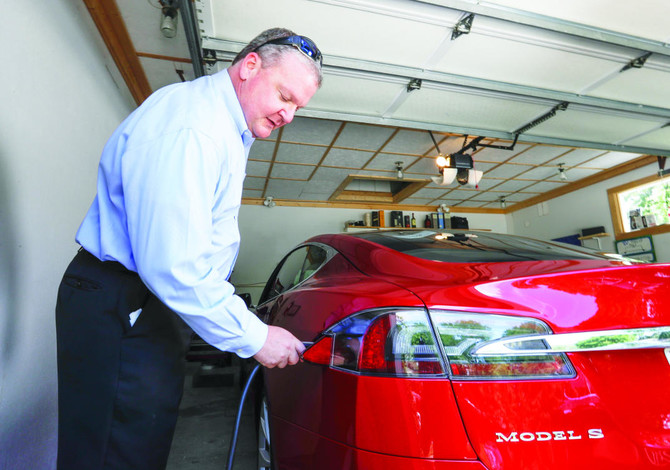
For electric cars to take off, they will need place to charge
For electric cars to take off, they will need place to charge


Latest updates


© 2026 SAUDI RESEARCH & PUBLISHING COMPANY, All Rights Reserved And subject to Terms of Use Agreement.