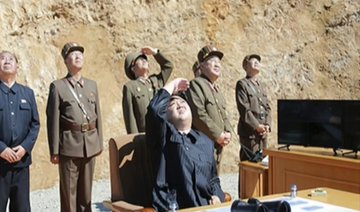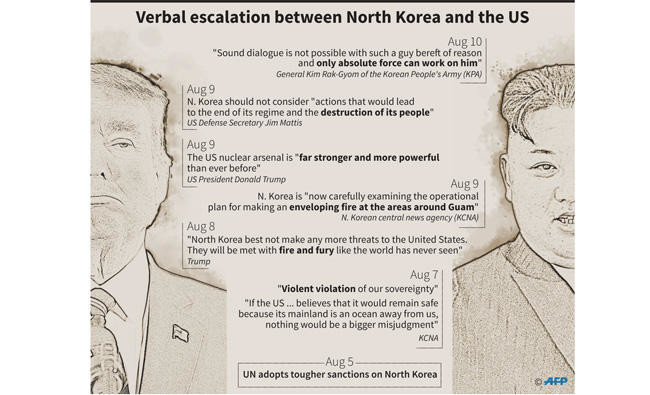
SEOUL: Guam is a launching point for US strategic bombers that the North, virtually flattened by US bombs during the 1950-53 Korean War, sees as particularly threatening. US bombers have flown over the Korean Peninsula several times to show American strength after Pyongyang’s missile tests. Unlike past missile launches that landed much closer to North Korean territory, firing a barrage toward Guam would be extremely provocative, almost compelling a response. Trying to intercept the missiles, however, would open up a whole new range of potential dangers. Here is the calculus.
The pros
Each missile North Korea launches brings it closer to having a reliable nuclear force capable of striking the US mainland, or its allies and military facilities in Asia. Kim Jong-un has radically accelerated the pace of the North’s missile development, and many experts believe it could have an intercontinental ballistic missile (ICBM) able to hit major American cities within a year or two.
It already has ballistic missiles that can strike Japan, a key ally and host to roughly 50,000 US troops. It is very possible the North could attack Japan and US bases there with nuclear, chemical or biological warheads. But the North clearly still needs to conduct more tests to hone its technical skills.
In particular, doubts remain over whether it has perfected re-entry technology for its warheads. It also needs to train its troops to operate effectively in the field to handle nuclear warheads and missiles on short notice.
The cons
A big problem is that failure would not only be humiliating, but could actually weaken the US position more than doing nothing at all.
The US has pumped billions of dollars into its missile defense systems and sold hundreds of millions of dollars’ worth to its allies, including the very controversial deployment of a state-of-the-art system known by its acronym, THAAD, in South Korea. The US military has also conducted two ICBM interceptor tests since May. Officials called them successes, but critics say they do not replicate actual conditions close enough to be a fair gauge.
A failed intercept would likely embolden the North to move ahead even faster. It could also have a chilling psychological impact on allies like Japan and South Korea, which might seek to build up their own nuclear forces independently of Washington. Rival powers China and Russia, meanwhile, might see the exposed weakness as an opportunity to push forward more assertive policies of their own.
Even if it were successful, a policy of shooting down missiles would undoubtedly raise tensions, and put an uncomfortable squeeze on American allies on the frontlines.
Worst of all, if American intentions are not clear, an attempt to intercept a missile might be misinterpreted by Pyongyang — or Beijing or Moscow — and escalate into a real shooting war.