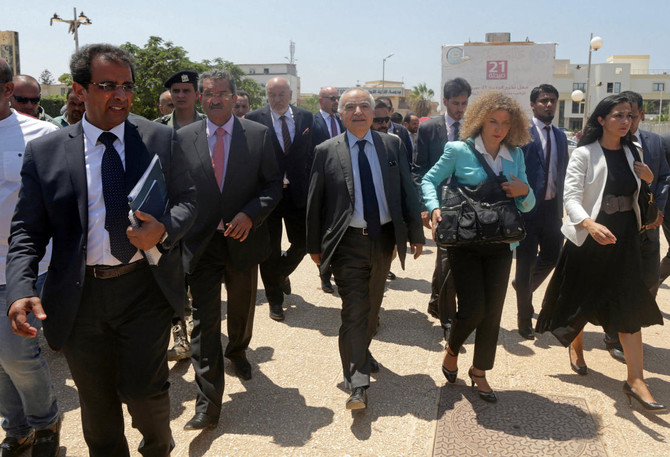
NEW YORK: UN children agency UNICEF has warned that more than 500,000 children in Libya need help and called on warring parties to end the violence and negotiate a political solution to the crisis.
Libya has spiraled into turmoil after a civil war ousted Muammar Qaddafi in 2011. Rival brigades of former rebels backed by competing political factions have turned against each other in a fight for control.
A UN-backed government in Tripoli is trying to extend its influence, though it is facing resistance from armed rivals.
Geert Cappelaere, UNICEF regional director, said that 550,000 children need assistance due the political instability, on-going conflict, displacement, and economic collapse.
“The wellbeing of girls and boys in Libya should be a priority for authorities, civil society and the international community,” Cappelaere said in a statement after visiting the country.
UNICEF said nearly 200,000 children in Libya need safe drinking water, while 315,000 need educational support with more than 550 schools in the country either destroyed, damaged or used as shelters.
Cappelaere warned that more than 80,000 children are internally displaced and migrant children in Libya are particularly vulnerable to abuse and exploitation, including in detention centers.
In a report in May, UNICEF said that thousands of unaccompanied children attempting to make it across the Mediterranean from Libya to Italy can become easy prey for traffickers who often sell them into exploitation, sometimes akin to contemporary forms of slavery.
UNICEF’s concern came as a migrant rescue organization said it was racing to the aid of anti-immigration activists whose boat had run into trouble in the Mediterranean.
The C-Star, which has vowed to expose what it describes as “collaboration” between privately-funded rescue ships and people traffickers, said on Twitter it had “developed a minor technical problem during the night,” leaving it adrift but not in distress.
Germany’s Sea-Eye, one of nine NGOs involved in migrant search and rescue (SAR) operations and a target of the C-Star’s campaign, said it had been “asked by the MRCC (command center in Rome) to assist the ship.”
The Italian coast guard could not be reached for a comment.
The C-Star has been plagued with problems since its mission began last month. It was initially refused permission to travel through the Suez Canal, before later being blocked over legal questions in Cyprus.
After finally making it to Libya’s SAR zone, it needed to refuel but found itself stuck off the coast of Tunisia earlier this week after fishermen and a powerful Tunisian union refused to allow passage.
French activist Clement Galand sent a message to AFP overnight Thursday to Friday saying the boat “has been refueled, everything is fine, we will return to the search and rescue zone” off Libya.
But by Friday morning the activists said a technical problem had forced them to turn off the ship’s engine and inform other vessels in the area.
The ship has been off the radar on maritime traffic sites since Wednesday. Galand said the ship was currently “between Malta and the Libyan coast.”
The 40-meter long ship, which is flying under a Mongolian flag, is leased by the far-right group “Generation Identity.”
Funded by Internet-collected donations of more than $212,000, the Austrian, French, German and Italian activists on board have vowed to ensure migrants rescued at sea off Libya be returned to Africa.
Two NGO ships were badgered at sea by the C-Star last week with a radio message telling them to “leave the rescue zone” and “stop acting as an incentive for human traffickers.”
The message echoed one transmitted on Thursday by the Libyan navy, which has banned any unauthorized foreign ships from entering the SAR zone off its coast.


![]()
More than half a million children in Libya need help: UNICEF
More than half a million children in Libya need help: UNICEF
Latest updates


Recommended


© 2026 SAUDI RESEARCH & PUBLISHING COMPANY, All Rights Reserved And subject to Terms of Use Agreement.