ISLAMABAD: Deposed Prime Minister Nawaz Sharif has gathered all the king’s horses and all the king’s men to trumpet his return rally to home base in the eastern city of Lahore, his party’s center of power.
He was given a warm farewell by Prime Minister Shahid Khaqan Abbasi and Finance Minister Ishaq Dar before embarking on his journey, a stretch of 280 km passing through 15 constituencies, 14 of which are held by the ruling party.
Sharif confirmed that Abbasi will continue as the premier until the next general election, due in 2018.
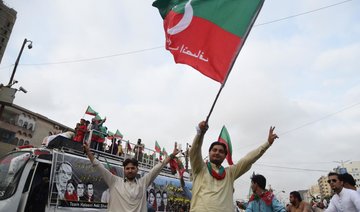
Celebrations are in full swing. Streets and highways are littered with streamers advertising Sharif and his Pakistan Muslim League-Nawaz (PML-N) party.
His supporters have flocked from near and far, further charging an already electrified atmosphere in and around the travel route.
“We’re showing our solidarity and love for Nawaz Sharif,” said one of his supporters. Arab News spoke to several people participating in the rally, and in one voice they said: “You can remove him from the chair but you can’t remove him from our hearts — let the judiciary and army know.”
Sharif’s rally is expected to amass hundreds of thousands of supporters traveling on the Grand Trunk Road, popularly known as GT Road, stopping in main cities to address his followers and enlarge his entourage.
The PML-N’s Tariq Fazal Chaudhry, minister of state for capital administration and development, told Arab News during the rally: “We’ll show our power, our strength, that he’s the people’s leader.”
Approximately 6,000 police have been deployed for security and 1,200 commandos to guard Sharif’s cavalcade following a bombing in Lahore that injured nearly three-dozen people.
The rally was delayed nearly two hours as Sharif awaited the Islamabad High Court’s decision on petitions filed against the procession by opposition party Pakistan Tehreek-e-Insaaf (PTI) of Imran Khan.
The court dismissed the PTI’s plea and allowed Sharif to proceed. Attempts to contact the PTI leadership were disrupted due to cell phone jammers.
The election commission, a day prior to Sharif’s rally, sent a notification directing the PML-N to appoint a new party president.
As per the Political Parties Order 2002, a disqualified parliamentarian cannot hold any position in the party.
House leader in the Senate, Raja Zafar-ul-Haq, said the PML-N has decided that Shahbaz Sharif will take the party’s mantle.
The party also confirmed that Kulsoom Nawaz, the former first lady, has been nominated as a candidate to fill her husband’s vacant seat of Lahore district constituency.
Her chances of winning the seat in the upcoming by-election are high, political observers told Arab News.
“It’s Sharif’s center of gravity,” said journalist Mohammed Nawab. “There’s no chance of any other party able to challenge the ruling party’s seat in that constituency.”
But this further complicates matters for Sharif, who has led the party since it came to prominence in the 1990s and has always been at its helm.
Well-reputed columnist Zahid Hussain, in an article published in a local daily, summed up Sharif’s sticking point that caused friction between him and the country’s mighty military.
“With his rise to the pinnacle of political power, Nawaz Sharif tried to break away from the influence of the military establishment that also brought him down in his previous terms,” the article read.
“Although (his party) has historically remained close to the military establishment, Nawaz Sharif tried to transform it into a mass populist party, though he may not have been fully successful in his endeavor.”
Sharif views his ouster as a conspiracy, stopping short of pointing fingers at the GHQ, the military’s headquarters in the garrison city of Rawalpindi. Though he has respected the court verdict disqualifying him, he disagrees with the decision.
Abbasi, a Sharif loyalist, said any move that hampers Pakistan’s progress is called a conspiracy, clarifying Sharif’s statement.
Abbasi has hinted at amending Article 62-1(f) of the Constitution, the clause that disqualified Sharif, who was declared “dishonest” by five judges on July 28.
But Sharif’s homecoming may not be as welcoming as planned due to the return of firebrand cleric Tahir-ul-Qadri.
He holds Sharif and his brother Shahbaz, chief minister of Punjab, responsible for the killing of 14 people, including his party workers, in a protest that turned violent due to police aggression on June 17, 2014 — known as the Lahore Model Town Incident.
Qadri, chief of the Pakistan Awami Tehreek (PAT) movement, gathered with several opposition party leaders and addressed a large crowd of supporters.
“For three years, we’ve been seeking justice and our appeals are pending before the courts,” said the disgruntled cleric.
“I request the same JIT (Joint Investigation Team)” that disqualified Sharif “to probe Model Town. For three years, the case hasn’t even been heard. Is this justice? Your (Sharif’s) case was heard for 273 days, then you say you’ve been dealt with cruelly.”
Qadri warned Sharif: “You think having power and doing whatever you want is democracy? That the law is only for the weak? You’ll have to answer for this. If you’ve heard my speech, hopefully you’ll cancel your plans for the ‘show’ on GT Road.”


![]()

Ousted Pakistani PM embarks on populist march in show of strength
Ousted Pakistani PM embarks on populist march in show of strength

Latest updates


© 2026 SAUDI RESEARCH & PUBLISHING COMPANY, All Rights Reserved And subject to Terms of Use Agreement.