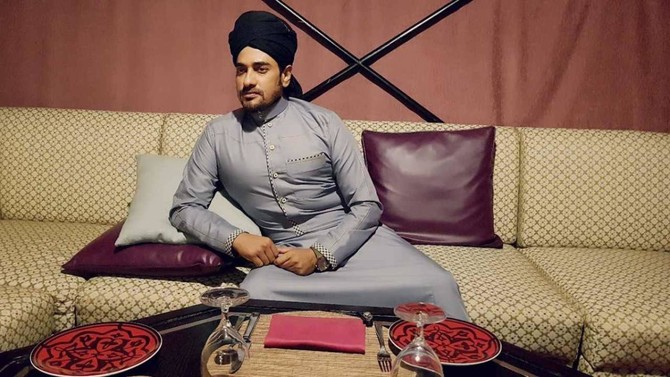
DHAKA: A Bangladeshi film star who became an Islamic preacher said Wednesday he wants to use his fame to draw young people in the Muslim-majority nation to the faith.
Ananta Jalil is the latest actor to take up the practice after 22-year-old Naznin Akter Happy, whose decision to become an ultra-conservative Islamic preacher was the subject of a best-selling book.
Thousands of fans turned out late last month to watch 39-year-old Jalil preach in the capital Dhaka. Photos of him wearing an Islamic turban and long robe went viral on social media.
He told AFP he had joined the Tablighi Jamaat — a Sunni Muslim evangelical movement that boasts millions of adherents in Bangladesh — after a pilgrimage to Makkah earlier this year.
“The main reason Allah gave us life... sent us to the earth is to worship Him. I learnt it there,” he said by phone on Wednesday.
“If I can preach Islam to the young generation, they’ll abide by Allah and the traditions of the prophet and they’ll say prayers five times a day.”
Unlike Happy, Jalil said he would keep making movies although his next one would be used to “propagate Islam.”
Jalil made his fortune as a textiles entrepreneur and used the money to bankroll films in which he played a starring role.
He has made six movies, starting with “Khoj” (“The Search“) in 2010, in which he played a secret service agent who takes on an international arms syndicate.
The moderate version of Islam practiced in Bangladesh for generations has been slowly replaced by a more orthodox version of the faith in recent years.
The burka most associated with the rigid Islam of Afghanistan and the Gulf is becoming more commonplace, new mosques and madrassas are flourishing and hard-liners have won symbolic victories in their push to overhaul Bangladesh’s secular constitution.
sa/cc/sm

Bangladesh film star turns Islamic preacher

Australia passes tougher laws on guns, hate crimes after Bondi shooting
- The gun control laws passed with the support of the Greens party despite opposition from the opposition conservative Liberal-National coalition
- The anti-hate laws passed with support from the Liberal party
SYDNEY: Australia has enacted new laws for a national gun buyback, tighter background checks for gun licenses and a crackdown on hate crimes in response to the country’s worst mass shooting in decades at a Jewish festival last month.
Two bills for stricter gun control and anti-hate measures passed the House of Representatives and Senate late on Tuesday during a special sitting of parliament.
The gun control laws passed with the support of the Greens party despite opposition from the opposition conservative Liberal-National coalition. The anti-hate laws passed with support from the Liberal party.
Introducing the gun reforms, Home Affairs Minister Tony Burke said individuals with “hate in their hearts and guns in their hands” carried out the December 14 attack at the famed Bondi Beach that killed 15 people.
“The tragic events at Bondi demand a comprehensive response from government,” Burke said. “As a government we must do everything we can to counter both the motivation and the method.”
The father and son gunmen allegedly behind the attack on Jewish Hanukkah celebrations used powerful firearms that were legally obtained, despite the son being previously examined by Australia’s spy agency.
PARLIAMENT RECALLED EARLY FOR SPECIAL SESSION
Prime Minister Anthony Albanese recalled parliament early from its summer break for this week’s special two-day session to toughen curbs after a shooting that shocked the nation and prompted calls for more action on gun control and antisemitism.
The proposed gun control measures enable the largest national buyback scheme since a similar campaign after a 1996 massacre in Tasmania’s Port Arthur, in which a lone gunman killed 35 people.
They also toughen firearm import laws as well as background checks for firearm licenses issued by Australian states, making use of information from the Australian Security Intelligence Organization.
Australia had a record 4.1 million firearms last year, the government said on Sunday, with more than 1.1 million of those in New South Wales, its most populous state and the site of the Bondi attack.
“The sheer number of firearms currently circulating within the Australian community is unsustainable,” Burke said.
The bill passed without the support of the opposition coalition, with a vote of 96-45 in the lower house, and 38-26 in the Senate.
“This bill reveals the contempt the government has for the million gun owners of Australia,” said Shadow Attorney-General Andrew Wallace of the Liberals.
“The prime minister has failed to recognize that guns are tools of trade for so many Australians.”
HATE CRIME PENALTIES STEPPED UP
A second bill steps up penalties for hate crimes, such as jail terms up to 12 years when a religious official or preacher is involved, and allows bans on groups deemed to spread hate.
The bill, which also provides new powers to cancel or refuse visas for those who spread hate, passed the lower house by a 116-7 margin and the Senate 38-22.
It won support from Liberal party lawmakers after ruling Labor struck a deal to include changes such as a requirement the government consult the opposition leader on the listing and delisting of extremist organizations.
The Liberals’ coalition partners abstained from the vote and the Greens opposed it, arguing it would have a “chilling effect” on political debate and protest.
“This bill targets those that support violence, in particular violence targeted at a person because of their immutable attributes,” said Attorney-General Michelle Rowland.
Such conduct is not only criminal but sows the seed of extremism leading to terrorism, she added. Police say the alleged Bondi gunmen were inspired by the Daesh group.
The measures were originally planned for a single bill, but backlash from both the coalition and the Greens forced the government to split the package and drop provisions for an offense of racial vilification.
In its own reforms, New South Wales limits individuals to possession of four guns, and beefs up the power of police to curb protests during designated terrorist attacks.