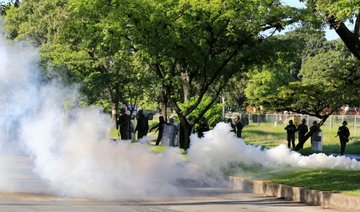
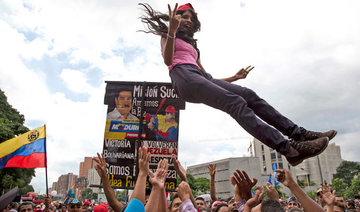
GENEVA: The UN decried Tuesday “widespread and systematic use of excessive force” against demonstrators in Venezuela, saying security forces and pro-government groups were responsible for at least 73 protester deaths.
Presenting the preliminary findings from an investigation conducted in June and July, the UN rights office described “a picture of widespread and systematic use of excessive force and arbitrary detentions against demonstrators in Venezuela.”
“Witness accounts suggest that security forces, mainly the National Guard, the National Police and local police forces, have systematically used disproportionate force to instil fear, crush dissent, and to prevent demonstrators from assembling, rallying and reaching public institutions to present petitions,” the rights office said in a statement.
“Government authorities have rarely condemned such incidents,” it stressed.
Venezuela, which is suffering from an acute economic crisis marked by shortages of basic goods, has experienced four months of street demonstrations against President Nicolas Maduro that have left 125 people dead.
After receiving no response to repeated requests for access to Venezuela to investigate the situation in the country, UN rights chief Zeid Ra’ad Al Hussein deployed a team of human rights officers to monitor the country remotely.
The investigators conducted 135 interviews between June 6 and July 31 with victims and their families, witnesses, civil society organizations, journalists, lawyers and doctors, among others.
“Since the wave of demonstrations began in April, there has been a clear pattern of excessive force used against protesters,” Zeid said in the statement.
“Several thousand people have been arbitrarily detained, many reportedly subjected to ill-treatment and even torture, while several hundred have been brought before military rather than civilian courts,” he said, stressing that “these patterns show no signs of abating.”
According to the preliminary findings, security forces were allegedly responsible for at least 46 of the protester deaths, while pro-government armed groups were behind 27.
It remained unclear who was behind the remaining deaths, the rights office said.
At the same time, nearly 2,000 people have been injured, while more than 5,050 people have been arbitrarily arrested, with over 1,000 reportedly still in detention, it said.
The rights office also decried “credible reports of cruel, inhuman or degrading treatment by security forces of such detainees, amounting in several cases to torture,” saying tactics included “electric shocks, beatings.., suffocation with gas, and threats of killings, and in some cases threats of sexual violence.”
Zeid warned that “these violations have occurred amid the breakdown of the rule of law in Venezuela, with constant attacks by the Government against the National Assembly and the Attorney-General’s Office.”
“The responsibility for the human rights violations we are recording lies at the highest levels of government,” he said.

UN slams ‘widespread and systematic use of excessive force’ in Venezuela
Two high-speed trains derail in Spain, police sources say 21 people killed
- The accident happened near Adamuz, in Cordoba province. So far, 21 people have been confirmed dead by police
MADRID: A high-speed train derailed and smashed into another oncoming train in southern Spain on Sunday, pushing the second train off the tracks in a collision that police sources confirmed to Reuters had killed at least 21 people.
The accident happened near Adamuz, in Cordoba province. So far, 21 people have been confirmed dead by police, with state broadcaster Television Espanola adding that 100 people had been injured, 25 seriously. The driver of one of the trains, which was traveling from Madrid to Huelva, was among those who died, the TV station added.
“The Iryo 6189 Malaga — (to Madrid) train has derailed from the track at Adamuz, crashing onto the adjacent track. The (Madrid) to Huelva train which was traveling on the adjacent track has also derailed,” said Adif, which runs the rail network, in a social media post.
Adif said the accident happened at 6:40 p.m. (1740 GMT), about 10 minutes after the Iryo train left Cordoba heading toward Madrid.
Iryo is a private rail operator, majority-owned by Italian state-controlled railway group Ferrovie dello Stato. The train involved was a Freccia 1000 train which was traveling between Malaga and Madrid, a spokesperson for Ferrovie dello Stato said.
The company said in a statement that it deeply regretted what had happened and had activated all emergency protocols to work closely with the relevant authorities to manage the situation.
The second train was operated by Renfe, which also did not respond to a request for comment.
Adif has suspended all rail services between Madrid and Andalusia.
HORRIFIC SCENE
The Iryo train had more than 300 passengers on board, while the Renfe train had around 100.
Paco Carmona, Cordoba fire chief, told TVE the first train heading to Madrid from Malaga had been evacuated.
The other train’s carriages were badly damaged, he said, with twisted metal and seats. “There are still people trapped. We don’t know how many people have died and the operation is concentrating on getting people out of areas which are very narrow,” he said. “We have to remove the bodies to reach anyone who is still alive. It is proving to be a complicated task.”
Transport Minister Oscar Puente said he was following events from rail operator Adif’s headquarters in Madrid.
“The latest information is very serious,” he posted on X. “The impact was terrible, causing the first two carriages of the Renfe train to be thrown off the track. The number of victims cannot be confirmed at this time. The most important thing now is to help the victims.”
The mayor of Adamuz, Rafael Moreno, told El Pais newspaper that he had been among the first to arrive at the scene of the accident alongside the local police and saw what he believed to be a badly lacerated body several meters from the accident site.
“The scene is horrific,” he said. “I don’t think they were on the same track, but it’s not clear. Now the mayors and residents of the area are focused on helping the passengers.”
CALLS FOR MEDICS
Images on local television showed a reception center set up for passengers in the town of Adamuz, population 5,000, with locals coming and going with food and blankets amid nighttime temperatures of around 42 degrees Fahrenheit (6 degrees Celsius).
A woman named Carmen posted on X that she had been on board the Iryo train to Madrid. “Ten minutes after departing (from Cordoba) the train started to shake a lot, and it derailed from coach 6 behind us. The lights went out.”
Footage posted by another Iryo train passenger, also on X, showed an Iryo staffer in a fluorescent jacket instructing passengers to remain in their seats in the darkened carriages, and those with first aid training to keep watch over fellow passengers. He also urged people to maintain mobile phone batteries to be able to use their torches when they disembarked.
Salvador Jimenez, a journalist for RTVE who was on board the Iryo train, shared images showing the nose of the rear carriage of the train lying on its side, with evacuated passengers sitting on the side of the carriage facing upwards.
Jimenez told TVE by phone from beside the stricken trains that passengers had used emergency hammers to smash the windows and climb out, and they had seen two people taken out of the overturned carriages on stretchers.
“There’s a certain uncertainty about when we’ll get to Madrid, where we’ll spend the night, we’ve had no message from the train company yet,” he said. “It’s very cold but here we are.”