MANILA: US Secretary of State Rex Tillerson said Monday he had told his Russian counterpart that Moscow’s meddling in the US presidential election had created “serious mistrust” between the two countries.
After meeting Foreign Minister Sergei Lavrov in Manila, Tillerson said he had also warned him Washington was deciding on a response to the Kremlin’s decision to order a cut in the size of the US mission in Moscow.
“Russian meddling in the elections was certainly a serious incident. We talked about that in the discussion that we had with Mr.Lavrov yesterday,” Tillerson told reporters.
“And trying to help him understand just how serious this incident had been and how seriously it had damaged the relationship between the US and the American people and the Russian people, that this had created serious mistrust and that we simply have to find some way to deal with that.”
Russia has furiously denied reports, endorsed by US intelligence agencies, that it attempted to swing last year’s US presidential in favor of the eventual victor, President Donald Trump.
Trump has played down the allegations, but the ongoing controversy cast a pall over already tense ties, which most recently saw President Vladimir Putin order the US diplomatic mission in Moscow cut 755 personnel.
“I told the foreign minister that we have not made a decision about how we would respond to the Russian request to remove US diplomatic personnel,” Tillerson said.
“I asked several clarifying questions, just to describe the thinking behind that diplomatic note that we received, but I told them we would respond by September 1,” he said, referring to Moscow’s deadline to shrink the mission.


Tillerson: Russian election meddling created ‘serious mistrust’
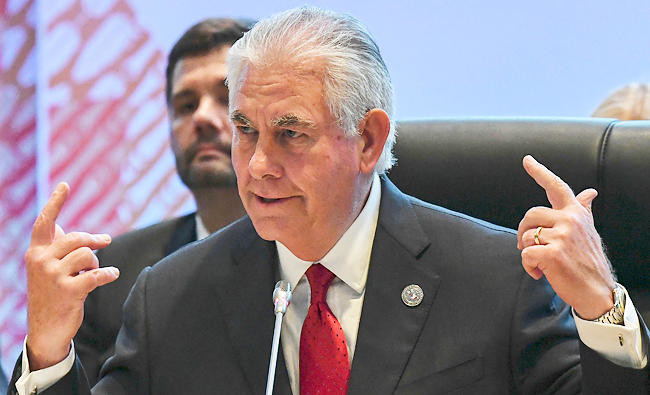
Tillerson: Russian election meddling created ‘serious mistrust’

Cuba says a 5th person died after people on a Florida-flagged speedboat opened fire on soldiers
- Authorities in Cuba said that on Feb. 26 Cuban soldiers confronted a speedboat carrying 10 people as the vessel approached the island and opened fire on the troops
- The shooting threatened to increase tensions between US President Donald Trump and Cuban authorities
HAVANA: Cuba said a fifth person has died as a consequence of a fatal shootout last month involving a Florida-flagged speedboat that allegedly opened fire on soldiers in waters off the island nation’s north coast.
The island’s interior ministry said late Thursday in a statement that Roberto Álvarez Ávila died on March 4 as a result of his injuries. It added that the remaining injured detainees “continue to receive specialized medical care according to their health status.”
Authorities in Cuba said that on Feb. 26 Cuban soldiers confronted a speedboat carrying 10 people as the vessel approached the island and opened fire on the troops. They said the passengers were armed Cubans living in the US who were trying to infiltrate the island and “unleash terrorism”. Cuba said its soldiers killed four people and wounded six others.
“The statements made by the detainees themselves, together with a series of investigative procedures, reinforce the evidence against them,” the Cuban interior ministry said in its statement, adding that “new elements are being obtained that establish the involvement of other individuals based in the US”
Earlier this week, Cuba said it had filed terrorism charges against six suspects that were on the speedboat. The government unveiled items said to have been found on the boat, including a dozen high-powered weapons, more than 12,800 pieces of ammunition and 11 pistols.
Cuban authorities have provided few details about the shooting, but said the boat was roughly 1.6 kilometers (1 mile) northeast of Cayo Falcones, off the country’s north coast. They also provided the boat’s registration number, but The Associated Press was unable to readily verify the details because boat registrations are not public in the state of Florida.
The shooting threatened to increase tensions between US President Donald Trump and Cuban authorities. The island’s economy was until recently largely kept economically afloat by Venezuela’s oil, which is now in doubt after a US military operation deposed then-Venezuelan President Nicolás Maduro.


