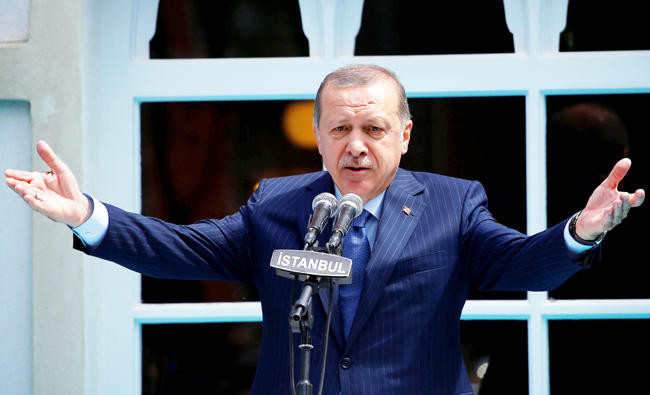
ANKARA: Turkey may launch a new cross-border military operation into northern Syria, President Recep Tayyip Erdogan said.
Ankara has already begun reinforcing its border against possible threats from Kurdish militants by dispatching artillery to the southeastern province of Kilis.
It will also deploy tanks and howitzers across the Syrian Kurdish-held region of Afrin, the Dogan news agency reported.
Turkey launched a cross-border operation into northern Syria, dubbed Euphrates Shield, last August to clear the area of Daesh and Syrian Kurdish People’s Protection Units, or YPG, both considered terrorist organizations by Ankara. That operation ended in late March 2017.
“We are determined to extend the dagger we have put into the heart of the terror entity project through the Euphrates Shield Operation with new moves,” Erdogan told a large crowd at a stadium opening ceremony.
Relations between Ankara and Washington have been strained over US support for the Syrian Kurds, considered a key regional partner against Daesh to take back the group’s self-claimed capital of Raqqa.
Turkey’s concern is that Syrian Kurds try to unify its semi-autonomous regions in northern Syria and threaten the territorial integrity of Turkey.
“The timing of this announcement is very telling,” said Cengiz Tomar, professor of international relations and vice-rector at Yalova University in Turkey.
“The only move that Turkey can make is to expand its intervention and to boost its military build-up toward the Kurdish held district of Afrin and Idlib in order to hinder the expansion of the YPG that is closely tied to the Kurdistan Workers Party, or PKK — a terrorist group that has carried out bloody attacks inside Turkey for decades.”
Tomar also said that for such a military operation to occur, Turkey needed approval from Russia, and the US was likely to oppose it, as it did with the Euphrates Shield operation.
“For now, the primary survival threat for Turkey is not Daesh, but Kurdish militants. So, it would focus its energy and military strategy on preventing a PKK/YPG belt on its southern border,” he said.
The move is also connected to the domestic politics of the region and its possible repercussions for regional balance, which is already delicate. Iraqi Kurds are planning an independence referendum on Sept. 25, which Ankara recently called “a terrible mistake.”
“Preserving Iraq’s territorial integrity and political unity is one of the fundamental principles of Turkey’s Iraq policy. This principle is a prerequisite for lasting stability, peace, security and prosperity in the region,” Turkey’s Foreign Ministry said in June.
Turkish warplanes bombed several PKK positions in northern Syria and Iraq in April, killing Iraqi peshmerga and YPG militants.

Erdogan plans new attack on northern Syria
Short Url
https://arab.news/5jtxs
Erdogan plans new attack on northern Syria
New Riyadh Air route to boost Dubai airport’s growth projection
- World’s busiest travel hub adding more routes to Saudi Arabia
- Dubai Airports forecasts 99.5 million passengers in 2026
DUBAI: Dubai International Airport (DXB), the world’s busiest travel hub, is expected to handle close to 100 million passengers this year, its operator said on Wednesday, building on a record performance in 2025.
Dubai Airports forecasts 99.5 million passengers in 2026, it said in a statement, as demand strengthens across several major markets.
DXB handled 95.2 million passengers last year, up 3.1 percent from 2024. India, Saudi Arabia and Britain remained among its largest markets, while China, Egypt and Italy recorded double-digit growth.
“We’ve had some pretty good growing markets … and those, I think, are the markets where there’s going to be considerable potential,” Dubai Airports CEO Paul Griffiths said in an interview, mentioning countries including China and Russia.
“We’re adding more routes to Saudi Arabia,” he said, adding that Riyadh Air, which is owned by the kingdom’s sovereign wealth fund and commenced operations last year, will start operating a route to and from DXB “over the next few months.”
Dubai, home to the world’s tallest tower and palm-shaped islands, is the Middle East’s biggest tourism and trade hub. It is also a key connecting point for flights between Europe and Asia, and last year welcomed 19.6 million international overnight visitors, according to government data.
DXB had its busiest day, month, quarter and year on record in 2025, operating “at the edge of physical capacity,” Dubai Airports said.
Griffiths said investment to roll out advanced hand baggage screening machines was helping to smooth the flow of traffic.
To meet rising demand and a fast-growing population, the emirate has announced a major $35 billion expansion at its second airport, Al Maktoum International, also operated by Dubai Airports.
That airport reported 30 percent growth in flights over the last year and handled 1.4 million passengers.
The expansion is designed to allow it to handle 150 million passengers per year over the next decade, before reaching an annual capacity of 260 million passengers when complete.
Dubai Airports forecasts 99.5 million passengers in 2026, it said in a statement, as demand strengthens across several major markets.
DXB handled 95.2 million passengers last year, up 3.1 percent from 2024. India, Saudi Arabia and Britain remained among its largest markets, while China, Egypt and Italy recorded double-digit growth.
“We’ve had some pretty good growing markets … and those, I think, are the markets where there’s going to be considerable potential,” Dubai Airports CEO Paul Griffiths said in an interview, mentioning countries including China and Russia.
“We’re adding more routes to Saudi Arabia,” he said, adding that Riyadh Air, which is owned by the kingdom’s sovereign wealth fund and commenced operations last year, will start operating a route to and from DXB “over the next few months.”
Dubai, home to the world’s tallest tower and palm-shaped islands, is the Middle East’s biggest tourism and trade hub. It is also a key connecting point for flights between Europe and Asia, and last year welcomed 19.6 million international overnight visitors, according to government data.
DXB had its busiest day, month, quarter and year on record in 2025, operating “at the edge of physical capacity,” Dubai Airports said.
Griffiths said investment to roll out advanced hand baggage screening machines was helping to smooth the flow of traffic.
To meet rising demand and a fast-growing population, the emirate has announced a major $35 billion expansion at its second airport, Al Maktoum International, also operated by Dubai Airports.
That airport reported 30 percent growth in flights over the last year and handled 1.4 million passengers.
The expansion is designed to allow it to handle 150 million passengers per year over the next decade, before reaching an annual capacity of 260 million passengers when complete.
© 2026 SAUDI RESEARCH & PUBLISHING COMPANY, All Rights Reserved And subject to Terms of Use Agreement.