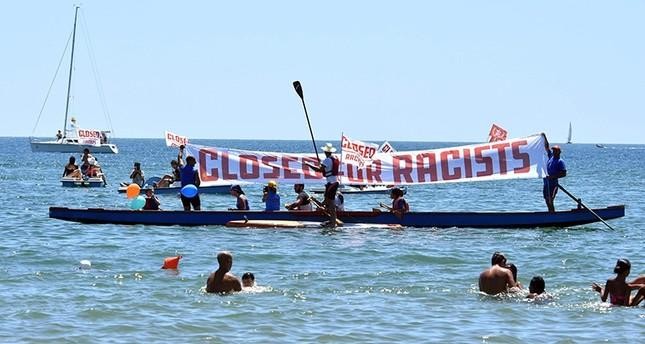
Tunisian fishermen vowed Sunday to block a ship carrying far-right activists from docking at their port, dealing a fresh blow to their mission to disrupt the flow of migrant boats from north Africa to Europe.
The C-Star, a boat chartered by anti-immigration group “Generation Identity,” passed through waters off Libya on Saturday.
It briefly tailed the Aquarius, operated by French group SOS Mediterranee, one of several NGO boats conducting search and rescue operations in an area notorious for deadly migrant boat sinkings.
Having left Cyprus on August 1, the 40-meter (130-foot) vessel was thought to be in need of supplies: but the fishermen in the southeastern Tunisian port of Zarzi had other ideas.
“If they come here we’ll close the refueling channel,” Chamseddine Bourassine, the head of the local fishermen’s organization, told AFP.
“It is the least we can do given what is happening out in the Mediterranean,” he added.
“Muslims and Africans are dying.”
An official at the port, who asked to remain anonymous, said: “What? Us let in racists here? Never!“
The C-Star headed straight from Cyprus to Libyan waters after being discouraged from attempting to dock en route in Greece and Sicily, with authorities concerned about the prospect of protests.
The self-styled “Defend Europe” mission has had a chequered history to date.
Their boat was held up for a week in the Suez Canal by Egyptian authorities looking for weapons.
Then, after it landed in the Cypriot port of Famagusta last month, several of its crew jumped ship and asked for asylum in Europe — exactly the kind of thing the mission was set up to prevent.
The C-Star crew say their main goal is to expose collaboration between NGO rescue ships and the traffickers who launch boats packed with migrants from Libya.
Humanitarian groups say Generation Identity is engaged in a potentially dangerous publicity stunt.
Since the start of 2014, some 600,000 people from Africa, the Middle East and South Asia have been rescued from traffickers’ boats and taken to Italy.
Over 10,000 have died en route and serial sinkings have resulted in privately funded or charity-run boats joining a multinational search and rescue operation coordinated by Italy’s coast guard.
NGO boats have rescued around one third of the nearly 100,000 people picked up this year, but their relations with Italy have become strained as pressure to stem the flow of migrants has mounted.
Critics say the NGOs make it too easy for the traffickers to guarantee would-be migrants safe passage to Europe, allegedly fueling the lucrative trade.
Italian authorities last week impounded one NGO boat, the Iuventa, which is operated by German association Jugend Rettet.
They accused its crew of being in direct contact with traffickers to organize pick-ups of boatloads of migrants from locations very close to the Libyan coast.
On Sunday, the Aquarius and Doctors without Borders (MSF) took part in a rescue operation in which around 100 people were plucked from a distressed dinghy.
The number of such rescues in international waters has fallen sharply over the last five weeks to under half the level of the same period last year.
Italian officials are cautiously optimistic that this reflects a breakthrough in their efforts to strengthen the Libyan coast guard’s capacity to combat traffickers.
The Libyan navy told AFP that between Thursday and Saturday the coast guard, which has received training and new equipment from Rome, had intercepted five trafficker boats carrying a total of 878 people.
Rights organizations have voiced concern over the focus on sending boats back to Libya.
They say the migrants on board face detention in squalid camps and the risk of torture, sexual violence and forced labor.
Italian officials defend the strategy as the only way to end a humanitarian crisis threatening to overwhelm the country’s reception facilities.

Tunisian fishermen vow to block ‘racist’ anti-migrant ship
Five takeaways from Mojtaba Khamenei’s defiant first message
- Khamenei’s father Ali Khamenei, supreme leader since 1989, wife, sister, child and brother-in-law were all killed on February 28 at the start of the US-Israeli war
- The message was not accompanied by video or audio of the new leader giving the remarks, or even a new still image
PARIS: Iran’s new supreme leader Mojtaba Khamenei on Thursday issued his first message since his elevation to the post, threatening revenge for his father’s killing, though he did not deliver the declaration in person.
Khamenei’s father Ali Khamenei, supreme leader since 1989, was killed on February 28 at the start of the US-Israeli war against the Islamic republic in an air strike that also claimed the lives of other top security officials and family members.
Mojtaba Khamenei was himself wounded, according to statements by some Iranian officials and state television, but there remains uncertainty over his whereabouts and physical condition.
Here are five takeaways from his first statement as supreme leader.
- Uncertainty over condition -
“The first message of the supreme leader of the Islamic revolution, his excellency Ayatollah Seyyed Mojtaba Hossein Khamenei!” an Iranian TV anchor declared before reading out the lengthy statement.
There was, however, no attempt to end the speculation over Khamenei’s condition, and the statement was not accompanied by video or audio of the new leader giving the remarks, or even a new still image.
Instead, the statement was read against the backdrop of an archive photo of Khamanei and a computer-generated flag of the Islamic republic.
- Call for revenge -
In the statement, Khamenei offered no hint that he was seeking to make peace with Iran’s enemies, and instead emphasized his desire for revenge in a war that has claimed the life of his father and his wife.
“A limited amount of this revenge has so far taken concrete form, but until it is fully achieved, this case will remain among our priorities,” Khamenei said.
“We will seek compensation from the enemy, and if they refuse, we will take as much of their property as we determine, and if that is not possible, we will destroy the same amount of his property,” he added.
He singled out a deadly strike on a school in Minab in southern Iran that Iranian authorities have said was carried out by the US and left 150 people dead, describing it as a “crime the enemy deliberately committed.”
A preliminary US military investigation has determined that a missile struck the school because of a targeting mistake, The New York Times reported on Wednesday.
- Threats to enemies -
Echoing the language of his late father, Khamanei also emphasized Iran’s potential to cause havoc across the region by squeezing oil supplies and using regional proxies.
He called for using “the lever of blocking the Strait of Hormuz” — a strategic waterway through which a fifth of global oil passes.
“The will of the people is for the continuation of an effective and deterrent defense that will make the enemy regret its actions.”
He warned that “studies have also been carried out on opening other fronts in which the enemy has little experience and in which it will be extremely vulnerable,” without giving details.
Those fronts would be “activated” if the war continued, he said.
- Warning to region -
Khamenei noted that Iran shared land or sea borders with some 15 countries and “we have always desired warm and constructive relations” with these neighbors.
But Khamenei called for the closure of US bases in nearby countries, saying “the claim of establishing security and peace by America was nothing more than a lie.”
“These countries must determine their stance regarding those who have invaded our dear homeland and killed our people.”
- Grieving son and husband -
He lauded his father as a “shining treasure and distinguished figure in history,” and said he had seen the late ayatollah’s corpse after his “martyrdom.”
Khamenei described the body as “a mountain of steadfastness” with the fist of his father’s one functioning hand — his other arm was paralyzed after a bomb attack in the 1980s — clenched in a sign of defiance.
Khamenei emphasized that as well as his father, he had also lost in the attack “my dear and loyal wife,” his sister, her child and his brother-in-law.
He did not mention his mother, who previous reports said had also been killed. The Fars news agency said Thursday those reports were inaccurate and she was still alive.
Khamenei said that he had learned of his appointment by the Assembly of Experts clerical body “at the same time as you” on television through the state broadcaster.