Myanmar troops arrest Rohingya suspects; 6 Buddhists killed

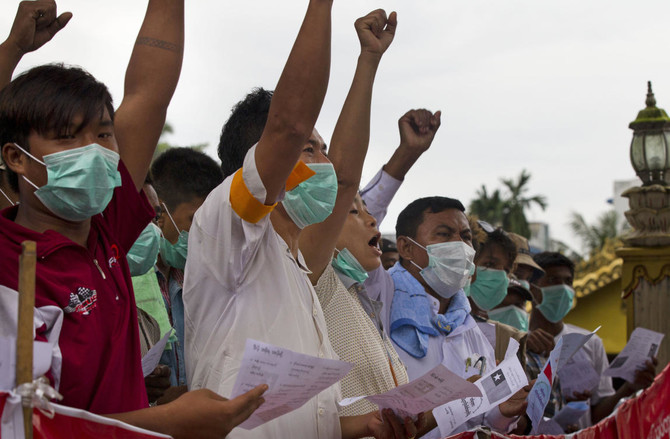
Buddhist nationalists shout slogans during a protest at their camp at entrance of a pagoda Thursday, Aug. 3, 2017, in Yangon, Myanmar. (AP)
Updated 05 August 2017
Follow

Myanmar troops arrest Rohingya suspects; 6 Buddhists killed

MYANMAR: Security forces in Myanmar fired warning shots to disperse Muslim villagers while they were arresting four suspected insurgents in a western region where government troops have been accused of human rights violations against Rohingya minority, officials said Saturday.
About 600 villagers surrounded troops in Rathedaung township in Rakhine state on Friday while they were searching for six men suspected of financing a “terrorist” group, said police officer Zaw Win Aung.
He said the villagers carried slingshots, sticks and machetes as they approached the troops, who responded by firing 40-50 warning shots. They managed to arrest four suspects, he said.
On Thursday, the government said that six Buddhists were killed and two other villagers are missing in Kaigyi village in Maungdaw township, also in Rakhine state.
It wasn’t clear who was responsible, but Maj. Zayar of the border guard police headquarters in Maungdaw said they were searching for culprits.
The government has shut down northern Rakhine to independent journalists, rights experts and humanitarian workers for almost nine months except for organized media trips.
The military has launched operations in the northern part of Rakhine since last October, when suspected Rohingya militants killed nine police officers along the border with Bangladesh.
Rights groups said that during the crackdown, more than 1,000 houses have been burned down, an unknown number of civilians killed and hundreds of Rohingya men and boys arrested. The government said that the operation had ended in February.
Last month, the UN human rights envoy to Myanmar, Yanghee Lee, expressed disappointment over a lack of government effort to tackle problems behind the violence between Buddhists and Muslims. She said she saw little improvement in the situation for Rohingya and that the government prevented her from visiting several areas there.


26 Doctors without Borders workers remain unaccounted for in South Sudan a month after attacks

Updated 4 sec ago
Follow

26 Doctors without Borders workers remain unaccounted for in South Sudan a month after attacks

  • A hospital in the town of Lankien was bombed by government forces, MSF said
  • “We have lost contact with them amid ongoing insecurity”

NAIROBI: More than two dozen Doctors Without Borders workers remain unaccounted for a month after attacks in South Sudan, the medical charity said.
Two facilities belonging to the group, known by French acronym MSF, were attacked on Feb. 3 in Jonglei State, northeast of the capital, Juba, where violence has displaced an estimated 280,000 people since December.
A hospital in the town of Lankien was bombed by government forces, MSF said, while another medical facility in the town of Pieri was raided by “unknown assailants.” Both were located in opposition-held areas.
Staff working at the two facilities fled alongside much of the local population into deeply rural areas where armed clashes and aerial bombardments were ongoing.
MSF said in a statement on Monday that “26 of 291 of our colleagues working in Lankien and Pieri remain unaccounted for.
“We have lost contact with them amid ongoing insecurity,” it said.
The lack of communication with its staff could be linked to the limited network connectivity in much of the state. Staff members who had been contacted described “destruction, violence and extreme hardships.”
Fighting escalated sharply in December, when opposition forces captured a string of government outposts in north central Jonglei. In January, the government responded with a counteroffensive that recaptured most of the area it had lost.
Displaced people in Akobo, an opposition-held town near the Ethiopian border, described horrific violence by government fighters. Many described not being able to find food or water as they walked for days to reach safety.
The attacks on MSF facilities in Lankien and Pieri are part of an uptick in violence on humanitarian staff, supplies and infrastructure, aid groups say. MSF facilities have been attacked 10 times in the last 12 months.
“This violence has taken an unbearable toll not only on health care services, but on the very people who kept them running,” said Yashovardhan, MSF head of mission in South Sudan, who only uses one name.
“Medical workers must never be targets,” he said. “We are deeply concerned about what has happened to our colleagues and the communities we serve.”