Justice Ministry: All defendants get fair trial in Saudi courts

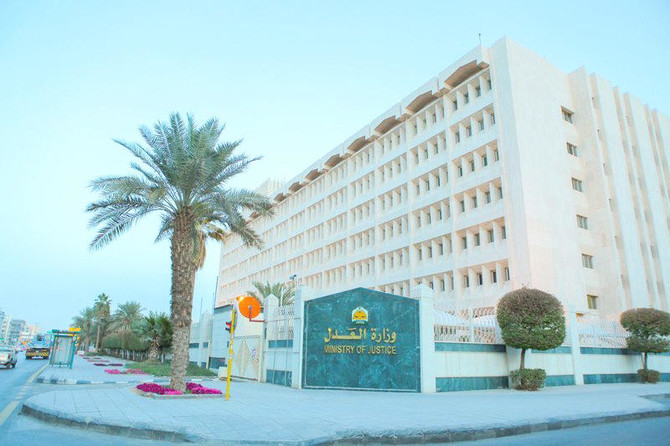
A general view of the Ministry of Justice building in Saudi Arabia. (File photo)
Updated 05 August 2017
Follow

Justice Ministry: All defendants get fair trial in Saudi courts

JEDDAH: Following Saudi Arabia’s Supreme Court’s decision to uphold the death sentences of 14 people convicted of a range of offenses that posed a threat to national security, and which also involved killing innocent civilians, the spokesman of the Saudi Ministry of Justice, Sheikh Mansour Al-Ghafari, maintained that all defendants receive fair trials in Saudi courts, which meet all the required criteria and conditions of the Saudi legal system.
Al-Ghafari said that all sentences against defendants in terrorist cases are subject to meticulous audit and review in the Special Appeal Court and the Supreme Court. Death sentences, in particular, require validation from both a Court of Appeal and the Supreme Court, which means they need to go through many stages, involving the participation of 13 judges, before the sentence is ultimately approved, Al-Ghafari said.
Throughout this period, defendants enjoy full legal rights, including the right to appoint attorneys of their choice, and the ministry pays the ensuing expenses if the defendant cannot afford them, he added.
Moreover, he stressed that all court hearings are held in the presence of defendants’ parents and representatives of the press and human rights groups.
In cases where defendants are non-Saudis, the spokesman said, the embassies of their home countries are notified to send representatives to attend the trials.
Al-Ghafari added that the court gives defendants enough time to prepare and present their defense, and harsh sentences are only passed for the most dangerous crimes — those which threaten the safety and security of society and represent a violation of human rights and dignity, principally the rights to life and security.


Saudi wildlife center records rare sighting of critically endangered leatherback turtle in Red Sea

Updated 05 February 2026
Follow

Saudi wildlife center records rare sighting of critically endangered leatherback turtle in Red Sea

  • NCW says the leatherback traveled thousands of kilometers to reach the Red Sea
  • The closest known nesting grounds are located in India’s Andaman Islands, some 6,500 km distant

RIYADH: Saudi Arabia's National Center for Wildlife (NCW) has documented a rare sighting of a leatherback sea turtle in the Red Sea, marking a significant biological record for one of the planet's most critically endangered marine species.

The sighting occurred approximately 30 kilometers off the coast of Al-Qunfudhah within the Blue Holes Protected Area, a newly established marine reserve, according to the Saudi Press Agency.

The NCW confirmed that the presence of a leatherback in these waters is an exceptional event. Recognized as the largest turtle species on Earth, the leatherback can weigh up to 900 kilograms. It is easily identified by its unique leathery, black carapace—distinguished by five longitudinal ridges rather than a hard bony shell—and its ability to dive to depths exceeding 1,000 meters.

Shutterstock image

Noting the species' migratory nature, the center explained that leatherbacks travel thousands of kilometers foraging for jellyfish. The specimen likely navigated through the Bab el-Mandeb Strait in search of food. 

This is considered a remarkable journey, the NCW said, noting that the nearest known populations reside in the Indian Ocean, spanning waters from South Africa to Sri Lanka (roughly 7,000 to 8,000 kilometers away). The closest known nesting grounds are located in India’s Andaman Islands, approximately 6,500 kilometers distant. No nesting activity has been recorded in the Red Sea.

According to the IUCN Red List, the leatherback is Critically Endangered in the Indian Ocean. While data for the Red Sea and Arabian Gulf is scarce, recent isolated sightings include a juvenile recorded in Jordan in December 2025 and another off Djibouti in 2019.

The NCW emphasized that these rare appearances highlight the ecological importance of the Kingdom's marine conservation efforts in the Red Sea. The center pointed to the Farasan Islands Marine Protected Area, along with the new Blue Holes and Ras Hatiba reserves, as critical sanctuaries that could support the potential expansion of such endangered species' ranges.