ANKARA: The US Embassy in Ankara has described as “inaccurate” media reports that Washington has sent tanks and hundreds of truckloads of weapons into Syria to support the Kurdish People’s Protection Units (YPG).
“These reports ignore basic facts about the current situation in Syria,” the embassy tweeted.
“The majority of US military assistance, consisting primarily of light weapons and ammunition, has supported Syrian Arab Coalition elements of the SDF (Syrian Democratic Forces),” while “a much smaller percentage of weapons given to Kurdish elements of the SDF are limited.”
The embassy said the US will continue to provide full transparency to Turkey regarding what weapons are delivered to the YPG.
Ankara considers the YPG a terrorist organization and an extension of the Kurdistan Workers’ Party (PKK), which has been waging a three-decade-long insurgency in Turkey.
The nature of cooperation between the US and the YPG has been a delicate issue between Washington and Ankara.
Turkey insists that the US should work with other local ground forces such as the Free Syrian Army (FSA), which Ankara has been backing, instead of the YPG.
Nihat Ali Ozcan, a retired major now serving as a security analyst at the Ankara-based think tank TEPAV, said the embassy statement is a public diplomatic effort to reassure Turkey, and media reports are somewhat exaggerated.
“It’s clear that groups fighting Daesh in Raqqa are using some US military equipment to liberate it, and it’s known that military organization, as well as land and air support, are mainly provided by the US,” Ozcan told Arab News. He said if the US considers the YPG a partner in Syria, it is natural and inevitable that it will help it militarily.
As such, US-Turkish tensions over the YPG “are likely to continue” unless domestic politics in Turkey toward the Kurdish issue changes, he added.
Dr. Magdalena Kirchner, Mercator-IPC fellow at the Istanbul Policy Center, said senior US officials have repeatedly expressed willingness to mitigate the risk that local partners misappropriate materiel support, whether by limiting supply to immediate and exclusively anti-Daesh objectives, or by recovering weapons once the fight is over.
“In that context, they argue that military assistance to the YPG is tactical, transactional and limited in time and extent,” Kirchner told Arab News.
“It remains to be seen, however, if the US can live up to expectations of immediate arms recovery, which many experts see as very difficult in such a complex battleground.”
Kirchner said a mid- to long-term challenge for the US will be to balance the need for allied ground forces after the battle for Raqqa to stabilize and govern liberated areas, with the YPG’s aspirations, which are contested by national and regional players.
“So far, Washington has refused to take a public position on this, referring to the immediate and joint challenge regarding Daesh,” she said.
“But it’s hard to imagine that the Trump administration has an appetite for a major troop deployment to Syria instead of continuing to work with proxies,” she added.
“As long as there’s no conversation, let alone a consensus or strategy among allies about the political future of the YPG and other armed non-state actors in Syria, the high risk of conflict protraction and spill-over into Iraq and Turkey persists and could undermine US intentions in the region.”


![]()
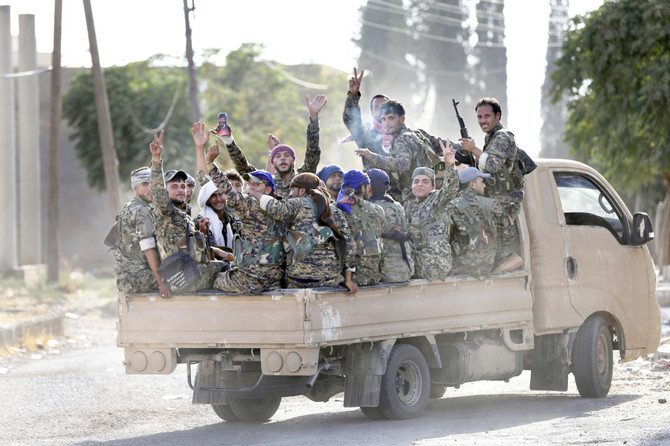
Arms supplies to Kurds: US vows ‘full transparency’
Arms supplies to Kurds: US vows ‘full transparency’



Latest updates


Recommended


© 2026 SAUDI RESEARCH & PUBLISHING COMPANY, All Rights Reserved And subject to Terms of Use Agreement.