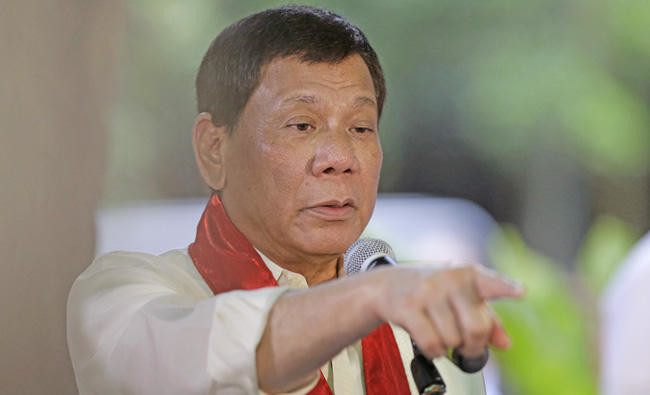
MANILA: North Korean leader Kim Jong-Un is a “maniac” who could destroy Asia by triggering a nuclear war, Philippine President Rodrigo Duterte said Wednesday, ahead of a regional summit to be attended by the regime’s foreign minister.
Using characteristically crude language, Duterte teed off against Kim ahead of a regional security meeting in Manila where the hermit state’s ballistic missile tests will be a hot agenda item.
“He is playing with dangerous toys and this crazy man, do not be fooled by his face, that chubby face that looks nice,” Duterte, 72, said of Kim in a nationally televised speech.
“That son-of-a-whore maniac, if he makes a mistake then the Far East will become an arid land. It must be stopped, this nuclear war, because (if) a limited confrontation blows up here, I tell you the fallout, the soil, the resources. I don’t know what will happen to us. We won’t be able to plant anything productive.”
Under Kim’s leadership, Pyongyang has accelerated its nuclear ambitions, in defiance of international condemnation and multiple sets of United Nations sanctions.
North Korea last week conducted its second intercontinental ballistic missile test, which led Kim to boast he could strike any target in the United States.
US Secretary of State Rex Tillerson and Chinese Foreign Minister Wang Yi will also be in Manila for the security forum, which is hosted by the 10-member Association of Southeast Asian Nations (ASEAN).
The ministers will express “grave concern” over North Korea’s nuclear missile test, according to a draft copy of the chairman’s statement obtained by AFP and scheduled to be released on Tuesday next week at the end of the ASEAN Regional Forum.
Duterte, who won presidential elections last year, has come under fire from foreign leaders over his war on drugs that has claimed thousands of lives and led to warnings by rights groups that he may be overseeing a crime against humanity.
He typically flavors his speeches with crude language and jokes deemed by many to be offensive, including about rape.
Duterte last year called then US president Barack Obama a “son of a whore” for criticizing the drug war.

North Korea’s Kim a ‘maniac’: Philippines’ Duterte
Prabowo, Trump expected to sign Indonesia-US tariff deal in January 2026
- Deal will mean US tariffs on Indonesian products are cut from a threatened 32 percent to 19 percent
- Jakarta committed to scrap tariffs on more than 99 percent of US goods
JAKARTA: Indonesia expects to sign a tariff deal with the US in early 2026 after reaching an agreement on “all substantive issues,” Jakarta's chief negotiator said on Tuesday.
Indonesia’s Coordinating Minister for Economic Affairs Airlangga Hartarto met with US trade representative Jamieson Greer in Washington this week to finalize an Indonesia-US trade deal, following a series of discussions that took place after the two countries agreed on a framework for negotiations in July.
“All substantive issues laid out in the Agreement on Reciprocal Trade have been agreed upon by the two sides, including both the main and technical issues,” Hartarto said in an online briefing.
Officials from both countries are now working to set up a meeting between Indonesian President Prabowo Subianto and US President Donald Trump.
It will take place after Indonesian and US technical teams meet in the second week of January for a legal scrubbing, or a final clean-up of an agreement text.
“We are expecting that the upcoming technical process will wrap up in time as scheduled, so that at the end of January 2026 President Prabowo and President Trump can sign the Agreement on Reciprocal Trade,” Hartarto said.
Indonesian trade negotiators have been in “intensive” talks with their Washington counterparts since Trump threatened to levy a 32 percent duty on Indonesian exports.
Under the July framework, US tariffs on Indonesian imports were lowered to 19 percent, with Jakarta committing to measures to balance trade with Washington, including removing tariffs on more than 99 percent of American imports and scrapping all non-tariff barriers facing American companies.
Jakarta also pledged to import $15 billion worth of energy products and $4.5 billion worth of agricultural products such as soybeans, wheat and cotton, from the US.
“Indonesia will also get tariff exemptions on top Indonesian goods, such as palm oil, coffee, cocoa,” Hartarto said.
“This is certainly good news, especially for Indonesian industries directly impacted by the tariff policy, especially labor-intensive sectors that employ around 5 million workers.”
In the past decade, Indonesia has consistently posted trade surpluses with the US, its second-largest export market after China.
From January to October, data from the Indonesian trade ministry showed two-way trade valued at nearly $36.2 billion, with Jakarta posting a $14.9 billion surplus.