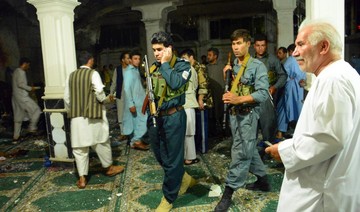
Security tight ahead of burial for Afghan mosque victims

Security forces respond at the site of a suicide attack followed by a clash between Afghanistan's forces and IS fighters during an attack on Iraq embassy in Kabul, Afghanistan on Monday, July 31, 2017. (AP)
Updated 02 August 2017
Follow

Security tight ahead of burial for Afghan mosque victims

KABUL: Afghan authorities have tightened security ahead of a mass funeral for the victims of last night’s suicide attack at a Shiite mosque that killed 29 people.
A suicide attacker opened fire inside a mosque packed with worshippers at evening prayers, before detonating his explosives. A second explosion came 10 minutes later.
No one has claimed responsibility for the bombing in western Herat province but it came a day after the Daesh group warned it would attack Shiites.
Provincial spokesman Jilani Farhad says that to reduce the chance for more attacks, a planned Shiite protest to denounce the attack will be held just before the burial on Wednesday afternoon, rather than at a separate time and location.
Along with the 29 killed, 64 people were wounded, 10 of them critically.


ICE agents can’t make warrantless arrests in Oregon unless there’s a risk of escape, US judge rules

Updated 2 sec ago
Follow

ICE agents can’t make warrantless arrests in Oregon unless there’s a risk of escape, US judge rules

  • US District Judge Mustafa Kasubhai issued a preliminary injunction in a proposed class-action lawsuit
  • Case targets Department of Homeland Security’s practice of arresting immigrants they happen to come across
PORTLAND, Oregon: US immigration agents in Oregon must stop arresting people without warrants unless there’s a likelihood of escape, a federal judge ruled Wednesday.
US District Judge Mustafa Kasubhai issued a preliminary injunction in a proposed class-action lawsuit targeting the Department of Homeland Security’s practice of arresting immigrants they happen to come across while conducting ramped-up enforcement operations — which critics have described as “arrest first, justify later.”
The department, which is named as a defendant in the suit, did not immediately comment in response to a request from The Associated Press.
Similar actions, including immigration agents entering private property without a warrant issued by a court, have drawn concern from civil rights groups across the country amid President Donald Trump’s mass deportation efforts.
Courts in Colorado and Washington, D.C., have issued rulings like Kasubhai’s, and the government has appealed them.
In a memo last week, Todd Lyons, the acting head of US Immigration and Customs Enforcement, emphasized that agents should not make an arrest without an administrative arrest warrant issued by a supervisor unless they develop probable cause to believe that the person is in the US illegally and likely to escape from the scene before a warrant can be obtained.
But the judge heard evidence that agents in Oregon have arrested people in immigration sweeps without such warrants or determining escape was likely.
The daylong hearing included testimony from one plaintiff, Victor Cruz Gamez, a 56-year-old grandfather who has been in the US since 1999. He told the court he was arrested and held in an immigration detention facility for three weeks even though he has a valid work permit and a pending visa application.
Cruz Gamez testified that he was driving home from work in October when he was pulled over by immigration agents. Despite showing his driver’s license and work permit, he was detained and taken to the ICE building in Portland before being sent to an immigration detention center in Tacoma, Washington. After three weeks there, he was set to be deported until a lawyer secured his release, he said.
He teared up as he recounted how the arrest impacted his family, especially his wife. Once he was home they did not open the door for three weeks out of fear and one of his grandchildren did not want to go to school, he said through a Spanish interpreter.
Afterward a lawyer for the federal government told Cruz Gamez he was sorry about what he went through and the effect it had on them.
Kasubhai said the actions of agents in Oregon — including drawing guns on people while detaining them for civil immigration violations — have been “violent and brutal,” and he was concerned about the administration denying due process to those swept up in immigration raids.
“Due process calls for those who have great power to exercise great restraint,” he said. “That is the bedrock of a democratic republic founded on this great constitution. I think we’re losing that.”
The lawsuit was brought by the nonprofit law firm Innovation Law Lab, whose executive director, Stephen Manning, said he was confident the case will be a “catalyst for change here in Oregon.”
“That is fundamentally what this case is about: asking the government to follow the law,” he said during the hearing.
The preliminary injunction will remain in effect while the lawsuit proceeds.