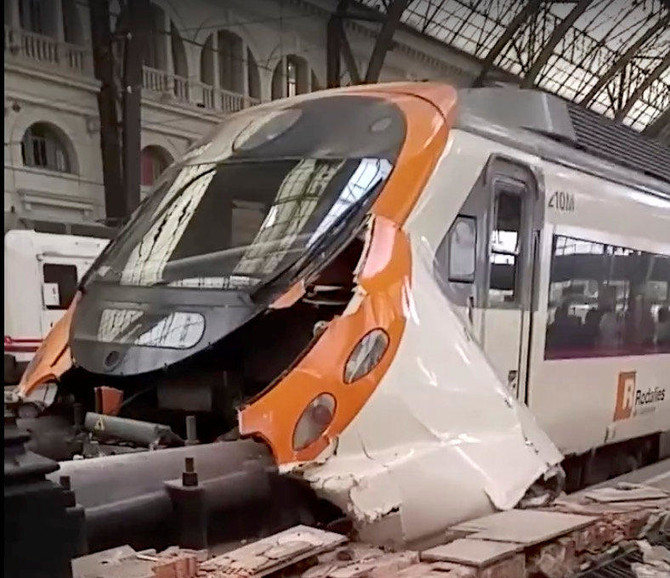
54 injured, 1 seriously, in Spanish train crash

A commuter train is seen crashed into a railway buffer in Barcelona’s Francia station, Spain July 28, 2017 in this still image from a video obtained from social media. (REUTERS/Felix Rios)
Updated 28 July 2017
Follow

54 injured, 1 seriously, in Spanish train crash

MADRID: Emergency services say 40 people received medical treatment after a morning commuter train they were traveling on crashed into the buffers in a station in northeastern Barcelona early Friday.
The Catalan regional emergency services said one person was seriously injured and the rest, including the driver, treated for minor injuries, following the accident at Francia station on the northern side of the city.
Initially, the services had said five people had been seriously injured, among them the driver.
The accident occurred at 7.15 a.m. (0515 GMT).
Train services were not interrupted.


China FM tells EU diplomats not to blame Beijing for bloc’s problems

Updated 1 sec ago
Follow

China FM tells EU diplomats not to blame Beijing for bloc’s problems

BEIJING: China’s foreign minister told his French and German counterparts that Beijing was not to blame for Europe’s economic and security problems as he pushed for more cooperation at a summit in Munich, a foreign ministry statement said Saturday.
Wang Yi made the comments at a meeting with France’s Jean-Noel Barrot and Germany’s Johann Wadephul on the sidelines of the Munich Security Conference on Friday.
He sought to promote China as a reliable partner of the European Union at a time when the bloc is trying to reduce its dependence on both Beijing and an increasingly unpredictable Washington.
“China’s development is an opportunity for Europe, and Europe’s challenges do not come from China,” Wang said, according to the statement.
Warning that “unilateralism, protectionism, and power politics” were on the rise globally, he said he hoped Europe would “pursue a rational and pragmatic policy toward China.”
“The two sides are partners, not adversaries; interdependence is not a risk; intertwined interests are not a threat; and open cooperation will not harm security.”
The meeting came against the backdrop of trade tensions between the two giant economies and disputes over what the EU sees as China’s support for Russia’s war in Ukraine.
The EU is seeking to cut its reliance on China for strategic goods like rare earths while also rebalancing a trade relationship that sees it run a large deficit with the world’s second-largest economy.
In recent years, the two sides have clashed over Chinese electric-vehicle exports, which threaten Europe’s car industry and which Brussels argues are based on unfair subsidies, and Chinese tariffs on EU goods ranging from cheese to cognac.
Wang urged Germany and France to help “give a clear direction for the development of China-Europe relations.”
In a separate meeting with Wadephul — also on Friday — Wang touted economic and trade cooperation as “the cornerstone of China-Germany ties,” according to a foreign ministry readout.
Wang also met Britain’s foreign minister Yvette Cooper, telling her that Beijing and London should “explore more potential for cooperation,” while the two sides also discussed Ukraine and Iran.