AMMAN: Syrian militants linked to a former Al-Qaeda affiliate consolidated their grip over large parts of the northwestern province of Idlib on Sunday after their main rival evacuated a major border crossing with Turkey, rebels and residents said.
Witnesses said the departing rebels, of the Ahrar Al-Sham group, had moved a large convoy of heavy equipment and tanks and hundreds of its fighters away from the Bab Al-Hawa crossing with Turkey and had headed to areas it controls further south in Idlib and in the neighboring province of Hama.
Their pullout was stipulated under terms of a cease-fire deal reached on Friday following three days of heavy fighting that had pitted Ahrar Al-Sham, a powerful rebel group with a foothold across Syria, against Hayat Tahrir Al-Sham, an alliance led by Al-Qaeda’s former Syria branch.
The Al-Qaeda-linked militants of Hayat Tahrir Al-Sham had surrounded their adversaries near the Syria-Turkey border crossing after rapid advances in a strategic stretch of territory along the border with Turkey, and after ousting their rivals from the province’s main towns and villages.
Members of Hayat Tahrir Al-Sham said their control of the border area is aimed at preventing the entry into Idlib of Turkish forces or rival rebel groups.
The fighting between the two largest rebel groups, which left scores of dead and injured, was by far the heaviest inter-rebel fighting since the start of the conflict.
Emboldened by their success at Bab Al-Hawa, the militants of Tahrir Al-Sham also dislodged Ahrar Al-Sham fighters on Sunday from another border crossing, Kherbet Al-Jouz, that is used as a conduit for humanitarian relief supplies.
The militant sweep across Idlib has raised concerns that the closure of key crossing points on the border with Turkey could choke off the flow of aid and essential goods.
More than 2 million people live in Idlib, which has become a refuge for many of the displaced, including rebel fighters and their families who left areas seized by the Syrian army.
In several Idlib towns, including Saraqeb and Atareb, hundreds of residents have taken to the streets to protest against the militants. Other local councils have evicted the militant fighters from their towns.
Many locals fear the militants’ hold on Idlib will make the area a target of renewed attacks by both Russian forces and the Syrian army.
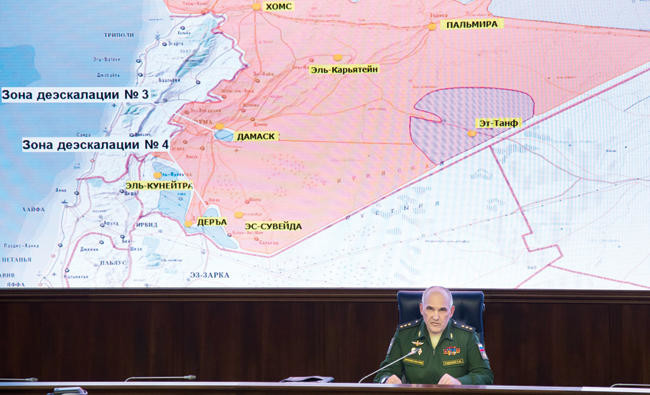
Meanwhile, the chief of the Russian general staff said on Monday that Moscow has deployed military police to monitor the cease-fire in a safe zone in the eastern suburbs of Damascus.
Russia has been providing air cover for Syrian President Bashar Assad’s offensive against Daesh since 2015 and previously deployed a military police force to patrol the city of Aleppo last year.
Russia, Iran, which supports Assad, and Turkey, which backs rebels fighting his forces, in May approved a plan to create four “de-escalation” zones in Syria, pressing Assad’s air force to halt flights over designated areas across the war-torn country.
Col. Gen. Sergei Rudskoi told a news conference Monday that Russia set up two checkpoints and four monitoring posts in one of the zones, in the area known as eastern Ghouta. The Russian Defense Ministry last week said that the Assad regime and the opposition reached an agreement on the boundaries of the zone, several days after bombardment and airstrikes in the area.


![]()
Al-Qaeda-linked group cements control of Syria’s Idlib
Al-Qaeda-linked group cements control of Syria’s Idlib
Latest updates


Recommended


© 2026 SAUDI RESEARCH & PUBLISHING COMPANY, All Rights Reserved And subject to Terms of Use Agreement.