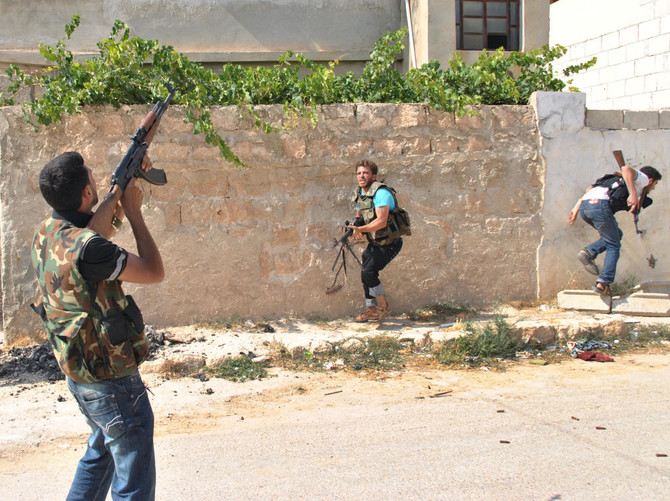
BEIRUT: Syrian government warplanes carried out several air strikes in the Eastern Ghouta area east of Damascus on Sunday, a day after the Syrian military declared a cessation of hostilities in the area, the Syrian Observatory for Human Rights said.
The British-based monitoring group said Saturday had been relatively calm after the ceasefire took effect with isolated incidents of shellfire.
On Sunday, six air strikes hit the towns of Douma and Ain Terma in rebel-held Eastern Ghouta, it reported.
There was no immediate comment from the government or army.
Syria's military declared a "cessation of fighting activities" starting at noon on Saturday in besieged Eastern Ghouta, which has long been controlled by the opposition.
One rebel group in Eastern Ghouta quickly welcomed the ceasefire.
A separate statement from Cairo-based political opposition movement Al-Ghad, headed by Ahmad Jarba, said the agreement had been reached in Cairo, sponsored by Egypt and Russia and with the involvement of mainstream rebel groups.
There was to be a full ceasefire in Eastern Ghouta, no government forces would enter the area and aid would be allowed in, it said.
Numerous attempts at a lasting ceasefire in western Syria, where rebels have lost ground to government forces and their allies over the last year, have often collapsed with both sides trading the blame.
The United States, Russia and Jordan reached a ceasefire and "de-escalation agreement" for southwestern Syria this month, which has reduced violence. That agreement did not include Eastern Ghouta.

Syrian warplanes strike near Damascus despite cease-fire — Syrian Observatory
Egypt receives €1bn from EU as reward for economic reforms progress
- Payment is the 2nd installment of a €5bn macro-financial assistance loan package agreed in 2024
- European Commission President Ursula von der Leyen says it reflects Cairo’s efforts to build a stronger economy
LONDON: Egypt received €1 billion ($1.16 billion) from the EU on Thursday. The payment, designed to help boost the country’s financial stability, is part of a €5 billion macro-financial assistance package agreed in 2024.
The transfer was made after Egypt implemented a range of economic reforms, including improvements to public financial management and the foreign exchange market, the European Commission said.
The money is intended to help Egypt cover part of its financing needs, ensure economic stability, and support the country's economic reform agenda.
The €5 billion in macro-financial assistance, part of a broader €7.4 billion package, comes in the form of concessional loans that Egypt will have 35 years to repay. Thursday’s payment was the second, after an initial €1 billion was disbursed in December 2024. The remaining €3 billion is expected to be paid in two further installments this year.
Rania Al-Mashat, Egypt’s minister of planning, economic development and international cooperation, said the funding reflected the depth of Egyptian-European relations.
The financing package is directly linked to Egypt’s program of reforms designed to unlock the country’s economic potential, she added.
European Commission President Ursula von der Leyen said the latest payment “shows both the EU’s commitment to this partnership and Egypt’s efforts to build a stronger and greener economy.”
The commission said Egypt had fulfilled all the required conditions for the disbursement of funds, including that it remains on track with the requirements of an International Monetary Fund program. The IMF last month said it had reached an agreement with Egypt for reviews of that program, which could unlock about $2.5 billion.
Egypt secured an expanded $8 billion IMF package in March 2024, contingent on the country carrying out economic reforms.
The Egyptian economy has stabilized following a financial crisis in 2023 and 2024 that led to the devaluation of the Egyptian pound, a severe shortage of foreign exchange, and record-high inflation.