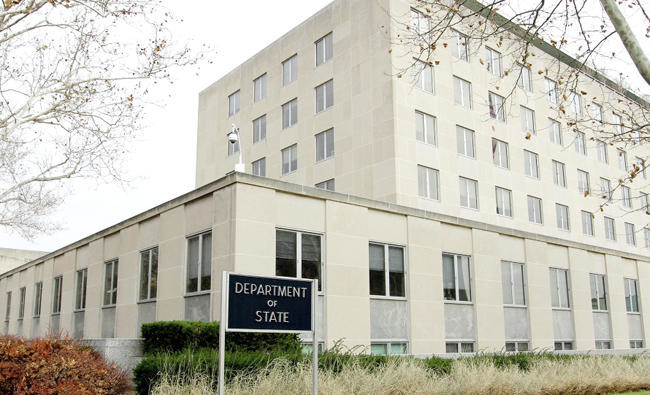
JEDDAH: The US State Department’s annual report on terrorism for 2016, released on Thursday, praises Saudi counterterrorism efforts.
“Saudi Arabia continued to maintain a strong counterterrorism relationship with the US and supported enhanced bilateral cooperation to ensure the safety of both US and Saudi citizens within Saudi territories and abroad,” the report said.
“Saudi Arabia remained a key member and active participant in the Global Coalition to Defeat Daesh, as evidenced by its co-leading the Counter-Daesh Coalition’s Counter-Finance Working Group (CIFG) alongside the US and Italy. The Saudi government condemned Daesh’s activities and participated in coalition military action to defeat the group in Syria and Iraq,” the report added.
“The Saudi Arabian government continued to build and reinforce its capacity to counter terrorism and violent extremist ideologies... Saudi Arabia maintained a high counterterrorism operational tempo, made a number of highly publicized arrests of terrorist suspects, and disrupted active terrorist cells across the Kingdom.”
Saudi Arabia “expanded existing counterterrorism programs and rhetoric to address the phenomenon of returning foreign terrorist fighters; and leveraged terrorist finance provisions of its Law for Crimes of Terrorism and Terrorist Financing (CT Law) and Royal Decree A/44 to counter the funding of violent extremist groups in Iraq, Syria, Lebanon, and elsewhere. The government also launched several new countering violent extremism (CVE) initiatives.”

US State Department praises Saudi counterterrorism efforts
Red Sea Global unveils scientific model for regenerative tourism worldwide
- The report details the model’s rollout at “The Red Sea” and “AMAALA” destinations, backed by studies covering 8 marine habitats
TABUK: Red Sea Global (RSG) has unveiled a science-based model aimed at achieving a 30 percent net positive conservation benefit across its tourism destinations by 2040.
The framework is now available for global adoption, according to a statement released by RSG.
Owned by Saudi Arabia’s Public Investment Fund (PIF), Red Sea Global is the multi-project developer behind ambitious regenerative tourism destinations like “The Red Sea” and “AMAALA.”
As a cornerstone of the Kingdom’s Vision 2030, the company aims to diversify the national economy while setting new global benchmarks for sustainable, nature-positive development.
CEO John Pagano stated that openly sharing this detailed approach will help elevate the global tourism sector and secure a healthier environment for future generations.
The cornerstone of this initiative is the proprietary SIIG Model, a four-step framework:
• Survey: Establish biodiversity baselines and monitor long-term changes.
• Identify: Assess risks to priority habitats and species.
• Intervene: Execute evidence-based actions, such as regulating fishing and enhancing natural habitats.
• Gain: Measure and verify biodiversity improvements.
The report details the model’s rollout at “The Red Sea” and “AMAALA” destinations, backed by extensive 2022–2023 environmental baseline studies covering eight marine habitats and priority species groups during 2022 and 2023.

A major intervention is the 5,015-square-kilometer Fishery Management Area in Al-Wajh Lagoon. The plan reserves 38 percent of the area for priority conservation—protecting 62 percent of local coral reefs—while allocating 61 percent for sustainable fishing.
According to scientific modeling, eliminating fishing in high-protection zones could increase reef fish populations by 113 percent, sharks and rays by 72 percent, and marine mammals by 24 percent. These measures are expected to boost coral resilience, support ecosystem recovery, and protect vulnerable species like sea turtles and seabirds.
Ihab Kindi, RSG’s Red Sea Destination Executive Director, called the data-driven model a practical roadmap for large-scale marine recovery. The complete methodology is available in the new report, “The SIIG Model: A Roadmap Toward Achieving Measurable Conservation Gains.”