Barclays, former execs to face 2019 trial in Qatar fundraising case

Last month, the Serious Fraud Office (SFO) said that it was accusing the men, and the Barclays holding company, of conspiracy to commit fraud. (Reuters)
Updated 18 July 2017
Follow

Barclays, former execs to face 2019 trial in Qatar fundraising case

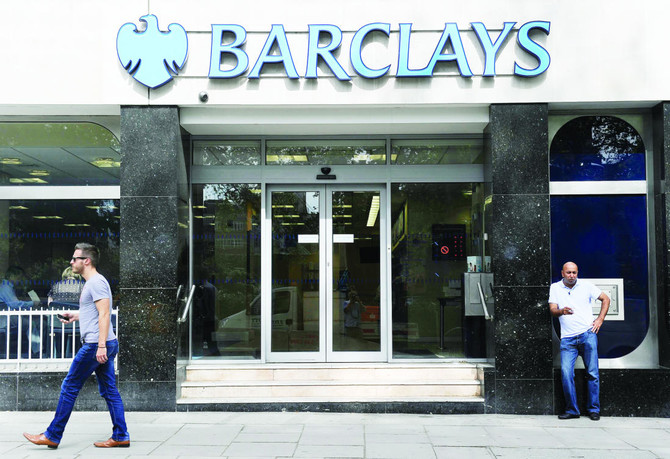
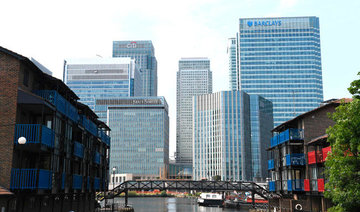
LONDON: Four former senior executives of Barclays, the British banking group, will stand trial for conspiring to commit fraud over the 2008 fundraising that brought in Qatar institutions as shareholders, a hearing in London decided on Monday.
A judge at Southwark Crown Court in the UK capital set a date in January 2019 for the trial, which will be the first time any British bank executives have been held responsible for alleged crimes committed during the global financial crisis. The trial is expected to last 16 weeks.
Last month, the Serious Fraud Office (SFO), the British investigating body responsible for prosecuting large-scale financial crimes, said that it was accusing the men, and the Barclays holding company, for conspiracy to commit fraud.
Former Barclays Chief Executive Officer John Varley, Roger Jenkins, former head of Middle East business, Thomas Kalaris, former head of wealth and investment management, and Richard Boath, former head of European financial institutions were charged with fraud conspiracy for their part in fundraisings that brought in a total £12 billion ($15.7 billion) from Qatari and other financial institutions.
Qatar put up most of the cash injections in 2008 at £6.3 billion, and is still a big holder of the group’s shares, with 6 percent of the total.
Varley and Jenkins, and the Barclays holding company, were also charged with providing unlawful financial assistance to Qatari institutions. The bank holding company paid Qatari investors £322 million in fees and provided a $3 billion loan facility at the same time.
Barclays wanted the cash to save it from having to take money from the British government, which would have involved a loss of independence and controls over its ability to pay big bonuses to its executives.
At an earlier hearing, the four men indicated that they would be pleading not guilty to the charges. Barclays said it was reserving judgment on how to plead in the case.
There has been speculation that the SFO might also charge the operating company, Barclays Bank, with charges relating to the events in 2008.
There have been no charges against the two Qatari institutions which bought the Barclays shares: The sovereign wealth fund Qatar Holding and Challenger Universal, a special-purpose vehicle set up to hold investments on behalf of Sheikh Hamad Bin Jassim bin Jabr Al-Thani, then-prime minister of Qatar and his family.


Arab food and beverage sector draws $22bn in foreign investment over 2 decades: Dhaman 

Updated 28 December 2025
Follow

Arab food and beverage sector draws $22bn in foreign investment over 2 decades: Dhaman 

JEDDAH: Foreign investors committed about $22 billion to the Arab region’s food and beverage sector over the past two decades, backing 516 projects that generated roughly 93,000 jobs, according to a new sectoral report. 

In its third food and beverage industry study for 2025, the Arab Investment and Export Credit Guarantee Corp., known as Dhaman, said the bulk of investment flowed to a handful of markets. Egypt, Saudi Arabia, the UAE, Morocco and Qatar attracted 421 projects — about 82 percent of the total — with capital expenditure exceeding $17 billion, or nearly four-fifths of overall investment. 

Projects in those five countries accounted for around 71,000 jobs, representing 76 percent of total employment created by foreign direct investment in the sector over the 2003–2024 period, the report said, according to figures carried by the Kuwait News Agency. 

“The US has been the region's top food and beverage investor over the past 22 years with 74 projects or 14 projects of the total, and Capex of approximately $4 billion or 18 percent of the total, creating more than 14,000 jobs,” KUNA reported. 

Investment was also concentrated among a small group of multinational players. The sector’s top 10 foreign investors accounted for roughly 15 percent of projects, 32 percent of capital expenditure and 29 percent of newly created jobs.  

Swiss food group Nestlé led in project count with 14 initiatives, while Ukrainian agribusiness firm NIBULON topped capital spending and job creation, investing $2 billion and generating around 6,000 jobs. 

At the inter-Arab investment level, the report noted that 12 Arab countries invested in 108 projects, accounting for about 21 percent of total FDI projects in the sector over the past 22 years. These initiatives, carried out by 65 companies, involved $6.5 billion in capital expenditure, representing 30 percent of total FDI, and generated nearly 28,000 jobs. 

The UAE led inter-Arab investments, accounting for 45 percent of total projects and 58 percent of total capital expenditure, the report added, according to KUNA. 

The report also noted that the UAE, Saudi Arabia, Egypt, and Qatar topped the Arab ranking as the most attractive countries for investment in the sector in 2024, followed by Oman, Bahrain, Algeria, Morocco, and Kuwait. 

Looking ahead, Dhaman expects consumer demand to continue rising. Food and non-alcoholic beverage sales across 16 Arab countries are projected to increase 8.6 percent to more than $430 billion by the end of 2025, equivalent to 4.2 percent of global sales, before exceeding $560 billion by 2029. 

Sales are expected to remain highly concentrated geographically, with Egypt, Saudi Arabia, Algeria, the UAE and Iraq accounting for about 77 percent of the regional total. By product category, meat and poultry are forecast to lead with sales of about $106 billion, followed by cereals, pasta and baked goods at roughly $63 billion. 

Average annual per capita spending on food and non-alcoholic beverages in the region is projected to rise 7.2 percent to more than $1,845 by the end of 2025, approaching the global average, and to reach about $2,255 by 2029. Household spending on these products is expected to represent 25.8 percent of total expenditure in 13 Arab countries, above the global average of 24.2 percent. 

Arab external trade in food and beverages grew more than 15 percent in 2024 to $195 billion, with exports rising 18 percent to $56 billion and imports increasing 14 percent to $139 billion. Brazil was the largest foreign supplier to the region, exporting $16.5 billion worth of products, while Saudi Arabia ranked as the top Arab exporter at $6.6 billion.