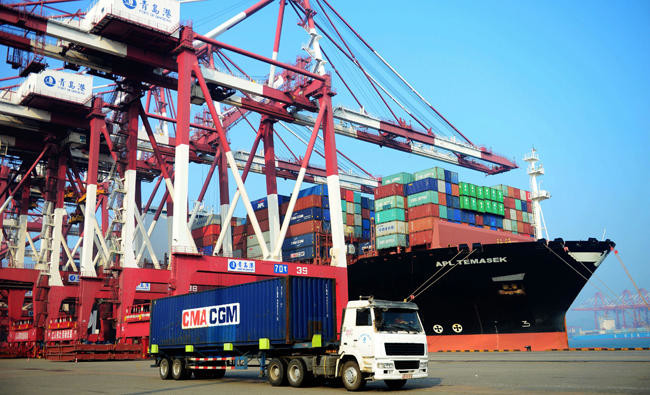
SHANGHAI/BEIJING: Bilateral talks aimed at reducing the US trade deficit with China have yielded some initial deals, but US firms say much more needs to be done as a deadline for a 100-day action plan expired on Sunday.
The negotiations, which began in April, have reopened China’s market to US beef after 14 years and prompted Chinese pledges to buy US liquefied natural gas (LNG). American firms have also been given access to some parts of China’s financial services sector.
More details on the 100-day plan are expected to be announced in the coming week as senior US and Chinese officials gather in Washington for annual bilateral economic talks, rebranded this year as the “US-China Comprehensive Economic Dialogue.”
“We hope to report further progress on the 100-day deliverables next week,” a US Commerce Department spokesman said on Saturday. “That will be the basis for judging the extent of progress.”
The spokesman declined to discuss potential areas for new agreements since a May 11 announcement on beef, chicken, financial services and LNG.
Earlier in April, when Chinese President Xi Jinping met US President Donald Trump for the first time at his Florida resort, Xi agreed to a 100-day plan for trade talks aimed at boosting US exports and trimming the US trade deficit with China.
The US goods trade deficit with China reached $347 billion last year. The gap in the first five months of 2017 widened about 5.3 percent from a year earlier, according to US Census Bureau data.
“It is an excellent momentum builder, but much more needs to be done for US-China commercial negotiations to be considered a success,” said Jacob Parker, vice president of China operations at the US-China Business Council (USCBC) in Beijing.
There has been little sign of progress in soothing the biggest trade irritants, such as the US demands that China cut excess capacity in steel and aluminum production, lack of access for US firms to China’s services market, and US national security curbs on high-tech exports to China.
The Trump administration is considering broad tariffs or quotas on steel and aluminum on national security grounds, partly in response to what it views as a glut of Chinese production that is flooding international markets and driving down prices.
North Korea has cast a long shadow over the relationship, after Pyongyang tested what some experts have described as an intercontinental ballistic missile on July 4.
Trump has linked progress in trade to China’s ability to rein in North Korea, which counts on Beijing as its chief friend and ally.
“Trade between China and North Korea grew almost 40 percent in the first quarter. So much for China working with us — but we had to give it a try!” Trump said on Twitter after the North Korean missile test.
American beef is now available in Chinese shops for the first time since a 2003 US case of “mad cow” disease, giving US ranchers access to a rapidly growing market worth around $2.6 billion last year.
More beef deals were signed during an overseas buying mission by the Chinese last week.
“There are hopes there will be even more concrete results,” Chinese Foreign Ministry spokesman Geng Shuang told a daily news briefing in Beijing on Friday. He did not elaborate.
Critics of the 100-day process said China had already agreed to lift its ban on US beef last September, with officials just needing to finalize details on quarantine requirements.
China, meanwhile, has delivered its first batch of cooked chicken to US ports after years of negotiating for access to the market. But unlike the rush by Chinese consumers for the first taste of American beef, Chinese poultry processors have not had a flurry of orders for cooked chicken.
Demand should improve once China is allowed to ship Chinese grown, processed and cooked chicken to the US, said Li Wei, export manager at Qingdao Nine Alliance Group, China’s top exporter of processed poultry.
Other sectors in China under US pressure to open up have moved more slowly. US industry officials had signaled they were expecting more approvals. US executives say the review process still lacks transparency.
Financial services is another area where little progress has been made, US officials say.
USCBC’s Parker said it is unclear how long it will take for foreign credit rating agencies to be approved, or whether US-owned suppliers of electronic payment services will be able to secure licenses.
The bilateral talks have also not addressed restrictions on foreign investment in life insurance and securities trading, or “the many challenges foreign companies face in China’s cybersecurity enforcement environment,” Parker said.
In an annual report released Thursday, the American Chamber of Commerce in Shanghai said China remained a “difficult market.”

US-China trade talks sputtering at 100-day deadline
Building bridges: Saudi Arabia leads Gulf-Asia tech leap
ALKHOBAR: Saudi Arabia is forging new academic connections with Asia as the Kingdom’s Vision 2030 accelerates reforms in education and innovation.
Two academics — Prof. Eman AbuKhousa, a data science professor at the University of Europe for Applied Sciences in Dubai, and Prof. Hui Kai-Lung, acting dean of the HKUST Business School in Hong Kong —emphasize that the Kingdom’s transformation is reshaping the development of artificial intelligence and fintech talent across the region.
For AbuKhousa, responsible AI is not just about technology; it is fundamentally about intention. “It is about aligning technology with human values: ensuring fairness, transparency, and accountability in every system we build.”
She highlighted that the Middle East’s heritage of trust and ethics gives the region a competitive advantage. “Institutions should embed ethics and cultural context into AI education and create multidisciplinary labs where engineers collaborate with social scientists and ethicists,” she said.
At the University of Europe for Applied Sciences in Dubai, AbuKhousa trains students to question data, identify bias, and integrate integrity into innovation.
“Educators must model responsible use by explaining how data is sourced and decisions are made,” she explained. “Ultimately, responsible AI is less about algorithms than about intention; teaching future innovators to ask not only ‘Can we?’ but ‘Should we?’”
She further noted:“Saudi Arabia’s Vision 2030 has turned digital education into a national movement placing technology and innovation at the heart of human development.”
AbuKhousa emphasized the transformative opportunities for women in the Kingdom: “Today, Saudi female students are designing models, leading AI startups, and redefining what digital leadership looks like.”
Prof. Hui views this transformation through the lens of fintech. “Fintech is deeply embedded in Vision 2030, serving as a key enabler of its three pillars: a vibrant society, a thriving economy, and an ambitious nation,” he said.
Hui stressed that Saudi Arabia’s investment capacity and modern regulatory framework “create a conducive environment for innovation.” Having collaborated with Aramco, The Financial Academy, and Prince Mohammed Bin Salman College of Business and Entrepreneurship, he highlighted the strategic potential of the Kingdom’s young population. “The Kingdom has one of the youngest populations in the world, with a median age below 30,” he said.
Opinion
This section contains relevant reference points, placed in (Opinion field)
“This demographic presents a tremendous opportunity for higher education to shape future leaders, and our collaborations in Saudi Arabia are highly targeted to support this goal.”
AbuKhousa argued that universities must lead innovation rather than follow it. “Universities must evolve from teaching institutions into innovation ecosystems,” she said. “The real bridge between research and industry lies in applied collaboration: joint labs, shared data projects, and co-supervised capstones where students solve live industry challenges.”
“At UE Dubai, we’ve introduced an Honorary Senate of Business Leaders to strengthen that bridge, bringing decision-makers directly into the learning process,” she added.
DID YOU KNOW?
Vision 2030 has made digital education central to Saudi Arabia’s development strategy.
Women in Saudi Arabia are now designing AI models and leading startups.
Universities are transforming into innovation ecosystems bridging research and industry.
Cross-border collaborations with Hong Kong and Dubai are accelerating fintech and AI growth.
Hui noted that cross-border cooperation between Hong Kong and Saudi Arabia is growing rapidly. “Saudi Arabia’s scale, strategic location, and leadership in the Arab world offer Hong Kong an ideal partner,” he said. “Hong Kong’s academic and regulatory experience can help the Kingdom fast-track its digital transformation.”
He highlighted lessons from Hong Kong’s fintech journey. “Hong Kong’s fintech journey offers critical lessons for Saudi Arabia, particularly in creating a balanced ecosystem for innovation,” he said. “Education and regulation are both important. We need education at all levels and beyond schools to expose people to these ideas; having diverse and rich experiences also helps, as the education needs to be supplemented by real-life implementation and usage experience. That is what Hong Kong can offer.”

AbuKhousa emphasized that women’s participation in technology must extend beyond access to influence. “Empowering women in technology begins with reimagining representation: from inclusion to influence,” she said. “We need more women not only learning tech, but leading teams, designing systems, and shaping AI policy. Institutions must normalize women’s presence in decision-making spaces and provide visible mentorship networks to counter imposter syndrome.”
Both experts agreed that innovation must remain human-centered and accountable. “As AI becomes integral to financial systems, governments must strike a careful balance between innovation, data ethics, and compliance,” Hui said. “Establishing clear regulatory frameworks and transparency standards is crucial.”
AbuKhousa concurred, emphasizing the role of education in AI adoption: “Educators must position generative AI as a thinking partner, not a shortcut. The goal is to teach students how to use AI critically, not merely that they can.”
Hui predicts that “AI, blockchain, and cybersecurity will be transformative forces in the region’s financial sector.” AbuKhousa sees a similar momentum in education: “The Gulf is entering a defining phase where AI becomes the backbone of education and workforce development.”
The experts concluded that the Kingdom’s digital transformation, anchored in Vision 2030, is connecting classrooms, industries, and continents through human-centered innovation.