ECUADOR: After years of taking a backseat to Western style, indigenous fashion is re-emerging in Ecuador, thanks to a new generation of designers who are re-imagining traditional clothes.
“Make the turn snappy!” says Juana Chicaiza, who founded the modeling agency “Awkis y Nustas” — “Princes and Queens” in the Quechua language.
She is teaching her young charges how to best show off the “anaco,” a traditional Andean skirt, on the catwalks.
A former beauty queen with long dark hair, Chicaiza — a member of the Puruha indigenous group — was mocked at a pageant because of her traditional garb.
The experience inspired the 32-year-old to open her agency in 2013 and “strengthen the identity” of the Puruha on the runways, where models now sashay in outfits that mix “the Western and the ancestral.”
Latin American agencies generally seek models with hourglass figures and fine features, the designer told AFP.
“We’re not looking for that,” Chicaiza said. “We’re looking for women with character.”
In Ecuador, indigenous peoples make up 30 percent of the population of 16.5 million, according to organizations representing them.
But many inhabitants do not recognize themselves as such: official census records say the country’s indigenous population is just seven percent of the total.
Like Chicaiza, fashion designers are also working to help people renew their pride in their heritage.
Lucia Guillin and Franklin Janeta, who are also members of the Puruha ethnic group, have launched their own indigenous fashion labels — respectively, Churandy and Vispu.
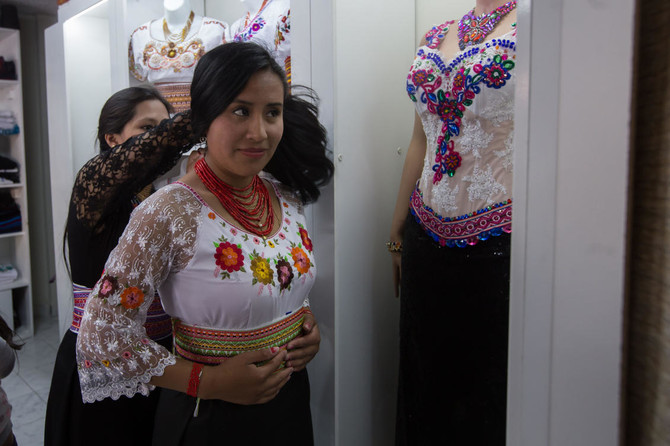
“Our Puruha clothes have disappeared and young people have started dressing in the Western style,” says Guillin, donning one of her own shoulder-baring creations.
Pieces from their lines, including tops and skirts embellished with hand-embroidered flowers, range in price from $150-800.
The most expensive items, often embellished with stones and embroidery, are aimed at brides and beauty queens.
The designers use traditional ornaments and symbols, like flowers or the sun, but are making updates more in line with contemporary styles, such as with more daring cuts.
“There were no low-cut necklines, no short sleeves,” Janeta said. “I asked myself, ‘What if we changed it?’ Because young girls like things a little more modern.”
Guillin, for her part, has succeeded in convincing women to wear the anaco skirt proudly once more by giving the garment a hint of edge, playing with styles including mermaid cuts, trains, flaring and side-slits, she said.
“We must put a stop to the idea that Indians are closed off,” she said. “If we continue with this, we also risk losing our culture.”
According to Janeta, who said he makes some $12,000 a month in sales, customers are beginning to understand the value of the handmade attire.
“We taught people how to distinguish different qualities,” he said. “Before it was difficult to sell a blouse for more than 60 dollars — not anymore. They’ll pay up to 400 dollars for a corset.”
This new generation of indigenous entrepreneurs also includes Esther Miranda, Jose Mullo and Jacqueline Tuquinga — who launched the perfume brand Yuyary (Memory, in Quechua) — designers who also see Westerners as potential target consumers.
“As it’s a brand in Quechua, people think it’s just for our communities,” Miranda said. “But we want to go beyond that.”


![]()
![]()
![]()

Ecuador designers reinvent indigenous style for modern age

Ecuador designers reinvent indigenous style for modern age
Latest updates


Recommended


© 2026 SAUDI RESEARCH & PUBLISHING COMPANY, All Rights Reserved And subject to Terms of Use Agreement.