Iraqi police parade car bombs seized from Daesh

1 / 5
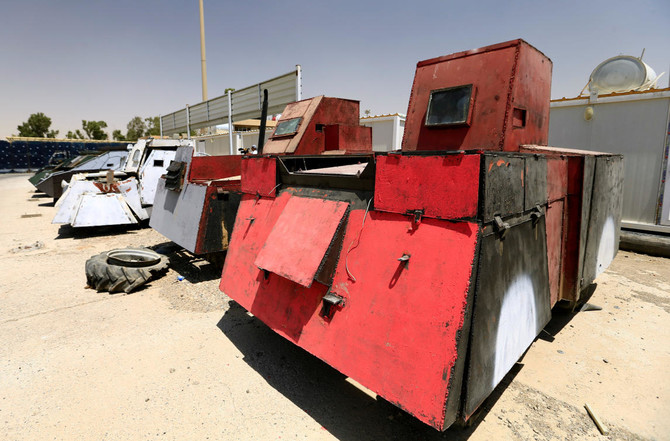
Vehicles used for suicide car bombings, made by Daesh militants, are seen at Federal Police Headquarters after being confiscated in Mosul, Iraq July 13, 2017. (REUTERS)
2 / 5
Vehicles used for suicide car bombings, made by Daesh militants, are seen at Federal Police Headquarters after being confiscated in Mosul, Iraq July 13, 2017. (REUTERS)
3 / 5
Vehicles used for suicide car bombings, made by Daesh militants, are seen at Federal Police Headquarters after being confiscated in Mosul, Iraq July 13, 2017. (REUTERS)
4 / 5
Vehicles used for suicide car bombings, made by Daesh militants, are seen at Federal Police Headquarters after being confiscated in Mosul, Iraq July 13, 2017. (REUTERS)
5 / 5
Vehicles used for suicide car bombings, made by Daesh militants, are seen at Federal Police Headquarters after being confiscated in Mosul, Iraq July 13, 2017. (REUTERS)
Updated 14 July 2017
Follow

Iraqi police parade car bombs seized from Daesh

MOSUL: Iraqi police displayed 23 vehicles that had been turned into car bombs and also an anti-aircraft gun, all captured from Daesh militants during the battle for the city of Mosul.
The vehicles shown to the media were mostly civilian cars, covered in thick metal armor, with small glass ports for a driver to see through, and had been equipped with bombs.
They appear similar to vehicles used in apparent suicide attacks shown in Islamic State propaganda.
Many had been painted in camouflage or blue, the color of Iraqi Federal Police vehicles, in a bid to fool surveillance aircraft into mistaking them for Iraqi forces’ vehicles.
“Heroes of the Emergency Rapid Division and the Federal Police seized these cars in successful night raids,” Iraqi Federal Police captain Bassam Hillo Kadhim said.
Most eye-catching among the vehicles was a tank turret, complete with its gun, mounted on the back of a large truck, which police officials said had been designed to target military aircraft and ground troops from a distance.
Iraqi forces plan to destroy the vehicles.
On Friday Iraqi forces were still facing pockets of resistance from Daesh in Mosul’s Old City, four days after the prime minister declared victory over the militants.


Hezbollah chief accuses Israel of ignoring ceasefire agreement

Updated 3 sec ago
Follow

Hezbollah chief accuses Israel of ignoring ceasefire agreement

  • Naim Qassem says moves to disarm his group in Lebanon are an 'Israeli-American plan'
  • Lebanese military is expected to complete Hezbollah’s disarmament south of Litani River as oart of ceasefire
BEIRUT: Hezbollah leader Naim Qassem on Sunday said moves to disarm the group in Lebanon are an “Israeli-American plan,” accusing Israel of failing to abide by a ceasefire agreement sealed last year.
Under heavy US pressure and fears of expanded Israeli strikes, the Lebanese military is expected to complete Hezbollah’s disarmament south of the Litani River — located about 30 kilometers (19 miles) from the border with Israel — by the end of the year.
It will then tackle disarming the Iran-backed movement in the rest of the country.
“Disarmament is an Israeli-American plan,” Qassem said.
“To demand exclusive arms control while Israel is committing aggression and America is imposing its will on Lebanon, stripping it of its power, means that you are not working in Lebanon’s interest, but rather in the interest of what Israel wants.”
Despite a November 2024 ceasefire that was supposed to end more than a year of hostilities between Israel and the Iran-backed Hezbollah group, Israel has kept up strikes on Lebanon and has maintained troops in five areas it deems strategic.
According to the agreement, Hezbollah was required to pull its forces north of the Litani River and have its military infrastructure in the vacated area dismantled.
Israel has questioned the Lebanese military’s effectiveness and has accused Hezbollah of rearming, while the group itself has rejected calls to surrender its weapons.
“The deployment of the Lebanese army south of the Litani River was required only if Israel had adhered to its commitments... to halting the aggression, withdrawing, releasing prisoners, and having reconstruction commence,” Qassem said in a televised address.
“With the Israeli enemy not implementing any of the steps of the agreement... Lebanon is no longer required to take any action on any level before the Israelis commit to what they are obligated to do.”
Lebanese army chief Rodolphe Haykal told a military meeting on Tuesday “the army is in the process of finishing the first phase of its plan.”
He said the army is carefully planning “for the subsequent phases” of disarmament.