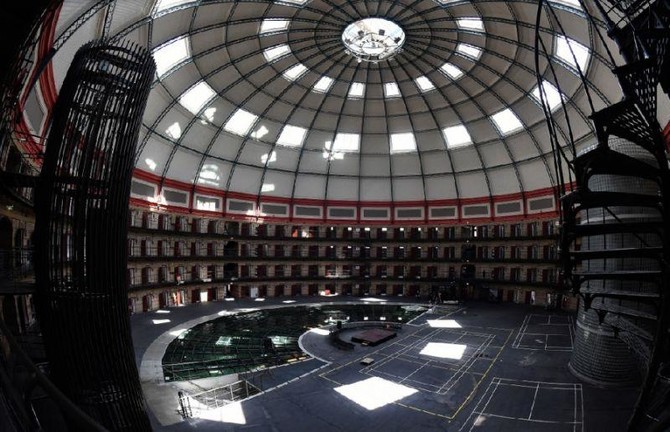
NETHERLANDS: Voices echo around the magnificent, luminous dome of Breda prison, breaking the silence of the 130-year-old building, now empty of inmates like dozens of others in The Netherlands.
Falling crime rates over the last decade, as well as changing ideas about punishing criminals have robbed this penitentiary of its original purpose, and its gates clanged shut in 2014.
Built in 1886, it was possible to watch everything happening in the prison from its central courtyard under the main dome — a classic example of the 18th century social theory of Panopticism on passive behavior when people are constantly observed, first mooted by the English philosopher Jeremy Bentham and later built upon by his French counterpart Michel Foucault.
Metal spiral staircases snake all around the dome down to the former canteen under the glass floor. Old sports areas are marked out on concrete, all are surrounded by cells stacked four storys high, their now-rusted doors swinging open.
Unlike the previous occupants, some 90 businesses hold the keys to the building, free to come and go at will.
Miguel de Waard, co-founder of the 3D Red Panda VR start-up, is among those who believe they have found a perfect office location, helping give new life to a protected national monument.
“We just instantly fell in love with this particular office: the high ceiling, the nice touches and the big windows and the lighting,” de Waard told AFP.
“We don’t see bars, I think, when we look outside, we just see a beautiful part of Breda.”
But he acknowledged the past has cast long shadows. “Every time we enter the dome or the women’s prison, it’s pretty dark, that’s true. And there’s a lot of history and sometimes you can feel it as well,” he said.
“The first time we were here and we had the keys, we were, like, wandering around at night in the dark and it’s a pretty amazing experience.”
There are now only 38 prisons still in operation in The Netherlands, with 27 closed since 2014.
Six were sold for about 20.7 million euros ($23 million), while others have been rented out, often as centers for asylum seekers, bringing in a total of around 18 million euros.
After leaping crime rates swelled Europe’s prison population in the 1990s, numbers in The Netherlands have dropped thanks, in part, to prevention programs and a greater focus on re-integration.
“Judges are sentencing people in different ways. Not more lightly, but differently, with community service, or ankle bracelets” and rehabilitation clinics, said Anneloes van Boxtel, who administers the interior ministry’s real estate.
Crimes fell some 26 percent between 2007 and 2015, according to the official Central Statistics Bureau.
In a decade, the number of people imprisoned every year in The Netherlands fell from 50,650 in 2005 to 37,790 in 2015. And the rate of incarceration stands at 57 prisoners per 100,000 residents, compared with 458 in the United States.
So the Dutch have sought to put their empty cells to good use.
A detention center in northern Veenhuizen has been rented out — guards included — to Norway to house its own inmates. A former women’s jail in northeastern Zwolle is now an award-winning restaurant.
With a 60-million-euro price tag, a penitentiary in Amsterdam Overamstel is to be transformed into a new residential district with thousands of homes. And a center in Haarlem, bought by the local municipality for 6.4 million euros, will open its doors in 2019 as a university college.
In Breda, the prison and its 33,302 square meters (358,330 square feet) of space was handed over to a special body in 2016 to be re-used for “social” projects.
“That was our biggest challenge: to open the prison again,” said Mandy Jak, communications and marketing adviser for the VPS association.
But interest has been huge, with some 300 people swiftly signing up to move in.
“It actually feels like not a prison any more. If you look around, it looks like a prison of course, but with all those start-ups, it’s got new energy,” she added.
However, one summer evening new “inmates” were spotted, as about 350 people were once again locked in, taking part in perhaps the ultimate “Prison Escape” adult adventure game that have become popular in many countries. Barricaded into the cells, participants have to plot an escape over three hours with the help of some 80 actors.
But once rid of these thrill-seekers, the building again sank into silence. Until the next business day.


![]()
Life behind bars gets new twist in empty Dutch prisons
Life behind bars gets new twist in empty Dutch prisons
Latest updates


© 2026 SAUDI RESEARCH & PUBLISHING COMPANY, All Rights Reserved And subject to Terms of Use Agreement.