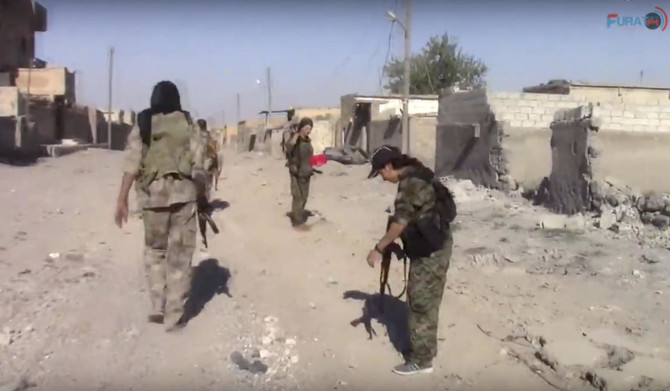
BEIRUT: A month into the battle to capture the Daesh group’s self-styled capital, U.S-backed Syrian forces have encircled the militants inside Raqqa, breached their fortified defenses and inched closer to the heart of the city. Yet the battle has barely begun.
More than 2,000 militants are holed up with their families and tens of thousands of civilians in Raqqa’s center, the city’s most densely populated quarters.
Although a fraction the size of Iraq’s Mosul, Raqqa’s urban warfare may prove as grueling, and those fighting the extremists risk being dragged into side battles with other groups in Syria’s complex civil war.
In Raqqa’s case, the Syrian Kurdish militia that is the main US ally against Daesh has been rattled by Turkey’s mobilization on the other side of the country. Turkey is threatening to launch an offensive against a Kurdish enclave in western Syria with the help of Syrian opposition fighters. Turkish troops have mobilized near the border, and the recent Turkish shelling of Kurdish villages killed at least three civilians.
Kurdish officials warned that Turkey’s moves threaten to derail the Raqqa campaign by forcing the Kurdish militia to redeploy to defend its enclave.
Syria observers also point to the lack of capabilities and training of the U.S-backed Syrian fighters, known as the Syrian Democratic Forces, compared to the Iraqi troops battling Daesh militants in Mosul and the surrounding Nineveh province since August.
“So (Mosul) is actually a yearlong campaign. I don’t think Raqqa will take that long, but it will take time,” US special envoy Brett McGurk told the Dubai-based Al-Aan TV during a visit to the Raqqa front last month. He refused to specify a timeline.
Another issue is who will run Raqqa once the militants are driven out. The area’s Arab population is likely to oppose any control by the Kurds, who are the dominant faction of the SDF. The US-led coalition has said a local council formed by the SDF will govern.
Meanwhile, the Syrian government has vowed it will rule Raqqa, and its forces nearby could try to take advantage of the shifting situation and step in.
The coalition last week estimated some 2,500 militants remain in Raqqa. Senior members and foreigners are believed to have evacuated, and most of those who remain are believed to be Syrian fighters and tactical commanders.
They have used many of the same tactics as in Mosul, showing a similar level of organization and discipline. They deploy suicide car bombs and armed drones against advancing fighters and launch street battles in the dead of night. They carry out surprise counter-attacks in areas already recaptured by the SDF.
“This defense is designed to draw out the fight and drive up the cost for the coalition and the local population,” said Jennifer Cafarella, a Syria expert at the Institute of War Study.
Last year’s battle for the northern town of Manbij, which is half the size of Raqqa but was an important transit hub for Daesh, lasted over two months and ended with the militants retreating with hundreds of civilians as hostages.
In this case, the militants so far appear determined to fight to the end. If that’s the case, the SDF will have to “exterminate everyone before seizing control of Raqqa,” said Rami Abdurrahman, head of the Syrian Observatory for Human Rights.
Assad’s ally Russia has also made clear it opposes giving the Raqqa militants any exit corridor because they would then head to Deir el-Zour, where the Syrian government is waging its own campaign against Daesh, Abdurrahman said.
Since June 6, SDF fighters have waged assaults on Raqqa from the east, west and north, seizing around 20 percent of its districts. Last week, they moved across the Euphrates River, which defines Raqqa’s southern side, completing the encirclement. From there they punched into the Old City in the center.
But it remains to be seen which side is more overstretched by fighting on four fronts. The militants at one point counter-attacked, seizing parts of one eastern district, Al-Sinaa, and it took the SDF days to wrest it back.
SDF fighters face belts of improvised explosives around the city, said Col. Joseph Scrocca, a coalition spokesman.
As they try to get through the bomb-laden streets, the militants hit them with heavy machine guns, rocket-propelled grenades, explosive-laden drones and snipers, he said. “There is still a lot of hard fighting to go.”
An estimated 50,000 to 100,000 civilians are believed to still be in Raqqa, caught in the crossfire.
The Observatory reported 224 civilians have been killed by airstrikes, including 38 children, 28 women and one of its own activists. Fighting and airstrikes also killed 311 Daesh militants, while the SDF lost 106 fighters, the Observatory reported.
Abdalaziz Alhamza, a founding member of the group Raqqa is Being Slaughtered Silently, which has monitored events in the city since the Daesh takeover in January 2014, said SDF forces don’t advance without a blanket of airstrikes that have kept the civilians locked up in their homes with shrinking supplies of water and food.
Alhamza’s uncle was killed last week while getting water from a well in a school nearby. Alhamza said when the first airstrike hit, the uncle rushed to help children taking refuge in the school, then a second strike killed him. He had to be buried in the school because his family couldn’t reach his body, Alhamza said, speaking from New York.
His group documented 27 people killed while fetching water at the river in the past month. Drinking river water has also spread water-borne diseases and a fear of cholera, he said.
At the same time, Daesh has continued arrests and executions of residents accused of collaborating with the coalition or violating the group’s extreme interpretation of Islamic laws. One woman was stabbed in the heart with a knife for an undetermined violation, and some were crucified for not fasting during Islam’s holy month of Ramadan, he said.


![]()
A fraction of Mosul, Syria’s Raqqa no less challenging
A fraction of Mosul, Syria’s Raqqa no less challenging
Latest updates


© 2026 SAUDI RESEARCH & PUBLISHING COMPANY, All Rights Reserved And subject to Terms of Use Agreement.