Ghana eyes surfing to boost tourism numbers

1 / 2
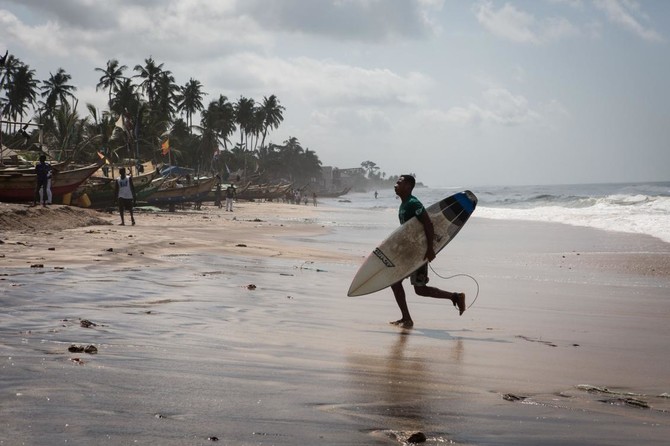
Emmanuel Ansah (Bebe) finishes his semi final set during the international surf day competition on Kokrobite Beach, Ghana on June 18, 2017. The beach, some 30 kilometres (20 miles) west of central Accra, was dotted with dug-out fishing boats, Rastafarians selling t-shirts and small children playing in the sand. According to the World Bank, 897,000 international tourists visited Ghana in 2015. In comparison, just over 1.1 million went to Kenya and 8.9 million travelled to South Africa. (AFP)
2 / 2
Surfers finish their semi-final set, during the annual international surf day competition on Kokrobite Beach, Ghana, on June 18, 2017. The beach, some 30 kilometres (20 miles) west of central Accra, was dotted with dug-out fishing boats, Rastafarians selling t-shirts and small children playing in the sand. According to the World Bank, 897,000 international tourists visited Ghana in 2015. In comparison, just over 1.1 million went to Kenya and 8.9 million travelled to South Africa. (AFP)
Updated 09 July 2017
Follow

Ghana eyes surfing to boost tourism numbers

Kokrobite, Ghana: Brett Davies paced up and down the sloping sands of Kokrobite beach in Ghana, organizing surfers from 20 different countries at his annual international competition.
Along the beach, some 30 kilometers (20 miles) west of Accra, dotted with dug-out fishing boats, Rastafarians were selling T-shirts and small children were playing in the sand.
Davies, 42, is leading the push to bring surfers to the West African nation as a way to help boost the country’s under-developed tourism sector.
The British national already runs a surf school at Kokrobite and has helped to bring surfing to Busua, near the border with Ivory Coast.
“The greatest thing about surfing in Ghana is that we have uncrowded world-class waves that appeal to the beginner and intermediate market,” he told AFP.
“Most well-known destinations are very localized and very intimidating to the average surfer.”
At the competition, which was held last month, local reggae boomed from the speakers stacked in the corner of a car-park.
In the water, Emmanuel Ansah cut across the breaks, deftly manoeuvring his board, trying to catch the eye of the judges sitting on a wooden platform, looking out to sea.
The 19-year-old from Busua started surfing five years ago and described his first time on the waves as “like having a new girlfriend.”
“I was so happy,” he said. Now he, too, wants to see Ghana become a surfing destination in its own right — and one day represent the West African nation at overseas competitions.


According to the World Bank, 897,000 international tourists visited Ghana in 2015. In comparison, just over 1.1 million went to Kenya and 8.9 million traveled to South Africa.
But the World Travel and Tourism Council (WTTC) estimates numbers for Ghana could jump to nearly 1.3 million this year and more than 2.0 million by 2027.
In the last few years travel and tourism have directly contributed $1.3 billion to Ghana’s economy — the equivalent of about 3.0 percent of gross domestic product.
Tourism generally focuses on natural attractions like waterfalls and national parks, historic slave forts and cultural activities.
But with some 550 kilometers of unspoiled coastline, watersports on the Atlantic Ocean, off the palm tree-lined golden sands, are being seen as a major draw.
“Surfing has a huge potential,” said Ghana tourism specialist Gilbert Abeiku Aggrey. “We have not developed our beaches.
“We have not done anything, it’s a raw opportunity for anyone who wants to come.”
Attracting surfers is seen as a good way to bring in middle-income earners to Ghana, plugging a growing gap between budget travelers, volunteers and those on business.
“The gap between the low end and the high end is very huge, it’s an untapped market,” said Aggrey.
“It is because people aim at making profit so they hike the price or rate looking for the high-end travelers.”


The high cost of flights and accommodation in Ghana has been blamed for deterring tourists.
A stay at a standard three-star hotel in the capital can set travelers back $100 (88 euros) a night, while flights even within West Africa can be eye-wateringly expensive.
The head of the Ghana Tourism Authority, Kwesi Agyemang, said there are plans to start targeting different interest groups and improve regulation.
The authority’s work includes targeting other countries for visitors.
The government’s National Tourism Development Plan in 2012 noted there were “completely virgin” beaches in Ghana’s Western Region because of lack of access.
They showed “great potential for development,” it added.
Ghana’s new government, in power since January this year, has put a fresh emphasis on tourism and wants to develop Accra’s under-developed and impoverished beach front.
The Marine Drive Tourism Investment Project aims to develop nearly 100 hectares (250 acres) of the shoreline with hotels, shopping malls, theme parks, an office and casino.
In the 2017 budget, Ghana’s finance minister Ken Ofori-Atta said tourism could help address soaring levels of debt and high unemployment.
Ghana, once celebrated for its rapidly growing economy, saw rates of growth slow to some 3.6 percent in 2016 — the lowest in two decades and well down on 14 percent in 2011.
Davies accepted that government help was needed but, whatever happens, he will be encouraging people to ride the waves.
“Ghana is just about to explode due to surfing tourism and it’s very exciting times for surfing in Ghana,” he added.


ICE agents can’t make warrantless arrests in Oregon unless there’s a risk of escape, US judge rules

Updated 2 sec ago
Follow

ICE agents can’t make warrantless arrests in Oregon unless there’s a risk of escape, US judge rules

  • US District Judge Mustafa Kasubhai issued a preliminary injunction in a proposed class-action lawsuit
  • Case targets Department of Homeland Security’s practice of arresting immigrants they happen to come across
PORTLAND, Oregon: US immigration agents in Oregon must stop arresting people without warrants unless there’s a likelihood of escape, a federal judge ruled Wednesday.
US District Judge Mustafa Kasubhai issued a preliminary injunction in a proposed class-action lawsuit targeting the Department of Homeland Security’s practice of arresting immigrants they happen to come across while conducting ramped-up enforcement operations — which critics have described as “arrest first, justify later.”
The department, which is named as a defendant in the suit, did not immediately comment in response to a request from The Associated Press.
Similar actions, including immigration agents entering private property without a warrant issued by a court, have drawn concern from civil rights groups across the country amid President Donald Trump’s mass deportation efforts.
Courts in Colorado and Washington, D.C., have issued rulings like Kasubhai’s, and the government has appealed them.
In a memo last week, Todd Lyons, the acting head of US Immigration and Customs Enforcement, emphasized that agents should not make an arrest without an administrative arrest warrant issued by a supervisor unless they develop probable cause to believe that the person is in the US illegally and likely to escape from the scene before a warrant can be obtained.
But the judge heard evidence that agents in Oregon have arrested people in immigration sweeps without such warrants or determining escape was likely.
The daylong hearing included testimony from one plaintiff, Victor Cruz Gamez, a 56-year-old grandfather who has been in the US since 1999. He told the court he was arrested and held in an immigration detention facility for three weeks even though he has a valid work permit and a pending visa application.
Cruz Gamez testified that he was driving home from work in October when he was pulled over by immigration agents. Despite showing his driver’s license and work permit, he was detained and taken to the ICE building in Portland before being sent to an immigration detention center in Tacoma, Washington. After three weeks there, he was set to be deported until a lawyer secured his release, he said.
He teared up as he recounted how the arrest impacted his family, especially his wife. Once he was home they did not open the door for three weeks out of fear and one of his grandchildren did not want to go to school, he said through a Spanish interpreter.
Afterward a lawyer for the federal government told Cruz Gamez he was sorry about what he went through and the effect it had on them.
Kasubhai said the actions of agents in Oregon — including drawing guns on people while detaining them for civil immigration violations — have been “violent and brutal,” and he was concerned about the administration denying due process to those swept up in immigration raids.
“Due process calls for those who have great power to exercise great restraint,” he said. “That is the bedrock of a democratic republic founded on this great constitution. I think we’re losing that.”
The lawsuit was brought by the nonprofit law firm Innovation Law Lab, whose executive director, Stephen Manning, said he was confident the case will be a “catalyst for change here in Oregon.”
“That is fundamentally what this case is about: asking the government to follow the law,” he said during the hearing.
The preliminary injunction will remain in effect while the lawsuit proceeds.