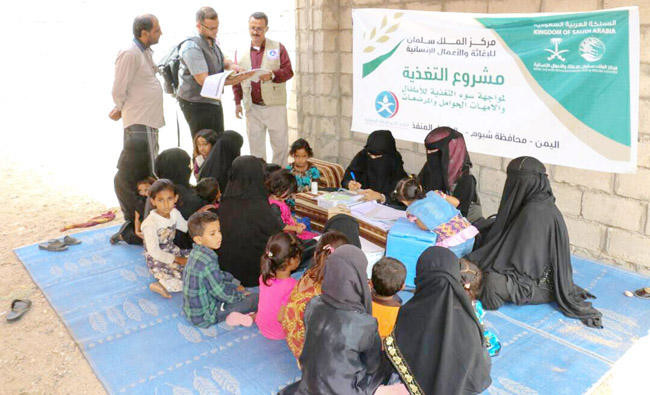
JEDDAH: A team from the King Salman Center for Relief and Humanitarian Aid (KSRelief) has visited Nasab in Yemen’s Shabwa governorate to inspect progress made in the project to confront malnutrition.
The number of children under 5 years of age diagnosed with malnutrition in the targeted health facilities in Shabwa is 1,941, and the number of children under 5 years treated for acute malnutrition is 118.
The number of pregnant and lactating mothers with acute malnutrition treated at the health facilities in Nasab is 258.
KSRelief has provided insecticides and spraying machines to control desert locusts in order to prevent epidemics and maintain food security in the governorates of Hadramaut, Shabwa, Abyan, Dhala, Marib, Jawf and Mahra, in coordination with the Saudi Ministry of Environment, Water and Agriculture and the Yemeni High Relief Committee, represented by the Yemeni Ministry of Agriculture and Irrigation.
KSRelief has supported water and environmental sanitation services, and provided drinking water and sanitation for vulnerable and displaced people in Yemen. The Center also recently distributed food aid in Abyan.
In a statement to the Saudi Press Agency (SPA), Abyan Gov. Abu Bakr Hussein lauded the Kingdom’s pivotal role in providing aid, as represented by KSRelief.

KSRelief inspects progress against malnutrition in Shabwa
Board of Grievances unveils judicial intelligence hackathon to foster innovation
- Registration opens on Sunday, Dec. 28, 2025, and continues through Jan. 20, 2026
RIYADH: Saudi Arabia’s Board of Grievances has opened registration for the Judicial Intelligence Hackathon, the institution’s first competition seeking sustainable solutions that harness cutting-edge technology to improve the efficiency of judicial procedures, the Saudi Press Agency reported.
Registration opens on Sunday, Dec. 28, 2025, and continues through Jan. 20, 2026, as part of efforts to cultivate talent and promote innovation in digital transformation and artificial intelligence in the judicial sector.
The board is calling on industry experts, experienced professionals, and university students to form teams of three to five members. Each team must be led by a Saudi citizen or academic staff member at least 18 years old.
Participants register via a dedicated portal on the board’s digital platform and must submit a preliminary proposal demonstrating practical and legal viability, incorporating advanced technology with appropriate quality standards, and showing innovation relevant to the board's operations with transformative impact and long-term sustainability.
Competition unfolds in two distinct tracks. The first addresses AI applications and creative solutions for administrative justice, tackling challenges such as minimizing procedural errors and offenses during virtual court proceedings and streamlining lawsuit filing classifications.
The second track emphasizes digital innovation enhancing user journeys, focusing on simplifying document submission processes when initiating lawsuits and developing accessibility solutions enabling seniors and people with disabilities to navigate board services more effectively.
Finalists are scheduled to be announced on Jan. 23, 2026, followed by virtual project discussion and presentation sessions on Jan. 28.
According to the SPA, this methodology for sourcing innovative concepts underscores the dedication of the board’s leadership to advance performance across judicial chambers and administrative divisions while pursuing strategic goals of refining administrative court litigation processes, expediting case resolutions, and establishing competitive leadership in the judicial arena.