

Iraqi Kurdish leader says no turning back on independence bid

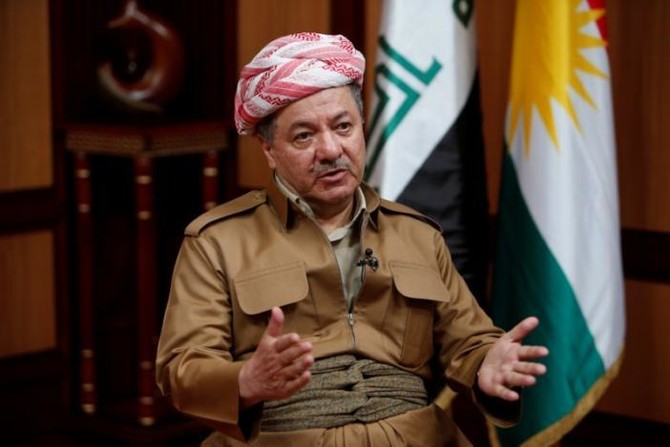
Iraq's Kurdistan region's President Massoud Barzani speaks during an interview with Reuters in Erbil, Iraq July 6, 2017. (REUTERS)
Updated 06 July 2017
Follow

Iraqi Kurdish leader says no turning back on independence bid

ERBIL: Iraq’s Kurdish leader said on Thursday that there was no turning back on a bid to achieve an independent Kurdish state, but he would pursue it through dialogue with Baghdad and regional powers to avoid conflict.
Masoud Barzani, President of the Kurdistan Regional Government (KRG), told Reuters in an interview that the timetable for independence after a Sept. 25 vote on the issue was “flexible but not open-ended.” He expected a “yes vote.”
The vote could turn into another regional flashpoint, with Turkey, Iran and Syria, along with Iraq the states with sizeable Kurdish populations, all resolutely opposed to an independent Kurdistan in northern Iraq. But Barzani played down such fears.
Within Iraq’s borders, there is growing concern the real purpose of the referendum is not secession, but to strengthen Kurdish claims over hotly disputed territory adjoining recognized KRG boundaries, such as the oil-rich region and city of Kirkuk, whose future has been in play for over a decade.
Inside the KRG, parties such as the Patriotic Union of Kurdistan (PUK) of Jalal Talabani or the dissident Gorran group, all favor independence but not necessarily under the leadership of Barzani and his Kurdistan Democratic Party (KDP).
At his palace in the hillside village of Salahaddin, Barzani said the vote would decide the fate of Kirkuk, which Kurdish Peshmerga forces prevented Daesh from capturing in 2014.
“Whatever the people of Kirkuk decide within the referendum, that decision should be respected,” said a relaxed Barzani.
The Peshmerga effectively runs Kirkuk, also claimed by Turkmen and Arabs. Hard-line Iran-backed Iraqi Shiite militias have threatened to expel the Kurds by force from this region and three other disputed areas — Sinjar, Makhmour and Khanaqin.
Barzani, a Kurdish nationalist who has long championed the rights of his people, said negotiations with Baghdad, neighbors and international powers would start immediately after the vote in order to reach an amicable agreement.
“Our main goal is to implement and achieve the decision of our people through peace and dialogue,” he said, wearing his traditional Peshmerga uniform.

HISTORIC BID
Barzani accused the Shiite-led Iraqi government, backed by Iran, of not sticking to a constitutional agreement of allowing the Kurds to have greater powers under a federal state set up after the US-led invasion that toppled Saddam Hussein in 2003.
“For 14 years we have been waiting and we have been discussing this partnership but we have always been told it’s not a good time and it’s not acceptable timing so my question is, when is the right time?“
The Kurds have been seeking an independent state since at least the end of World War One, when colonial powers divided up the Middle East, but their territory ended up split between modern-day Iraq, Syria, Turkey and Iran.
Saddam’s government waged the Anfal campaign against them in the 1980s, killing tens of thousands including with poison gas in the city of Halabja.
Barzani, whose father led struggles against Baghdad in the 1960s and 1970s, grew up in Iranian exile but returned as a teenager, joined the Peshmerga and took on the mantle of resistance. He said the Kurds were ready to take responsibility for the outcome of the referendum.
“We have to rectify the history of mistreatment of our people and those who are saying that independence is not good, our question to them is, if it’s not good for us, why is it good for you?“
Barzani played down speculation that the referendum would spark violence, saying “the legitimacy of the people is bigger than the legitimacy of any of the political parties or any of the external interventions.”
“I don’t think anybody can stand against the big wave of the people of Kurdistan when they decide their destiny. Maybe there will be some attempts to foil (it)... We will try our best not to allow that to happen.”
He said he was ready to allay the security concerns of Iraq, Turkey and Iran, saying that postponing independence would actually lead to greater instability.
“We have proved that we are factors of stability,” he said. “So what we do through a referendum is prevent that upcoming instability. We want to cut any possibility of bloodshed in the future.”

AFTER MOSUL
An additional element of regional volatility is Turkey’s determination to stop further advances across northern Syria by the Kurdish People’s Protection Forces (YPG) militia.
Ankara and the KDP are united in trying to stop the YPG – allied to the Kurdistan Workers Party (PKK) conducting an insurgency in Turkey – from consolidating self-rule in Syria. But Turkey regards Barzani’s independence bid as pulling in the opposite direction.
He said his “Kurdish state” would give full assurances to ethnic minorities including Christians, Yazidis, and Shabaks, indicating his Peshmerga forces had already lost hundreds of fighters to retake their areas from Daesh.
As the battle to recapture the Iraqi city of Mosul draws to a close, Barzani said victory is incomplete without a political reconciliation plan.
He accused the Iraqi government of failing to prepare a post-battle political, security and governance plan.
“I warned if you are not going to have this political plan, the situation will reverse.”
He said a high-level committee formed by the Kurdish region, the Baghdad government and a US-led military coalition to help Mosul leaders rebuild the city had never convened.
“I have big concerns about the situation in Mosul and about post-liberation, because the end of Daesh in Mosul doesn’t mean the end of Daesh. Those factors, the environment that brought it into Mosul have not (changed).”
“I have a big concern about the future of the area. I hope I will be wrong.” 


Foreign women linked to Daesh group in Syrian camp hope for amnesty after government offensive

Updated 8 sec ago
Follow

Foreign women linked to Daesh group in Syrian camp hope for amnesty after government offensive

  • Many of the women are either wives or widows of Daesh fighters who were defeated in Syria
  • “There were changes in the behavior of children and women. They became more hostile,” the camp’s director said

ROJ CAMP, Syria: Foreign women linked to the Daesh group and living in a Syrian camp housing more than 2,000 people near the border with Iraq are hoping that an amnesty may be on the horizon after a government offensive weakened the Kurdish-led force that guards the camp.
The women spoke to The Associated Press on Thursday in northeast Syria’s Roj camp, where hundreds of mostly women and children linked to Daesh have been held for nearly a decade.
The camp remains under control of the Kurdish-led Syrian Democratic Forces, which until recently controlled much of northeastern Syria. A government offensive this month captured most of the territory the group previously held, including the much larger Al-Hol camp, which is holding nearly 24,000 mostly women and children linked to Daesh.
Many of the women are either wives or widows of Daesh fighters who were defeated in Syria in March 2019, marking the end of what was once a self-declared caliphate in large parts of Iraq and Syria.
The most well-known resident of the Roj camp, Shamima Begum, was 15 when she and two other girls fled from London in 2015 to marry Daesh fighters in Syria. Begum married a Dutch man fighting for Daesh and had three children, who all died.
Last month, Begum lost her appeal against the British government’s decision to revoke her UK citizenship. Begum refused to speak to AP journalists at the camp.
The director of the Roj camp, Hakmiyeh Ibrahim, said that the government’s offensive on northeast Syria has emboldened the camp residents, who now tell guards that soon they will be free and Kurdish guards will be jailed in the camp instead.
“There were changes in the behavior of children and women. They became more hostile,” the camp’s director said. “It gave them hope that the Daesh group is coming back strongly.”
Since former Syrian President Bashar Assad was toppled in a lightning rebel offensive in December 2024, the country’s new army is made up of a patchwork of former insurgent groups, many of them with Islamist ideologies.
The group led by now-interim President Ahmad Al-Sharaa was once linked to Al-Qaeda although Al-Sharaa’s group and Daesh were rivals and fought for years. Since becoming president, Al-Sharaa — formerly known by the nom de guerre Abu Mohammed Al-Golani — has joined the global coalition against Daesh.
Camp residents hope for amnesty
One woman from Tunisia who identified herself only as Buthaina, pointed out that Al-Sharaa was removed from the UN and US lists of terrorists.
“People used to say that Al-Golani was the biggest terrorist. What happened to him later? He became the president of Syria. He is not a terrorist any more,” she said. “The international community gave Al-Golani amnesty. I should be given amnesty too.”
She added, “I did not kill anyone or do anything.”
The camp director said more than 2,300 people are housed in the Roj camp. They include a small number of Syrians and Iraqis, but the vast majority of them — 742 families — come from nearly 50 other countries, the bulk of them from states in the former Soviet Union.
That is in contrast to Al-Hol camp, where most residents are Syrians and Iraqis who can be more easily repatriated. Other countries have largely been unwilling to take back their citizens. Human rights groups have for years cited poor living conditions and pervasive violence in the camps.
The US military has begun moving male Daesh detainees from Syrian prisons to detention centers in Iraq, but there is no clear plan for the repatriation of women and children at the Roj Camp.
“What is happening now is exactly what we have been warning about for years. It is the foreseeable result of international inaction,” said Beatrice Eriksson, the cofounder of the children rights organization Repatriate the Children in Sweden. “The continued existence of these camps is not an unfortunate by-product of conflict, it is a political decision.”
Some women don’t want to go home
Some of the women interviewed by the AP said they want to go back home, while others want to stay in Syria.
“I did not come for tourism. Syria is a Muslim country. Germany is all infidels,” said a German woman who identified herself only as Aysha, saying that she plans to stay.
Another woman, a Belgian who identified herself as Cassandra, said she wants to get out of the camp but would like to stay in the Kurdish-controlled area of Syria.
She said that her French husband was an Daesh fighter killed in the northern city of Raqqa, once considered the de facto capital by Daesh. She said Belgium has only repatriated women who had children, unlike her. She was 18 when she came to Syria, she said.
Cassandra added that when fighting broke out between government forces and Kurdish fighters, she started receiving threats from other camp residents because she had good relations with the Kurdish guards.
Future of the camps in limbo
The government push into northeast Syria led to chaos in some of the more than a dozen detention centers where nearly 9,000 members of Daesh have been held for years.
Syrian government forces are now in control of Al-Aqtan prison near Raqqa as well as the Shaddadeh prison near the border with Iraq, where more than 120 detainees managed to flee amid the chaos before most of them were captured again.
Part of an initial ceasefire agreement between Damascus and the SDF included the Kurdish-led group handing over management of the camps and detention centers to the Syrian government.
Buthaina, the Tunisian citizen, said her husband and her son are held in a prison. She said her husband worked in cleaning and did not fight, while her son fought with the extremists.
She has been in Roj for nine years and saw her other children grow up without proper education or a childhood like other children.
“All we want is freedom. Find a solution for us,” Buthaina said.
She said the Tunisian government never checked on them, but now she hopes that “if Al-Golani takes us there will be a solution.”
She said those accused of crimes should stand trial and others should be set free.
“I am not a terrorist. The mistake I made is that I left my country and came here,” she said. “We were punished for nine years that were more like 90 years.”