Asia tourism industry keeps elephants in cruel conditions, rights body says

1 / 2
This handout from the World Animal Protection taken on December 1, 2016 and released on July 5, 2017 shows elephants performing during a show for tourists in Thailand. Twice as many elephants work in Thailand's tourism industry as the rest of Asia combined, a new report revealed on July 6, 2017, with the vast majority kept in "severely inadequate conditions". - (AFP)
2 / 2
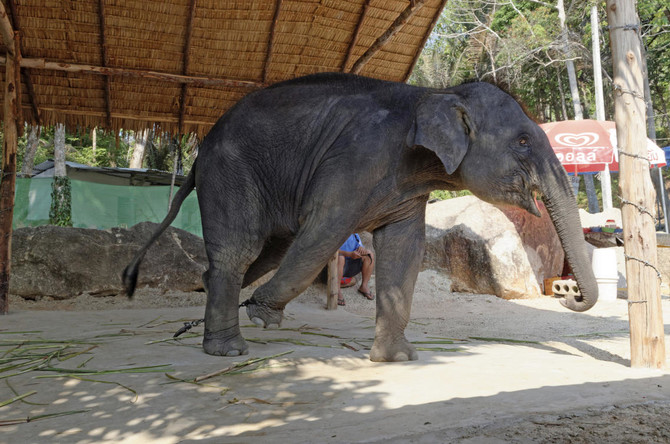
This undated photo released by World Animal Protection, shows an elephant used for entertainment at a venue in Thailand. An animal protection group says it wants tourists to know, that elephant on which you took a ride during your vacation in Thailand is probably a miserable victim of abuse. London-based World Animal Protection in a report released Thursday, July 6, 2017 says its survey of almost 3,000 elephants employed in entertainment venues in Thailand, Laos, Cambodia, Nepal, Sri Lanka and India found that three out of four are living in poor and unacceptable conditions. (World Animal Protection via AP)
Updated 06 July 2017
Follow

Asia tourism industry keeps elephants in cruel conditions, rights body says

BANGKOK: Hundreds of elephants used in Asia’s tourism industry are kept in “severely cruel” conditions, animal welfare group World Animal Protection said on Thursday.
Animal tourism in Asia has drawn increased scrutiny over the past year, partly because of a scandal involving a tiger attraction in Thailand, where wildlife authorities discovered scores of dead tiger cubs.
Almost 80 percent of about 3,000 elephants at tourist venues in Cambodia, India, Laos, Nepal, Sri Lanka and Thailand endure poor living conditions and diets and are overworked, the non-profit said in a report.
Thailand alone has an estimated 4,000 domesticated elephants, many working in the tourism trade, along with about 2,500 wild elephants.
“We want to change the demand from elephant riding and elephant shows toward activities that are elephant-friendly, such as observing elephants,” said Jan Schmidt-Burbach, a wildlife expert at World Animal Protection.
“If you can ride or have a selfie with the animal, chances are that is cruel to the animal,” he told Reuters.
Thailand, which registered record foreign tourist arrivals last year, has seen a rise of 30 percent in new elephant tourism venues since 2010.
Ittipan Khaolamai, manager of the Royal Elephant Kraal in Ayutthaya province, north of Bangkok, which is home to around 90 elephants, defended the use of elephants as tourist attractions, saying caretakers treated the animals well.
“Most mahouts look after the animals well because their livelihood also depends on the welfare of the elephant,” Ittipan added. 


US moves to counter China in Bangladesh, plans to pitch defense alternatives

Updated 3 sec ago
Follow

US moves to counter China in Bangladesh, plans to pitch defense alternatives

DHAKA: The United States is concerned about China’s ​expanding presence in South Asia and is planning to offer Bangladesh’s next government US and allied defense systems as alternatives to Chinese hardware, Washington’s ambassador to Dhaka told Reuters. Bangladesh votes in a general election on Thursday after a Gen Z-led uprising toppled India-allied premier Sheikh Hasina in August 2024. She has since taken refuge in New Delhi, allowing China to deepen its influence in Bangladesh as India’s presence wanes. China recently signed a defense agreement with Bangladesh to build a drone factory near the India border, worrying foreign diplomats. Bangladesh is also in talks with Pakistan to buy JF-17 Thunder fighter jets, a multi-role combat ‌aircraft jointly developed with ‌China.
“The United States is concerned about growing Chinese influence in South ​Asia ‌and ⁠is committed ​to ⁠working closely with the Bangladeshi government to clearly communicate the risks of certain types of engagement with China,” US Ambassador Brent T. Christensen said in an interview on Tuesday.
“The US offers a range of options to help Bangladesh meet its military capability needs, including US systems and those from allied partners, to provide alternatives to Chinese systems,” he said without offering further details.
The Chinese foreign ministry did not immediately respond to a request for comment.
Christensen also said that President Donald Trump’s administration would “like to see a good relationship between Bangladesh and India ⁠to support stability in the region.” New Delhi-Dhaka relations have nosedived since ‌Hasina fled, badly affecting visa services and cricket ties between the ‌two neighbors.

COMMERCIAL DIPLOMACY IS PRIORITY
Christensen said many US businesses were looking ​at potentially investing in Bangladesh but would want ‌the next government to show early and clear signs that it is “open for business.”
“Commercial diplomacy is one ‌of our top priorities, and we look forward to working with the new government to build on progress made with the interim government, particularly in strengthening commercial, economic, and security ties,” he said.
Energy producer Chevron has been in Bangladesh for decades but not many other US companies are visible in the densely populated country of 175 million people, ‌as high taxes and difficulties repatriating profits have created some hurdles.
There are no Starbucks or McDonald’s outlets in Bangladesh.
The envoy said Washington would ⁠work with “whichever government is elected ⁠by the Bangladeshi people.” The race is between two coalitions led by former allies, the Bangladesh Nationalist Party (BNP) and the Islamist Jamaat-e-Islami, with opinion polls suggesting the BNP holds an advantage.

AID FOR ROHINGYA REFUGEES
Regarding the 1.2 million Rohingya refugees sheltered in Bangladesh, the ambassador said the United States remained the largest contributor to humanitarian operations.
“The US remains the largest contributor to the Rohingya refugee response and continues robust health programming in Bangladesh,” he said, noting a recent $2 billion worldwide funding framework signed with the United Nations to improve the effectiveness of such assistance, including in Bangladesh.
He urged other international donors to take on a greater share of the burden.
“The US cannot sustain the bulk of the effort alone. International partners need to increase their support for the Rohingya response,” he said. In recent years, the UN refugee agency has ​been struggling to raise sufficient funds to support ​the Rohingya community, leading to cuts in their rations and the closure of some schools for them.