Improving Egypt-Hamas ties unsettle Palestinian politics

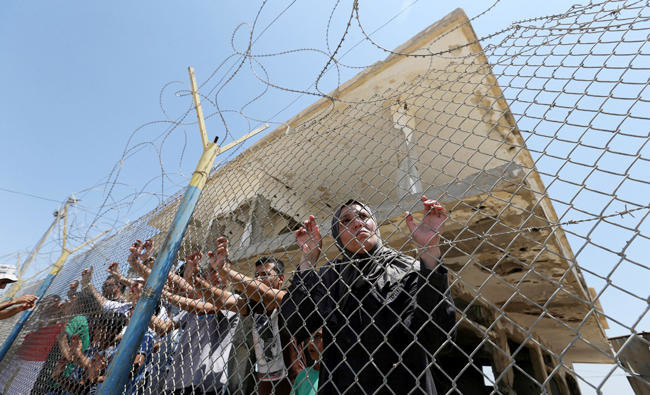
Palestinians gather in front of the gate of Rafah border crossing between Egypt and Gaza during a protest in the southern Gaza Strip. (Reuters)
Updated 06 July 2017
Follow

Improving Egypt-Hamas ties unsettle Palestinian politics

GAZA: A series of meetings between Hamas and senior officials in Cairo in recent weeks points to improving ties between Egypt and the Palestinian movement, with implications for Gaza, Palestinian politics and the wider region.
For much of the last decade, Egypt has joined Israel in enforcing a land, sea and air blockade of the Gaza Strip, a move to punish Hamas and its armed wing, which seized the territory in 2007 and has controlled it since.
The situation has worsened in the past month as Israel, at the request of the West Bank-based Palestinian Authority (PA), has cut electricity to Gaza, leaving it with barely four hours of power a day.
The sanctions are part of a yearslong effort by the PA, led by the rival Fatah party, to force Hamas to relinquish power in Gaza and join a unified government.
Power cuts have hit hospitals and water treatment plants, squeezing Gaza’s two million people amid a draining heat wave.
Sensing the need to act, and worried about losing popular support, Hamas has sought to mend ties with Egypt, which controls their one border crossing and has, under President Abdel Fattah El-Sisi, been highly wary of ties between Hamas and the Muslim Brotherhood, which El-Sisi ousted from power after mass protests.
Hamas’ newly appointed leader in Gaza, Yahya Sinwar, whose background is with the group’s militant wing, met Egyptian officials, including the intelligence chief, last month.
The meetings in Cairo were believed to have been facilitated by Mohammed Dahlan, 55, a former senior Fatah official who is originally from Gaza and is now a staunch opponent of Palestinian President Mahmoud Abbas, Fatah’s leader.
Dahlan, who spends much of his time in the UAE and is close to Egypt, has emerged as a powerbroker in the region, determined to bridge differences between Hamas and Cairo and potentially challenge Abbas for leadership.
In that respect, closer ties between Hamas and Cairo are a serious threat to Abbas, regional analysts said.
Not only because they help to bolster Hamas’ credibility in the region, but because they empower Dahlan and undermine the ability of the PA to cast itself as the dominant political body for Palestinians, they said.


Australia seeks charges over a 2024 Israeli airstrike in Gaza that killed an Australian aid worker

Updated 3 sec ago
Follow

Australia seeks charges over a 2024 Israeli airstrike in Gaza that killed an Australian aid worker

  • Australian Zomi Frankcom was one of four aid workers killed by an Israeli drone on April 1, 2024
MELBOURNE: Australia is demanding criminal charges over a 2024 Israeli airstrike on an aid convoy in Gaza that killed seven people, including an Australian aid worker, the country’s prime minister said Wednesday in a case that has drawn sweeping condemnation and strained relations between the two countries.
Prime Minister Anthony Albanese said he conveyed the request to visiting Israeli President Isaac Herzog during a meeting earlier in the day.
Australian Zomi Frankcom was one of four World Central Kitchen aid workers killed by an Israeli drone on April 1, 2024. The other aid workers were an American-Canadian dual citizen, a Palestinian and a Polish national. Three British security staff were also killed in the same airstrike.
There was no immediate response on Albanese’s request from Herzog, who visited the national capital, Canberra, on Wednesday after spending two days in Sydney, where he comforted Jews reeling from an antisemitic attack at Bondi Beach in December that left 15 dead.
Herzog’s visit triggers controversy
Though Australia’s major political parties largely back Herzog’s visit, Albanese spoke in Parliament on Wednesday to several lawmakers who opposed it, accusing the Israeli leader of inciting genocide in Gaza and inflaming community tensions within Australia.
The prime minister defended the visit and said it was an opportunity to “raise the issue” of the killed aid workers.
“That’s one of the reasons why you have dialogue in a respectful way; to get outcomes and to advance Australia’s national interests,” he told Parliament.
Four months after the aid convoy strike, an Australian inquiry found the airstrike resulted from procedural failures and errors on the part of the Israeli military.
Albanese said it was a “tragedy and an outrage” and that he made clear Australia’s “expectation that there be transparency about Israel’s ongoing investigation into the incident.”
“We continue to press for full accountability, including any appropriate criminal charges,” he added.
Israel’s president describes a ‘very emotional’ visit
Herzog told reporters that his visit has been “very emotional” in the wake of the suffering the Bondi massacre had caused Sydney’s Jewish community.
“It’s also an opportunity to bring the relations between our nations on a new beginning and a better future,” Herzog said outside Albanese’s office.
“I think the relations between us do not depend only on the issue of Israel and the Palestinians and the conflict but has a much broader base,” he added. “We should, together, make sure that it’s uplifted to new directions.”
Mainstream Jewish groups in Australia have welcomed the visit of Herzog, a former leader of the centrist Labour Party who now plays a largely ceremonial role.
Albanese and Herzog dined on Tuesday night at the prime minister’s official residence on Sydney Harbor before flying together to Canberra on Wednesday morning in an Australian air force jet.
Protests against Israel mark Herzog’s visit
Hundreds of demonstrators, some waving Palestinian flags, and several lawmakers gathered outside Parliament House to protest Herzog’s presence.
On Monday, as Herzog arrived in Sydney, thousands of demonstrators rallied there and also in downtown Melbourne. Australia’s two largest cities are home to 85 percent of Australia’s Jewish population.
Mehreen Faruqi, the Muslim deputy leader of the influential Greens party, told protesters outside Parliament House on Wednesday that Herzog was not welcome in Australia.
She condemned Albanese and New South Wales state Premier Chris Minns for police using pepper spray and aggressive tactics in clashes with protesters in Sydney on Monday. Police were given increased powers to arrest protesters due to Herzog’s visit.
“It is shameful that the premier of New South Wales and the prime minister of Australia are offering warm handshakes, photo opportunities and canapés to a war criminal, to a war criminal who has incited genocide, while those who are fighting for peace, who are protesting against the genocide, are attacked and assaulted and thrown to the ground,” Faruqi told the crowd, many of whom chanted “arrest Herzog.”
David Pocock, an independent senator and former captain of Australia’s rugby team, also joined the demonstration outside Parliament.
“It was the wrong decision to invite President Herzog at this time when we have seen so much strain on communities and tension in communities across the country,” Pocock told Australian Broadcasting Corp.
A heavy police presence at the Sydney rally on Monday prevented demonstrators marching from the Sydney Town Hall. Police arrested 27 demonstrators and charged nine, mostly with assaulting police.
Minns defended the police actions, saying that if the protesters had marched from the town hall, they might have clashed with thousands of mourners of the Bondi massacre who had gathered at an event with Herzog nearby.
Before returning to Israel, Herzog will visit Melbourne, where protests are planned for Thursday afternoon. In Melbourne, the Israeli president is to visit the ruins of the Adass Israel Synagogue, torched in late 2024.
Australia accused Iran of directing that arson attack and expelled Iranian Ambassador Ahmad Sadeghi last August.