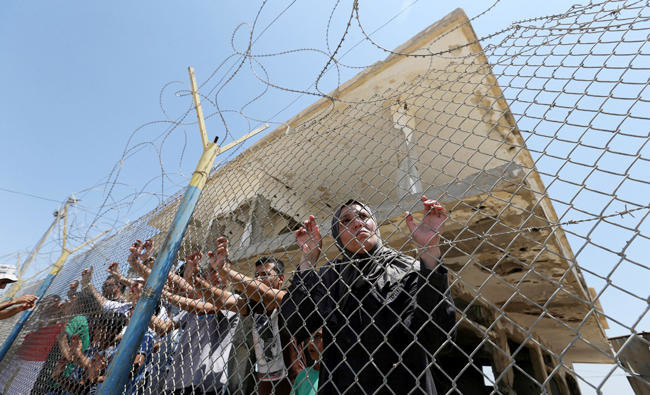
GAZA: A series of meetings between Hamas and senior officials in Cairo in recent weeks points to improving ties between Egypt and the Palestinian movement, with implications for Gaza, Palestinian politics and the wider region.
For much of the last decade, Egypt has joined Israel in enforcing a land, sea and air blockade of the Gaza Strip, a move to punish Hamas and its armed wing, which seized the territory in 2007 and has controlled it since.
The situation has worsened in the past month as Israel, at the request of the West Bank-based Palestinian Authority (PA), has cut electricity to Gaza, leaving it with barely four hours of power a day.
The sanctions are part of a yearslong effort by the PA, led by the rival Fatah party, to force Hamas to relinquish power in Gaza and join a unified government.
Power cuts have hit hospitals and water treatment plants, squeezing Gaza’s two million people amid a draining heat wave.
Sensing the need to act, and worried about losing popular support, Hamas has sought to mend ties with Egypt, which controls their one border crossing and has, under President Abdel Fattah El-Sisi, been highly wary of ties between Hamas and the Muslim Brotherhood, which El-Sisi ousted from power after mass protests.
Hamas’ newly appointed leader in Gaza, Yahya Sinwar, whose background is with the group’s militant wing, met Egyptian officials, including the intelligence chief, last month.
The meetings in Cairo were believed to have been facilitated by Mohammed Dahlan, 55, a former senior Fatah official who is originally from Gaza and is now a staunch opponent of Palestinian President Mahmoud Abbas, Fatah’s leader.
Dahlan, who spends much of his time in the UAE and is close to Egypt, has emerged as a powerbroker in the region, determined to bridge differences between Hamas and Cairo and potentially challenge Abbas for leadership.
In that respect, closer ties between Hamas and Cairo are a serious threat to Abbas, regional analysts said.
Not only because they help to bolster Hamas’ credibility in the region, but because they empower Dahlan and undermine the ability of the PA to cast itself as the dominant political body for Palestinians, they said.

Improving Egypt-Hamas ties unsettle Palestinian politics
Trump warns US to end support for Iraq if Al-Maliki returns
WASHINGTON: President Donald Trump on Tuesday threatened to end all US support for Iraq if Nouri Al-Maliki, a former prime minister with ties to Iran, returns to the post.
Trump, in his latest blatant intervention in another country’s politics, said that Iraq would make a “very bad choice” with Maliki, who has been nominated as prime minister by the largest Shiite bloc.
“Last time Al-Maliki was in power, the Country descended into poverty and total chaos. That should not be allowed to happen again,” Trump wrote on his Truth Social platform.
“Because of his insane policies and ideologies, if elected, the United States of America will no longer help Iraq,” he said.
“If we are not there to help, Iraq has ZERO chance of Success, Prosperity, or Freedom. MAKE IRAQ GREAT AGAIN!” he wrote, adopting his slogan at home.
Maliki left power in 2014 following pressure from the United States, which blamed his nakedly sectarian Shiite agenda for giving rise to the Daesh group of ultra-violent Sunni extremists.
The United States wields key leverage over Iraq as its oil export revenue is largely held at the Federal Reserve Bank in New York, in an arrangement reached after the 2003 US invasion that toppled Saddam Hussein.
Oil sales account for around 90 percent of Iraqi government revenues.
Trump’s statement came days after Secretary of State Marco Rubio voiced similar concerns in a telephone call with the incumbent prime minister, Mohammed Shia Al-Sudani. The United States had also sent a letter to Iraqi politicians saying that Washington views Al-Maliki negatively, political sources said.
Delay in parliament
By convention, a Shiite Muslim has been prime minister since the fall of Saddam, who ruthlessly repressed the Shiite majority in Iraq.
On Saturday, the Coordination Framework, an alliance of Shiite parties with varying ties to Iran that holds a parliamentary majority, endorsed Maliki.
Normally he would then be nominated by the president, who holds a largely ceremonial role.
Iraq’s parliament was set to elect a president on Tuesday but the vote was abruptly delayed.
The presidency traditionally goes to a Kurd, and the official INA press agency said that the two main Kurdish parties had requested more time to come to a consensus on a candidate.
Before Trump’s open call to dump Maliki, an Iraqi political source said that the Coordination Framework was set on moving forward with the nomination, believing that Al-Maliki could eventually allay Washington’s concerns.
A pro-Iranian government in Iraq would be a rare boon for Tehran’s Shiite clerical state after it suffered major setbacks at home and in the region.
The Islamic republic has killed thousands of Iranians since mass protests erupted in late December in one of the largest threats to the clerics’ rule since the 1979 Islamic revolution.
Since suffering the October 7, 2023 attacks, Israel has hit Iran both with strikes inside the country and heavy blows against Tehran’s Lebanese ally Hezbollah, while Iran lost its main Arab ally with the fall of Bashar Assad in Syria.
The United States has enjoyed smooth relations with Sudani, who has worked quietly to prevent violence by Iraqi Shiite armed groups tied to Iran.
Sudani has also cooperated with the United States to bring into Iraq a caravan of Islamic State prisoners from Syria, where the army recently moved on Kurdish fighters who had run the detention camps.
Even during Sudani’s term, Al-Maliki annoyed the then US administration of Joe Biden by helping push through a harsh anti-LGBTQ law.
The United States has long intervened in other countries, but Trump has broken precedent by meddling openly.
Trump has backed fellow right-wing candidates in elections in Poland, Romania and Honduras, where the Trump-backed winner was inaugurated Tuesday.
Trump earlier this month ordered a deadly military operation into Venezuela that removed leftist president Nicolas Maduro, a longtime US nemesis.