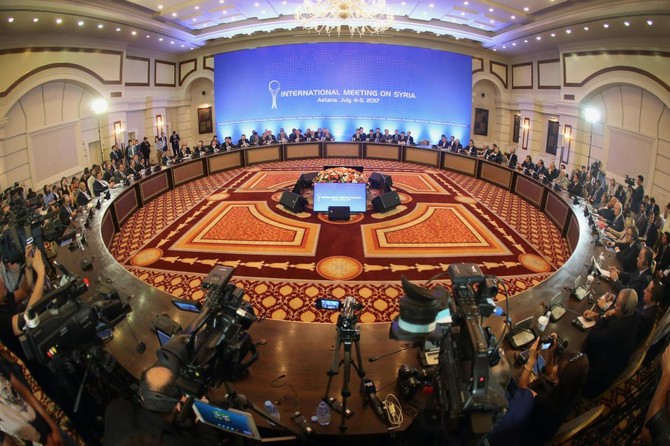
ASTANA: Russia, Turkey and Iran failed at peace talks Wednesday to hammer out details including the boundaries and policing of four safe zones in war-torn Syria, Moscow’s chief negotiator said.
Russian delegation head Alexander Lavrentiev said after the end of the latest two-day negotiations in Kazakhstan that documents outlining how the four zones should work “need finalizing” despite being “essentially agreed” between the three key powerbrokers.
Moscow and Tehran, which back Syrian regime, and opposition supporter Ankara agreed in May to establish four “de-escalation” zones in a potential breakthrough after more than six years of fighting that has claimed more than 320,000 lives.
While fighting dropped off in the weeks after the deal, it has ratcheted up in some areas since, and the international players have yet to finalize the boundaries of the zones or determine who will police them.
“We have not yet managed directly to establish the de-escalation zones,” Lavrentiev said, insisting however that “de-facto” safe areas already existed on the ground.
He added that there had been no definitive agreement over the contentious issue of “which specific forces” would police the zones.
A working meeting of representatives from Russia, Iran and Ankara is set to take place in Tehran at the start of August to help thrash out the remaining disagreements, Russian news agencies cited a joint statement as saying.

Russia says no final deal on Syria safe zones
In major policy shift on Syria, UN Security Council lifts sanctions on Hayat Tahrir Al-Sham
- Move reflects evolving Syrian political landscape in the post-Assad era, ending a global freeze on assets, travel ban and arms embargo
NEW YORK CITY: The UN Security Council on Friday removed Al-Nusra Front, the militant group that evolved into Hayat Tahrir Al-Sham, from its so-called Daesh and Al-Qaeda Sanctions List.
The move signals a major shift in international policy toward Syria’s evolving political landscape in the post-Assad era, and ends a global freeze on assets, travel ban and arms embargo that have been imposed on the group since 2014.
Al-Nusra Front and Hayat Tahrir Al-Sham were led by Ahmad Al-Sharaa, formerly Abu Mohammed Al-Julani, who is now Syria’s president and was a leading figure in the offensive that toppled the Assad regime.
The consensus decision by the Security Council’s sanctions committee was announced by the UK, which holds the presidency of the Security Council this month and was acting in the absence of the chair of the committee. It followed a request by the new Syrian authorities to delist “Al-Nusrah Front for the People of the Levant.”
The decision means measures that were applied to Hayat Tahrir Al-Sham under Security Council Resolution 2734, adopted in 2024, no longer apply. As a result, UN member states are notrequired to freeze the group’s funds, restrict the movement of its representatives, or block the supply or transfer of arms and related materiel.
Al-Nusra Front was added to the sanctions list for its ties to Al-Qaeda and involvement in the financing and execution of militant activities during the war in Syria. The UN initially continued to treat the group’s successor organization, Hayat Tahrir Al-Sham, as a listed alias.
Al-Sharaa has said the group severed all prior transnational jihadist links and is now solely focused on local Syrian matters.