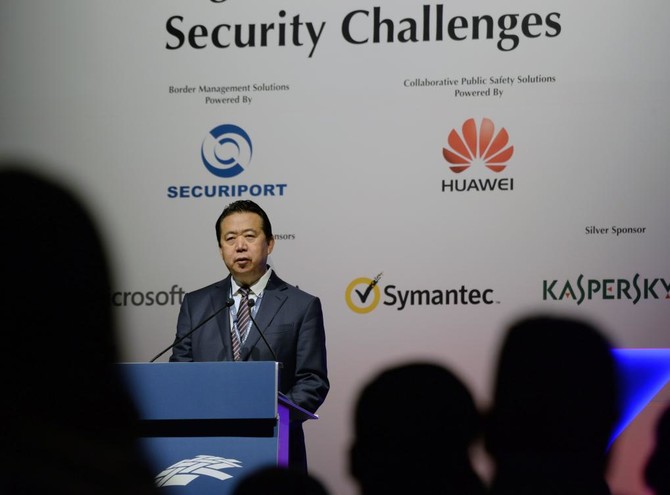
SINGAPORE: Countries and law enforcement agencies must work together to counter rising threats, especially those in cyberspace, the president of Interpol told a security congress on Tuesday.
In a wide-ranging speech, Meng Hongwei cited the recent outbreak of ransomware WannaCry, which has scrambled data at hospitals, factories, banks, government agencies and other businesses in Asia and beyond.
“Criminals will continue to exploit the exponential growth of the Internet and social communication platforms,” said Meng, a top Chinese police official.
“However, no single country or profession can rely solely upon its own capability to address the problem of transnational and organized crimes. We are all part of the world. We are all facing the same threats in (the) international arena,” Meng said.
Meng’s election to lead Interpol set off alarm bells among rights advocates over abuses and a lack of transparency within China’s legal system. His speech Tuesday was one of his first public appearances.
Lyon, France-based Interpol has 190 member nations and has the power to issue “red notices,” the closest instrument to an international arrest warrant in use today.
Interpol’s president is a largely symbolic but still influential figure who heads its executive committee, which is responsible for providing guidance and direction and implementing decisions made by its general assembly. Interpol Secretary-General Jurgen Stock is the organization’s chief full-time official and heads the executive committee.
Meng took over in November from Mireille Ballestrazzi of France for a four-year term. He was nominated by Interpol member countries.

Interpol president calls for unity in facing cyberattacks
Rubio says technical talks with Denmark, Greenland officials over Arctic security have begun
- US Secretary of State on Wednesday appeared eager to downplay Trump’s rift with Europe over Greenland
WASHINGTON: Technical talks between the US, Denmark and Greenland over hatching an Arctic security deal are now underway, Secretary of State Marco Rubio said on Wednesday.
The foreign ministers of Denmark and Greenland agreed to create a working group aimed at addressing differences with the US during a Washington meeting earlier this month with Vice President JD Vance and Rubio.
The group was created after President Donald Trump’s repeated calls for the US to take over Greenland, a Danish territory, in the name of countering threats from Russia and China — calls that Greenland, Denmark and European allies forcefully rejected.
“It begins today and it will be a regular process,” Rubio said of the working group, as he testified before the Senate Foreign Relations Committee. “We’re going to try to do it in a way that isn’t like a media circus every time these conversations happen, because we think that creates more flexibility on both sides to arrive at a positive outcome.”
The Danish Foreign Ministry said Wednesday’s talks focused on “how we can address US concerns about security in the Arctic while respecting the red lines of the Kingdom.” Red lines refers to the sovereignty of Greenland.
Trump’s renewed threats in recent weeks to annex Greenland, which is a semiautonomous territory of a NATO ally, has roiled US-European relations.
Trump this month announced he would slap new tariffs on Denmark and seven other European countries that opposed his takeover calls, only to abruptly drop his threats after a “framework” for a deal over access to the mineral-rich island was reached, with NATO Secretary-General Mark Rutte’s help. Few details of the agreement have emerged.
After stiff pushback from European allies to his Greenland rhetoric, Trump also announced at the World Economic Forum in Davos, Switzerland, last week that he would take off the table the possibility of using American military force to acquire Greenland.
The president backed off his tariff threats and softened his language after Wall Street suffered its biggest losses in months over concerns that Trump’s Greenland ambitions could spur a trade war and fundamentally rupture NATO, a 32-member transatlantic military alliance that’s been a linchpin of post-World War II security.
Rubio on Wednesday appeared eager to downplay Trump’s rift with Europe over Greenland.
“We’ve got a little bit of work to do, but I think we’re going to wind up in a good place, and I think you’ll hear the same from our colleagues in Europe very shortly,” Rubio said.
Rubio during Wednesday’s hearing also had a pointed exchange with Sen. Tim Kaine, D-Virginia, about Trump repeatedly referring to Greenland as Iceland while at Davos.
“Yeah, he meant to say Greenland, but I think we’re all familiar with presidents that have verbal stumbles,” Rubio said in responding to Kaine’s questions about Trump’s flub — taking a veiled dig at former President Joe Biden. “We’ve had presidents like that before. Some made a lot more than this one.”