Suspect in kidnapping of Chinese scholar ordered held without bond

1 / 2
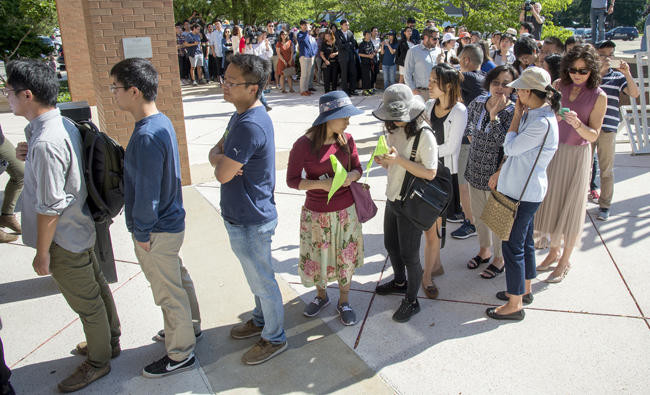
People line up outside the federal courthouse for first appearance of Brendt Christensen, the suspect in the kidnapping of Yingying Zhang, a Chinese scholar at the University of Illinois, on Monday in Urbana, Illinois. (Robin Scholz/The News-Gazette via AP)
2 / 2
This undated photo provided by the University of Illinois Police Department shows Yingying Zhang, a Chinese scholar at a central Illinois university town, who disappeared June 9, 2017. (Courtesy of the University of Illinois Police Department via AP)
Updated 03 July 2017
Follow

Suspect in kidnapping of Chinese scholar ordered held without bond

URBANA, Illinois: A federal judge in Illinois has ordered a man accused of kidnapping a visiting University of Illinois scholar from China to be held without bond.
Monday’s brief hearing was the first court appearance for 28-year-old Brendt Christensen since he was charged on Friday in the kidnapping of Yingying Zhang. Authorities have said they believe the 26-year-old Zhang is dead, although her body has not been found.
The (Champaign) News-Gazette reports that Christensen — clad in an orange jumpsuit — didn’t speak during the nine-minute hearing other than to acknowledge that he understood his rights.
Christensen is scheduled to attend a bond hearing before US Magistrate Judge Eric Long on Wednesday. A preliminary hearing is scheduled for July 14.
Christensen is accused of abducting Zhang in Urbana on June 9.
Hundreds of people were gathered outside the courthouse as the hearing was going on.
Judge Eric Long moved the first court hearing to a larger courtroom to accommodate his family and Zhang’s relatives.


Thailand’s Anutin picked as PM candidate in ‘consequential’ February polls

Updated 7 sec ago
Follow

Thailand’s Anutin picked as PM candidate in ‘consequential’ February polls

BANGKOK: Thailand’s caretaker leader Anutin Charnvirakul was picked by his party on Wednesday to stand as its candidate for prime minister in a general election in early February, as he bids to benefit ​from a wave of nationalism arising from an ongoing border conflict with Cambodia.
Less than 100 days after he was elected premier, Anutin dissolved parliament earlier this month when his minority government faced the threat of a no-confidence vote.
Speaking to party members and supporters on Wednesday, Anutin said he and his Bhumjaithai party were ready to return to power, describing the February 8 election as “the most consequential poll” for the ‌conservative political ‌outfit since its formation in 2008.
“Today we are ‌sure ⁠and ​ready ‌to enter the election race to serve Thailand and its people,” Anutin said.
“This is the first time the Thai people has high expectations from the Bhumjaithai Party.”
If re-elected, Anutin said that key executives of his government will keep their roles, including Finance Minister Ekniti Nitithanprapas, Foreign Minister Sihasak Phuangketkeow and Commerce Minister SupHajjee Suthumpun.
Anutin stands to gain from growing nationalist ⁠sentiment generated by the conflict with Cambodia, which reignited on his watch. However, analysts say the ‌election could be close and grant no clear ‍majority for any of the ‍parties involved.
Yodchanan Wongsawat, a leading prime ministerial candidate with the Pheu ‍Thai Party, told Reuters in an interview that he is open to join a coalition government.
In a nationwide survey conducted by the National Institute of Development Administration, Bhumjaithai is currently polling at 9.92 percent, fourth among the major parties ​competing in the vote.
But the survey also indicated that some 32.36 percent of voters had yet to decide which party ⁠they will back, leaving space for Bhumjaithai to gain ground in the coming weeks.
Bhumjaithai came third in the 2023 election, joining a Pheu Thai-led ruling coalition, with which it stayed until June this year.
The party withdrew its support following a leaked phone call between then Prime Minister Paetongtarn Shinawatra and former Cambodian leader Hun Sen.
Paetongtarn was later dismissed by the Constitutional Court in August, opening the door for Anutin.
A savvy political operator, Anutin maneuvered his way to the top job through a parliamentary vote in September after striking a deal with the opposition People’s Party, ‌the largest force in parliament.
That agreement, however, fell through earlier this month, setting the stage for February’s earlier-than-expected snap election.