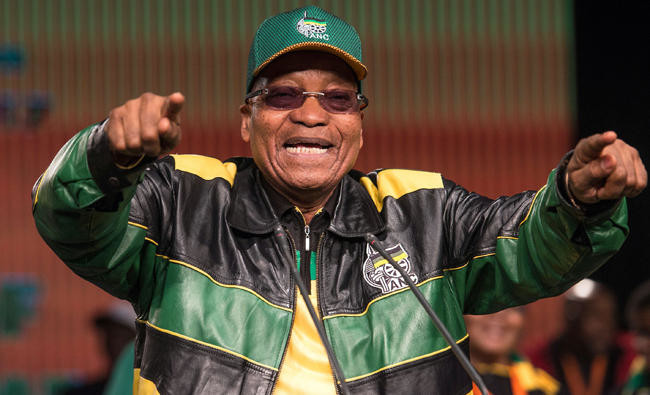
JOHANNESBURG: South African President Jacob Zuma, who has been weakened by growing criticism from within the ruling African National Congress (ANC) party, will face a vote of no confidence in Parliament on August 8, officials announced Sunday.
Opposition parties have pushed for the vote to be held in secret, hoping to encourage ANC lawmakers to vote Zuma out of office after a series of corruption scandals.
But the president retains strong support from many lawmakers in the ANC, which led the fight against apartheid.
In the last two years, Zuma has easily survived three votes of no confidence and a separate Parliament vote to remove him from office.
Parliamentary Speaker Baleka Mbete on Sunday issued a statement, saying the date for the no-confidence vote had been changed from Aug. 3 to Aug. 8, due to a scheduled Cabinet meeting.
Mbete, a Zuma ally, will decide whether the vote is secret after a case brought to the Constitutional Court by opposition parties, who have called for ANC lawmakers to “vote with their conscience.”
The no-confidence vote was initially scheduled for April but delayed to allow the court to rule.
The ANC has vowed to defeat the motion.
Zuma is due to step down as ANC head in December and as national president ahead of the 2019 election.
On Friday, he opened a party conference admitting that the ANC was beset by corruption and divisions that could threaten a hold on power that has prevailed since the end of apartheid in 1994.

Zuma faces vote of no confidence on Aug. 8
Russia says foreign forces in Ukraine would be ‘legitimate targets’
- Moscow has repeatedly said it will not tolerate the presence in Ukraine of troops from Western countries
MOSCOW: Russia would regard the deployment of any foreign military forces or infrastructure in Ukraine as foreign intervention and treat those forces as legitimate targets, the Foreign Ministry said on Monday, citing Minister Sergei Lavrov.
The ministry’s comment, one of many it said were in response to questions put to Lavrov, also praised US President Donald Trump’s efforts at working for a resolution of the war and said he understood the fundamental reasons behind the conflict.
“The deployment of military units, facilities, warehouses, and other infrastructure of Western countries in Ukraine is unacceptable to us and will be regarded as foreign intervention posing a direct threat to Russia’s security,” the ministry said on its website.
It said Western countries — which have discussed a possible deployment to Ukraine to help secure any peace deal — had to understand “that all foreign military contingents, including German ones, if deployed in Ukraine, will become legitimate targets for the Russian Armed Forces.”
The United States has spearheaded efforts to hold talks aimed at ending the conflict in Ukraine and a second three-sided meeting with Russian and Ukrainian representatives is to take place this week in the United Arab Emirates.
The issue of ceding internationally recognized Ukrainian territory to Russia remains a major stumbling block. Kyiv rejects Russian calls for it to give up all of its Donbas region, including territory Moscow’s forces have not captured.
Moscow has repeatedly said it will not tolerate the presence in Ukraine of troops from Western countries.
The ministry said Moscow valued the “purposeful efforts” of the Trump administration in working toward a resolution and understanding Russia’s long-running concerns about NATO’s eastward expansion and its overtures to Ukraine.
It described Trump as “one of the few Western politicians who not only immediately refused to advance meaningless and destructive preconditions for starting a substantive dialogue with Moscow on the Ukrainian crisis, but also publicly spoke about its root causes.”