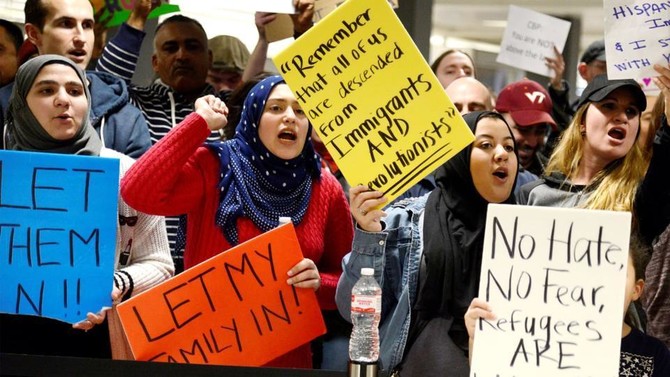
For Iranian-Americans, Trump travel ban keeps families apart

The Trump administration’s travel ban, while a shadow of its original self, has dealt a harsh blow to the Iranian-American community.(Reuters)
Updated 01 July 2017
Follow

For Iranian-Americans, Trump travel ban keeps families apart

IRVINE, Calif: Weddings have been moved and family visits delayed.
The Trump administration’s travel ban, while a shadow of its original self, has dealt a harsh blow to the Iranian-American community, where family ties run strong and friends and loved ones regularly shuttle between Los Angeles and Tehran.
But it isn’t the only immigration hurdle facing the community. Iranians allowed to seek visas to visit family in the United States may still have a hard time getting them with a screening process that can take months or longer, immigration lawyers said.
In the meantime, families are being kept apart. Iranian-American homemaker Mina Thrani, 38, had hoped to invite her aunt to visit her in Irvine over the Christmas holiday but can’t because of the ban.
Xena Amirani, an 18-year-old college student from Los Angeles, said her family has been grieving since her grandmother died after being struck by a car while crossing the street. They traveled to Iran to bury her. Now, her uncle and his wife want to travel together to visit the family in California to help console them, but the travel ban is in the way.
“It is pointless,” Amirani said.
The scaled-back version of President Donald Trump’s policy that took effect this week places new limits on visa policies for citizens of six Muslim-majority countries, including Iran. The temporary ban requires people who want new visas to prove a close family relationship in the US or an existing relationship with an entity like a school or business.
The US has nearly 370,000 Iranian immigrants, according to US Census Bureau estimates, far more than the other countries targeted by the order — Syria, Sudan, Somalia, Libya and Yemen.
Despite a lengthy history of friction between Tehran and Washington, personal ties between residents of the two countries have held strong.
“Everyone is being hit by this because everyone has a relative in Iran, and there is quite a lot of travel in between,” said Trita Parsi, president of the National Iranian American Council.
But travel isn’t always easy, and the challenge predates the Trump administration. Because there is no US embassy in Iran, Iranians must go to other countries for visa interviews, requiring time and money.
And it can take longer to get visas approved for Iranians than for citizens of many other countries, immigration attorneys said, while US officials conduct screenings.
“Even under Obama, it was very hard to get these visas and get the background checks cleared. But now, it is official policy,” said Ally Bolour, an immigration attorney in Los Angeles.
The Department of Homeland Security said this week that the Supreme Court’s decision to allow a partial reinstatement of the ban will help protect the US
But that rings hollow to some Iranian-Americans who note that many in their community came to the US seeking freedom following Iran’s Islamic revolution of the 1970s and that the hijackers who carried out the 2001 terrorist attacks in the United States were from other countries not limited by the ban.
Trump’s initial travel ban in January was broader, affecting current and new visas, which sparked chaos at airports around the world.
Mina Jafari, a 28-year-old graphic designer in Washington, said that during that time, her fiancée’s Iranian mother was in the process of obtaining a visa to travel to the couple’s wedding, but it was revoked because of the ban.
That prompted Jafari to move the wedding to Iran so her soon-to-be mother-in-law could attend. The only problem is her elder sister can’t go with her due to concerns about her political activism.
“I have family who is banned from Iran, family banned here,” Jafari said. “It is a really crazy situation.”


Australia bans a citizen with alleged links to militant Daesh group from returning from Syria

Updated 5 sec ago
Follow

Australia bans a citizen with alleged links to militant Daesh group from returning from Syria

  • The woman was planning to join another 33 Australians and fly on Monday from Damascus to Australia, Burke said
  • “These are horrific situations that have been brought on those children by actions of their parents”

MELBOURNE: Australia’s government banned an Australian citizen with alleged ties to the militant Daesh group from returning home from a detention camp in Syria, the latest development in the case of fraught repatriation of families of Daesh fighters.
The woman was planning to join another 33 Australians — 10 women and 23 children — and fly on Monday from Damascus, Syria, to Australia, Home Affairs Minister Tony Burke said Wednesday.
But the group was turned back by Syrian authorities to the Roj detention camp, due to unspecified procedural problems.
The Australian government had acted on news that the group planned to leave Syria, Burke said. He said the woman, whom he did not identify, had been issued with a temporary exclusion order on Monday and her lawyers had been provided with the paperwork on Wednesday.
She was an immigrant who left Australia for Syria sometime between 2013 and 2015, Burke said, declining to elaborate on whether she had children — though he generally blamed the parents for the predicaments of their offspring stranded in Syria.
“These are horrific situations that have been brought on those children by actions of their parents. They are terrible situations. But they have been brought on entirely by horrific decisions that their parents made,” Burke told Australian Broadcasting Corp.
Burke has the power to use temporary exclusion orders to prevent high-risk citizens from returning to Australia for up to two years.
The laws were were introduced to in 2019 to prevent defeated Daesh fighters from returning to Australia. There are no public reports of an order being issued before.
Burke said security agencies had not advised that any of the other Australians in the group warranted an exclusion order. Such orders can’t be made against children younger than 14.
Confusing messages at a cramped camp
At the Roj camp, tucked in Syria’s northeastern corner near the border with Iraq, the Australian women who had expected to travel home refused to speak to The Associated Press on Wednesday.
One of the women, Zeinab Ahmad, said they had been advised by an attorney not to talk to journalists.
A security official at the camp, Chavrê Rojava, said that family members of the detainees — who she said were Australians of Lebanese origin — had traveled to Syria to arrange their return. They brought temporary passports that had been issued for the would-be returnees, Rojava said.
“We have no contact with the Australian government regarding this matter, as we are not part of the process,” she said. “We have left it to the families to resolve.”
Rojava said that after the group had departed the camp to travel to Damascus, they were contacted by a Syrian government official and warned to turn back. The families were “very disappointed” upon returning to the camp, she said.
“We recently requested that all countries and families come and take back their citizens,” Rojava said.
She added that Syrian authorities do not want to see a “repeat of what happened in Al-Hol camp” — a much larger camp, also in northeastern Syria that once housed tens of thousands of people, mostly women and children, with alleged ties to Daesh.
Last month, during fighting between Syrian government forces and the Kurdish-led Syrian Democratic Forces, which had controlled Al-Hol, guards abandoned their posts and many of the camp’s residents fled.
That raised concerns that Daesh members would regroup and stage new attacks in Syria.
The Syrian government then established control of Al-Hol and has begun moving its remaining residents to another camp in Aleppo province. The Kurdish-led force remains in control of Roj camp and a ceasefire is now in place.
The thorny issue of repatriating Daesh-linked foreign citizens
Former Daesh fighters from multiple countries, their wives and children have been detained in camps since the militant group lost control of its territory in Syria in 2019. Though defeated, the group still has sleeper cells that carry out deadly attacks in both Syria and Iraq.
Australian governments have repatriated Australian women and children from Syrian detention camps on two occasions. Other Australians have also returned without government assistance.
Australia’s Prime Minister Anthony Albanese on Wednesday reiterated his position announced a day earlier that his government would not help repatriate the latest group.
“These are people who chose to go overseas to align themselves with an ideology which is the caliphate, which is a brutal, reactionary ideology and that seeks to undermine and destroy our way of life,” Albanese told reporters.
He was referring to the militants’ capture of wide swaths of land more than a decade ago that stretched across Syria and Iraq, territory where Daesh established its so-called caliphate. Militant from foreign countries traveled to Syria at the time to join the Daesh. Over the years, they had families and raised children there.
“We are doing nothing to repatriate or to assist these people. I think it’s unfortunate that children are caught up in this, that’s not their decision, but it’s the decision of their parents or their mother,” Albanese added.