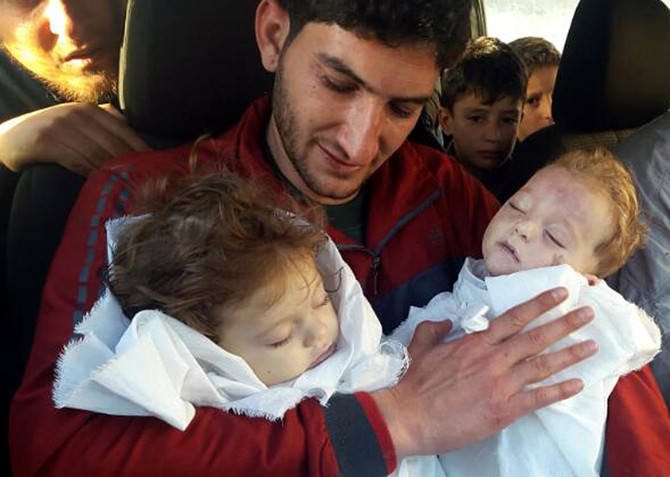
AMSTERDAM: The world’s chemical weapons watchdog said the banned nerve agent sarin was used in an attack in northern Syria in April that killed dozens of people, a report from a fact-finding team seen by Reuters on Thursday showed.
The report was circulated to members of the Organization for the Prohibition of Chemical Weapons (OPCW) in The Hague, but was not made public.
The attack on April 4 in the town of Khan Sheikhun in northern Idlib province was the most deadly in Syria’s civil war in more than three years. It prompted a US missile strike against a Syrian air base, which Washington said was used to launch the strike.
After interviewing witnesses and examining samples, a fact-finding mission (FFM) of the OPCW concluded that “a large number of people, some of whom died, were exposed to sarin or a sarin-like substance.
“It is the conclusion of the FFM that such a release can only be determined as the use of sarin as a chemical weapon,” a summary of the report said.
“Now that we know the undeniable truth, we look forward to an independent investigation to confirm exactly who was responsible for these brutal attacks so we can find justice for the victims,” US Ambassador to the UN Nikki Haley said in a statement on Thursday.
A joint UN and OPCW investigation, known as the JIM, can now look at the incident to determine who is to blame, she said.
The JIM has found Syrian regime forces were responsible for three chlorine gas attacks in 2014 and 2015 and that Daesh militants used mustard gas.
Western intelligence agencies had also blamed the regime of Bashar Assad for the April chemical attack. Syrian officials have repeatedly denied using banned toxins in the conflict.
The mission was unable to visit the site itself due to security concerns and will not attempt to get there, the head of the OPCW was said to have decided.
The report is based on “doubtful evidence,” Russian news agencies quoted Russia’s Foreign Ministry as saying on Friday.
“Unfortunately, after a first reading of this document we are forced to note that its conclusions are based on extremely doubtful evidence,” TASS news agency quoted Russia’s Foreign Ministry as saying.
“The contents of the report compiled by a special commission of the OPCW, are largely biased, which makes us think that the activities of this structure serve a political order,” TASS quoted the ministry as saying.
Moscow has said the attack was carried out by Assad’s opponents, who, Russian officials alleged, made it look as though it was the work of government forces.
Russian Foreign Minister Sergei Lavrov said on Thursday the report does not back claims by the US and its allies that the substance was dropped from aircraft.
He said: “The report released by the OPCW said they were not sure that the sarin found there had been airdropped in bombs. They don’t know how the sarin ended up there, yet tensions have been escalating for all these months.”
British Foreign Secretary Boris Johnson urged the international community to work together to bring to justice those responsible for the April 4 nerve gas attack in Syria.
Johnson said: “This confirmation cannot be ignored.”
While the OPCW report did not apportion blame, Johnson said: “The UK’s own assessment is that the Assad regime almost certainly carried out this abominable attack.”
He added: “I urge our international partners to unite behind the need to hold those responsible for this atrocity to account.”
Syria joined the chemicals weapons convention in 2013 under a Russian-US agreement, averting military intervention under then US President Barack Obama.
The US said on Wednesday the Syrian regime appeared to have heeded a warning this week from Washington not to carry out a chemical weapons attack.
Russia, the Syrian regime’s main backer in the civil war, warned it would respond proportionately if the US took pre-emptive measures against Syrian forces after Washington said on Monday it appeared the Syrian military was preparing to conduct a chemical weapons attack.

Sarin used in April attack, says chemical weapons watchdog
Fire from Iran, Lebanon triggers sirens across Israel
- Alerts were sounded in Jerusalem, Tel Aviv, Haifa and several other northern regions
- The Israeli army had noticed a gradual decrease in the number of Iranian missiles launched at Israel since Saturday
JERUSALEM: The Israeli military said it had detected multiple missile barrages from Iran on Wednesday, as well as launches from Lebanon, but added that the number of missiles fired from the Islamic republic at Israel was declining.
AFP journalists heard several blasts and multiple rounds of sirens from Jerusalem, while alerts also sounded in Tel Aviv, central Israel, Haifa and several other northern regions.
“The IDF identified missiles launched from Iran toward the territory of the State of Israel. Defensive systems are operating to intercept the threat,” the military said four times throughout the afternoon and early evening.
In a statement shortly after the first salvo was announced, the military said that “several launches... from Lebanon toward Israeli territory were successfully intercepted” after sirens sounded in central Israel.
The new salvos came on the fifth day of the Middle East war, which began on Saturday with joint US-Israeli strikes on Iran.
Lebanon was dragged into the war on Monday when the Tehran-backed Hezbollah group launched an attack on Israel to “avenge” the killing of Iran’s supreme leader Ayatollah Ali Khamenei, prompting ongoing Israeli air strikes.
Israeli military spokesman Lt. Col. Nadav Shoshani told reporters Wednesday evening that the army had noticed a gradual decrease in the number of Iranian missiles launched at Israel since the start of the war.
“We are speaking about many dozens the first day going down gradually to a few dozen and very low amounts,” he said.
“The barrages are much smaller. Today, some of them weren’t even a barrage, they were just one missile,” he added.
Shoshani said that some projectiles were launched from Iraq too, where some militias act as Iran proxies.
“We’ve seen small amounts of fire coming from Iraq, mostly UAVs (drones), but the vast majority of fire is from Iran and now from Hezbollah,” he said.
Israel’s Magen David Adom (MDA) emergency services said they had evacuated to hospital two people in central Israel with mild injuries, including “a man of about 30 with shrapnel wounds and another casualty with blast injuries.”
Police said in a statement that officers were dispatched to five locations in the Jerusalem area “where various intercepted projectiles had fallen, causing only damage.”
The military said that the “majority of the launches” from Lebanon were intercepted.
Not including Wednesday’s figures, MDA said that since the start of the war its teams had provided medical treatment to 414 casualties including “10 fatalities, 2 seriously injured, 6 moderately injured and 396 lightly injured.”
AFP journalists heard several blasts and multiple rounds of sirens from Jerusalem, while alerts also sounded in Tel Aviv, central Israel, Haifa and several other northern regions.
“The IDF identified missiles launched from Iran toward the territory of the State of Israel. Defensive systems are operating to intercept the threat,” the military said four times throughout the afternoon and early evening.
In a statement shortly after the first salvo was announced, the military said that “several launches... from Lebanon toward Israeli territory were successfully intercepted” after sirens sounded in central Israel.
The new salvos came on the fifth day of the Middle East war, which began on Saturday with joint US-Israeli strikes on Iran.
Lebanon was dragged into the war on Monday when the Tehran-backed Hezbollah group launched an attack on Israel to “avenge” the killing of Iran’s supreme leader Ayatollah Ali Khamenei, prompting ongoing Israeli air strikes.
Israeli military spokesman Lt. Col. Nadav Shoshani told reporters Wednesday evening that the army had noticed a gradual decrease in the number of Iranian missiles launched at Israel since the start of the war.
“We are speaking about many dozens the first day going down gradually to a few dozen and very low amounts,” he said.
“The barrages are much smaller. Today, some of them weren’t even a barrage, they were just one missile,” he added.
Shoshani said that some projectiles were launched from Iraq too, where some militias act as Iran proxies.
“We’ve seen small amounts of fire coming from Iraq, mostly UAVs (drones), but the vast majority of fire is from Iran and now from Hezbollah,” he said.
Israel’s Magen David Adom (MDA) emergency services said they had evacuated to hospital two people in central Israel with mild injuries, including “a man of about 30 with shrapnel wounds and another casualty with blast injuries.”
Police said in a statement that officers were dispatched to five locations in the Jerusalem area “where various intercepted projectiles had fallen, causing only damage.”
The military said that the “majority of the launches” from Lebanon were intercepted.
Not including Wednesday’s figures, MDA said that since the start of the war its teams had provided medical treatment to 414 casualties including “10 fatalities, 2 seriously injured, 6 moderately injured and 396 lightly injured.”
© 2026 SAUDI RESEARCH & PUBLISHING COMPANY, All Rights Reserved And subject to Terms of Use Agreement.