

MOSUL/BAGHDAD: For Ahmed Saied, a 54-year-old Iraqi schoolteacher, and many others Mosul can never be the same after Daesh militants blew up the leaning minaret that had graced his city for nearly 850 years.
“When I looked out of the window and saw the minaret was no longer there, I felt a part of me had died.”
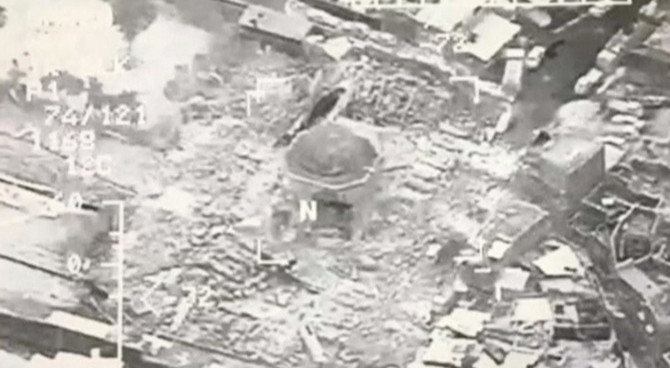
Militants destroyed the Grand Al-Nuri Mosque on Wednesday evening along with its famous minaret, affectionately called Al-Hadba, or “the hunchback” by Iraqis. In the dawn light, all that remained was the base projecting from shattered masonry.
The destruction came as Iraqi forces closed on the mosque, which also carried enormous symbolic importance for Daesh whose leader Abu Bakr Al-Baghdadi used it in 2014 to declare a “caliphate” spanning swathes of Syria and Iraq.
His black flag had been flying on the 45-meter minaret since June 2014, after Daesh militants surged across Iraq, seizing vast swathes of territory.
The insurgents chose to blow it up rather than see the flag taken down by US-backed Iraqi forces battling through the maze of narrow alleys and streets of the Old City, the last district still under control of Daesh in Mosul.
“In the early morning, I climbed up to my house roof and was stunned to see the Hadba minaret had gone,” Nashwan, a day-laborer living in Khazraj neighborhood near the mosque, said by phone. “I broke into tears. I felt I had lost a son of mine.”
The minaret was built with seven bands of decorative brickwork in complex geometric patterns also found in Persia and Central Asia. Its tilt and the lack of maintenance made it particularly vulnerable to blasts.
The media office for Iraq’s military distributed a picture taken from the air that showed the mosque and minaret largely reduced to rubble among the small houses and narrow alleys of the Old City. A video on social media showed the minaret collapsing vertically, throwing up a pall of sand and dust.
The Iraqi security forces are continuing to push into remaining Daesh-held territory, said US Army Col. Ryan Dillon, spokesman for the US-led international coalition assisting in the Iraqi effort to defeat Daesh.
“There are 2 sq km left in West Mosul before the entire city is liberated,” he told Reuters by phone.
For many, the destruction of the minaret marked the final collapse of Daesh rule in Mosul and augured its demise across Iraq. “Blowing up the Al-Hadba minaret and the Al-Nuri mosque amounts to an official acknowledgement of defeat,” Iraqi Prime Minister Haider Al-Abadi said Thursday on his website.
Al-Baghdadi in hiding
The mosque was destroyed as Iraq’s elite Counter Terrorism Service (CTS) fought their way to within 50 meters of it, according to an Iraqi military statement.
An Iraqi military spokesman gave the timing of the explosion as 9:35 p.m. (1835 GMT). The ground where the mosque stood was not yet taken as of midday Thursday.
Al-Baghdadi proclaimed himself ruler of all Muslims, from the mosque’s pulpit on July 4, 2014. His speech marked the first time he had revealed himself to the world. The footage broadcast then is to this day the only video recording of him as “caliph.”
The fall of Mosul would in effect mark the end of the Iraqi half of the “caliphate,” though Daesh would still hold territory west and south of the city. US-backed militias are closing on Daesh’s Syrian stronghold of Raqqa.
Al-Baghdadi has left the fighting in Mosul to local commanders and is believed to be hiding in the border area between Iraq and Syria, according to US and Iraqi military sources.
The mosque was named after Nuruddin Al-Zanki, a noble who fought the early crusaders from a fiefdom that covered territory in modern-day Turkey, Syria and Iraq. It was built in 1172-73, shortly before his death, and housed a school.
The mosque’s military and religious history embodies the spirit of Mosul, a conservative city, which supplied the armed forces with officers since modern Iraq was created, about 100 years ago, and until the fall of Saddam Hussein, after the 2003 US-led invasion.
The city balked at its loss of influence and some joined the insurgency against the new rulers of the country. When Daesh swept into Mosul in June 2014, they were welcomed by those who saw the takeover as promising an end to harsh treatment by security forces.
The mosque’s destruction occurred during the holiest period of the holy month of Ramadan, its final 10 days. Daesh has destroyed many Muslim religious sites, churches and shrines, as well as ancient Assyrian and Roman-era sites in Iraq and in Syria.
“Many different enemies controlled Mosul over the past 900 years but none of them dared to destroy the Hadba.” said Ziad, an arts students. “By bombing the minaret, they proved the are the worst of all barbarian groups in history.”


