Maasai land loss raises tensions in Kenya ahead of elections

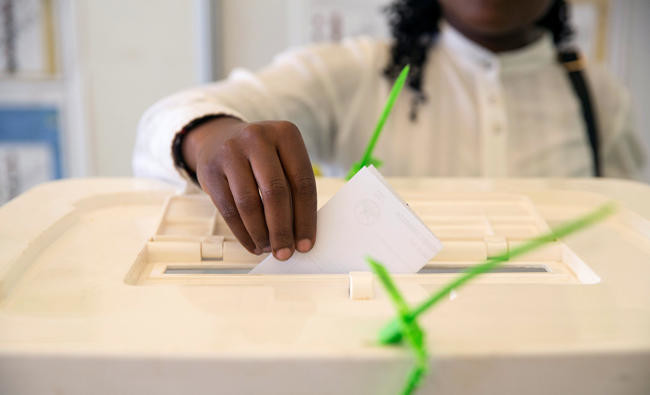
A Kenyan woman casts her vote at a mock polling station during a pre-election exhibition in Nairobi, Kenya, earlier this month. (Reuters)
Updated 20 June 2017
Follow

Maasai land loss raises tensions in Kenya ahead of elections

NAIROBI: Kenya’s opposition leader has raised tensions weeks ahead of elections by criticizing the Maasai community’s sale of ancestral land to other ethnic groups in an area hit by political violence in the 1990s, land rights experts said.
Many cash-strapped Maasai have become landless after subdividing and selling swathes of land to the south of Kenya’s capital, Nairobi, where they used to roam with their cattle.
“Years of neglect and abuse is forcing them to trade in their birthright for survival,” opposition presidential candidate Raila Odinga told a news conference on Monday.
“Jubilee has refused to enact proper laws to protect these community lands,” he said, referring to the ruling party of President Uhuru Kenyatta who hopes to retain power in elections on Aug. 8.
Last week, he called on non-Maasai communities to “remain” on their own land rather than buying up Maasai ancestral land around Kajiado, 80 km south of the capital, Nairobi.
Land has been one of the main drivers of conflict in Kenya since independence in 1963, with politicians whipping up historic grievances over land loss to incite their supporters to move away voters opposed to them, experts say.
Dozens have been killed and injured in Kenya’s Laikipia region over the last year as armed herders searching for pasture have driven tens of thousands of cattle onto private farms and ranches from overgrazed communal land.
“We urge the politicians to stop making disturbing comments on land,” Stephen Ambani, chairman of the Institution of Surveyors of Kenya, told a news conference on Tuesday.
“Our history has shown us how dangerous it can be in rekindling anxiety, hatred, hostility and conflict among communities.”
Much of Maasai-dominated Narok and Kajiado counties was made into group ranches, with shared title deeds, in the 1960s in an effort to better manage nomads’ grazing lands.
But mismanagement by elected committees, who often proved corrupt, led to the subdivision of land into individual title deeds, which have then been sold on, often to other ethnic groups.
“The overemphasis on privatization of land, in the long term, it’s going to be very bad,” said Hillary Ogina of the Kenya Land Alliance advocacy network.
“Pastoralism, as a way of livelihood, is also valid,” he said, adding that herders require large, communally owned land to give the animals enough grazing.
With increasingly frequent droughts and population growth, it is becoming harder for nomads to continue their traditional way of life.
Many young, educated Maasai are keen to sell their land and invest in businesses like hotels, Johnson Mali ole Kaunga, a Maasai activist told the Thomson Reuters Foundation.
“They end up buying vehicles, investing in things which don’t last,” he said in a phone interview.
“The best thing would actually be to maintain land as communal but if the community themselves are pushing for subdivision into private (titles), then it becomes a challenge.”
Leaders should help the Maasai find alternatives to livestock as a source of income, he said.
Odinga criticized the government for delays in implementing the 2016 Community Lands Act, which lays out the steps for communities to acquire titles to their ancestral land.
Around two-thirds of Kenya’s land is customarily owned without formal title deeds, making it easy for some individuals to sell it without other community members’ knowledge.
The government finalized the regulations to roll out the law last week and they should be approved by parliament in a couple of months, Peter Kahuho, secretary of the lands ministry, told a news conference on Monday. (Reporting by Katy Migiro @katymigiro; Editing by Ros Russell; Please credit the Thomson Reuters Foundation, the charitable arm of Thomson Reuters, that covers humanitarian news, women’s rights, trafficking, property rights and climate change.


Ex-CNN journalist Don Lemon pleads not guilty to Minnesota protest charges

Updated 7 sec ago
Follow

Ex-CNN journalist Don Lemon pleads not guilty to Minnesota protest charges

  • A magistrate judge ordered Lemon released to await trial, after a night in custody following his arrest late on Thursday by the FBI

LOS ANGELES: Former CNN news anchor Don Lemon entered a not guilty plea on Friday to federal charges over his role covering a protest at a Minnesota church against President Donald Trump’s immigration crackdown, the Republican administration’s ​latest move against a critic.
Lemon, now an independent journalist, livestreamed a protest against Trump’s deployment of thousands of armed immigration agents into Democratic-governed Minnesota’s biggest cities. The protest disrupted a January 18 service at Cities Church in St. Paul.
A magistrate judge ordered Lemon released to await trial, after a night in custody following his arrest late on Thursday by the FBI.
Dressed in a cream-colored double-breasted suit, Lemon spoke only to say “yes, your honor” when asked if he understood the proceedings. One of his attorneys said that he pleaded not guilty.
“He is committed to fighting this. He’s not going anywhere,” said Lemon attorney Marilyn Bednarski.
“I have spent my entire career covering the news. I will not stop now,” Lemon told reporters after the hearing. “I will not be silenced. I look forward to my day in court.”
A grand jury indictment charged Lemon, who is Black, with conspiring to deprive others of ‌their civil rights and violating ‌a law that has been used to crack down on demonstrations at abortion clinics but ‌also ⁠forbids obstructing access ​to houses ‌of worship. Six other people who were at the protest, including another journalist, are facing the same charges.
Thousands of protesters took to the streets of Minneapolis and other US cities on Friday to denounce an immigration crackdown in which federal agents fatally shot two US citizens, sparking one of the most serious political crises Trump has faced.

PRESS ADVOCATES ALARMED
Free press advocates voiced alarm over the arrests. Actor and activist Jane Fonda went to show support for Lemon, telling journalists the president was violating the Constitution. “They arrested the wrong Don,” Fonda said.
Trump, who has castigated the protesters in Minnesota, blamed the Cities Church protest on “agitators and insurrectionists” who he said wanted to intimidate Christian worshippers.
Organizers told Lemon they focused on the church because they believed a pastor there was also a senior US Immigration and Customs ⁠Enforcement employee.
More than a week ago, the government arrested three people it said organized the protests. But the magistrate judge in St. Paul who approved those arrests ruled that, without a grand jury indictment, ‌there was not probable cause to issue arrest warrants for Lemon and several others ‍the Justice Department also wanted to prosecute.
“This unprecedented attack on the First ‍Amendment and transparent attempt to distract attention from the many crises facing this administration will not stand,” Abbe Lowell, Lemon’s lawyer, said in a statement, ‍invoking constitutional free speech protections.
In the livestream archived on his YouTube channel, Lemon can be seen meeting with and interviewing the activists before they go to the church, and later chronicling the disruption inside, interviewing congregants, protesters and a pastor, who asks Lemon and the protesters to leave.
Independent local journalist Georgia Fort and two others who had been at the church were also arrested and charged with the same crimes.
US Magistrate Judge Dulce Foster on Friday ordered Fort’s release, denying prosecutors’ request to hold ​her in custody, according to court documents.

TRUMP CRITICS TARGETED
The Justice Department over the past year has tried to prosecute a succession of Trump’s critics and perceived enemies. Its charges against former FBI Director James Comey and New York Attorney General Letitia ⁠James, who both led investigations into Trump, were thrown out by a judge.
Lemon spent 17 years at CNN, becoming one of its most recognizable personalities, and frequently criticizes Trump in his YouTube broadcasts. Lemon was fired by CNN in 2023 after making sexist on-air comments for which he later apologized.
Trump frequently lambastes journalists and news outlets, going further than his predecessors by sometimes suing them for damages or stripping them of access-granting credentials.
FBI agents with a search warrant seized laptops and other devices this month from the home of a Washington Post reporter who has covered Trump’s firing of federal workers, saying it was investigating leaks of government secrets.
Press advocates called the FBI search involving the Post reporter and the arrests of Lemon and Fort an escalation of attacks on press freedom.
“Reporting on protests isn’t a crime,” said Jameel Jaffer, executive director of Columbia University’s Knight First Amendment Institute. Jaffer called the arrests alarming, and said Trump sought “to tighten the vise around press freedom.”
Trump has said his attacks are because he is tired of “fake news” and hostile coverage.
Legal experts said they were unaware of any US precedent for journalists being arrested after the fact, or under the two laws used to charge Lemon and Fort. They include the Freedom ‌of Access to Clinic Entrances Act, a 1994 measure that prevents obstructing access to abortion clinics and places of worship.