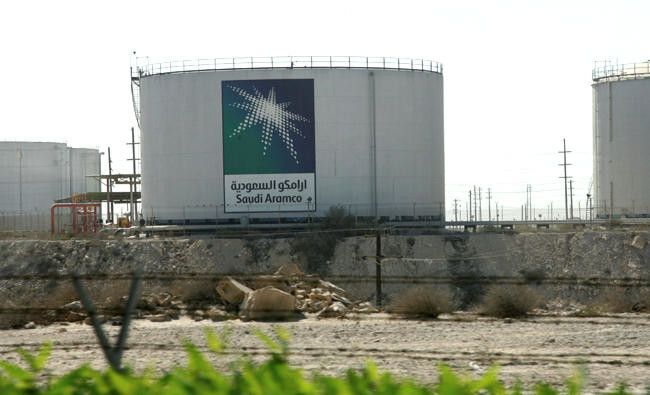
Saudi Aramco takes steps to maximize IPO valuation

Updated 20 June 2017
Follow

Saudi Aramco takes steps to maximize IPO valuation

DUBAI: The government of Saudi Arabia and Saudi Aramco are taking further steps toward maximizing the value of the state-owned oil giant in preparation for the sale of shares to citizens and international investors next year, according to reports.

The measures reportedly include moving some liabilities from Aramco to the government, as well as clarifying the relationship between the oil company and some of the non-oil projects it funds within the Kingdom.

According to a report by the Financial Times (FT), Aramco is looking to present potential investors with a set of “pristine” financial accounts designed to back up the official valuation of $2 trillion put on the company, the largest oil group in the world.

A spokesman for Aramco declined to comment on the report because the matters were still under consideration.

Another person familiar with the matter said that preparing detailed financial accounts was a normal part of the preparation process for an initial public offering (IPO) of shares on a stock exchange.  

There has been some skepticism among international energy analysts that the $2 trillion valuation figure will be reached, but — following a change to the Kingdom’s treatment of oil company taxation earlier this year — independent valuations have been moving upward toward the target.

One factor thought to be affecting investor sentiment has been Aramco’s historic financial support of non-oil projects, ranging from hospitals to sports stadiums.

The spokesman said that such projects were “in the long-term commercial interest of Saudi Aramco and have no material impact on its result.”

In addition to the measures recently taken and the taxation change, Aramco is also believed to have commissioned a new estimate of its overall reserves, vital for deciding valuation and is working with advisers on deciding a dividend policy, which will help determine investor appetite for the shares in any IPO.

The FT, citing four people briefed on the matter, said that the moves “reflected efforts to present a streamlined set of financials to investors.”

It added that an instruction has been issued to shift historical debts from foreign governments, including Jordan and Iraq, from Aramco’s accounts on to the government’s books. 

Under a separate resolution the Kingdom plans to create a mechanism — via a special tax deduction — to compensate Aramco for the financial cost of subsidizing fuels such as petrol for domestic motorists and gas for power generation, the FT added.

It also said that payments owed to Aramco by state entities, such as the national airline Saudi Arabian Airlines, which is also known as Saudia, and the domestic utility Saudi Electricity Company (SEC), will be moved to the Saudi Ministry of Finance.

Aramco is believed to be preparing historic 2015 and 2016 financial statements alongside pro-forma accounts for 2017 to investors for the first time ahead of the IPO.

The market flotation of Aramco will be by far the biggest IPO in history, with a value of $100 billion if, as has been officially suggested, 5 percent of the shares are sold on a $2 trillion valuation.

It is the centerpiece of the Vision 2030 strategy aimed at reducing the Kingdom’s dependence on oil and at transforming the national economy, and will be part of a $300 billion plan to privatize assets held by the Saudi government.

People familiar with the situation say that Aramco has been in talks with the stock exchanges in New York and London with a view to listing some of the shares on those exchanges, in addition to the Tadawul in Riyadh and possibly an Asian stock market.

• Frank Kane is an award-winning business journalist based in Dubai. He can be reached on Twitter @frankkanedubai


Six vital sectors drawing US investors to Saudi Arabia 

Updated 24 December 2025
Follow

Six vital sectors drawing US investors to Saudi Arabia 

RIYADH: Six vital sectors are drawing US investors, including entrepreneurs and small businesses, to Saudi markets as the Kingdom continues to develop its regulatory framework and foster innovation, Deborah Lehr, interim CEO of the Meridian International Center, said in an interview with Al-Eqtisadiah. 

Lehr, who is heading a trade and investment delegation to Saudi Arabia in her capacity as an economic advisor affiliated with the White House, stated that the six sectors include hospitality, luxury goods, and tourism, as well as culture, technology, and others. 

She noted that Saudi Arabia has significantly eased the process for foreign companies to establish a presence, a critical factor for small and medium-sized enterprises that may not yet have the scale to expand, making the Kingdom an attractive market for both large and innovative small companies. 

Following the success of the Saudi Crown Prince’s recent visit to Washington, she said, Meridian organized a US trade delegation to explore tangible and growing opportunities for US businesses in Saudi Arabia. 

Translating Vision 2030 priorities into real partnerships 

The delegation, which included representatives from Delta, Intel, Pernod Ricard, and Basilinna, among others, met a wide range of government officials, private-sector leaders, and entrepreneurs to explore how US companies can participate in Saudi market growth. 

According to Lehr, discussions were practical and forward-looking, focusing on translating Vision 2030 priorities into real business partnerships. 

She highlighted that most of the companies in the delegation were large enterprises operating across various sectors, underscoring the diversity of businesses active in Saudi Arabia. 

She pointed out that these companies joined the mission because they see the potential to scale their operations in Saudi Arabia — whether by increasing flight routes, enhancing airport security, offering advisory services to firms entering the Saudi or US markets, or exploring opportunities in the beverage sector. 

Relationship increasingly taking economic dimension 

Lehr hinted to the Saudi minister of investment that the US-Saudi relationship is also increasingly taking on an economic dimension. 

She noted that bilateral trade stands at around $40 billion, compared with Saudi-China trade of approximately $110 billion, highlighting untapped growth potential between the two countries, especially as diplomatic and political ties continue to strengthen. 

She said the reforms present valuable opportunities for US companies across multiple sectors, including advanced manufacturing, technology and logistics, as well as aviation, tourism and culture, alongside a wide range of services. 

With the regulatory environment being modernized and business stability increasing, the scope of US investment is set to expand further. More importantly, she added, the greater the engagement of companies, the stronger and more resilient the bilateral relationship will become in the years ahead. 

She emphasized that Saudi Arabia has undergone deep social and economic transformations, including increased female participation in the workforce and entrepreneurship, while emerging as a cultural hub with a thriving arts scene and new platforms for creative expression. 

Lehr further said that the world will witness growing global interest from companies and institutions eager to be part of Saudi Arabia’s remarkable transformation, amid increasing openness and a willingness to share its history, culture, and ambitions with the world. 

Saudi agenda offers tangible opportunities  

Lehr highlighted that during her visit, she focused on three key economic priorities. The first is Saudi Arabia’s strategic shift of capital from the oil and gas sector toward technology and innovation, a move that signifies not only economic diversification but also the Kingdom’s emergence as a globally competitive player. 

Second, the Kingdom’s reform agenda has provided tangible opportunities for foreign companies, reflecting real changes that facilitate international participation in Saudi growth. 

The third point she focused on was that the strong geopolitical and economic ties between the US and Saudi Arabia have bolstered investor confidence. As the Kingdom strengthens its global role and deepens relationships with partners such as the US, its attractiveness for long-term foreign direct investment continues to grow. 

She noted that sectors such as artificial intelligence, gaming and entertainment, advanced manufacturing, and the technology ecosystem are areas in which the US has strong competitive advantages, at a time when US firms are seeking new markets that offer stability and long-term potential. 

Giga-projects in Saudi Arabia, including AlUla and NEOM, have attracted global attention and highlighted emerging opportunities across the country. 

These projects demonstrate the Kingdom’s ambitious vision and its creation of entirely new sectors rather than merely expanding existing ones.