MOSUL: Iraqi forces pushed deeper into Mosul’s Old City on Monday after launching a final assault on Daesh, warning civilians to stay inside and telling terrorists to “surrender or die.”
Iraqi forces launched the operation on Sunday to retake the district, the last part of Iraq’s second city still held by Daesh after a months-long offensive.
Commanders say the terrorists are putting up fierce resistance and there are fears for more than 100,000 civilians believed to be trapped in the maze of narrow streets.
Staff Maj. Gen. Maan Al-Saadi, a top commander in Iraq’s elite Counter-Terrorism Service (CTS), said that heavy fighting had resumed at dawn on Monday.
“At 6:00 a.m., we pushed deeper into the Old City and took control of new areas in the Faruq neighborhood,” he said. “Daesh resistance has been fierce,” he said.
“They have blocked every entrance, planted IEDs (improvised explosive devices) and booby trapped houses our forces might be near,” he said.
“Penetrating was very difficult. Today the fighting is face to face.”
The push into Mosul’s historic heart on the west bank of the river Tigris marks the culmination of a months-long campaign by Iraqi forces to retake Daesh’s last major urban stronghold in the country.
The US-led coalition battling Daesh in Iraq and Syria has backed the offensive including with months of airstrikes.
The loss of Mosul would mark the effective end of the Iraqi portion of the cross-border “caliphate” Daesh declared in summer 2014 after seizing swathes of Iraq and Syria.
Sheltering from relentless fire and explosions near a sniper position on the edge of the Old City, CTS Capt.Ahmed Jassem described a bitter fight.
“We can’t bring our vehicles into these narrow streets. It means they cannot use as many car bombs either, but they use motorcycle bombs and even IEDs mounted on remote-controlled toy cars,” he said.
Iraqi forces stationed Humvees by the Grand Mosque on the retaken east side of Mosul, facing the Old City and mounted with speakers.
The loudspeakers blared messages to Daesh fighters, telling them: “You have only this choice: surrender or die.”
Late on Sunday, Iraqi forces dropped nearly 500,000 leaflets over the city, warning that they had “started attacking from all directions.”
The leaflets urge civilians to “stay away from open places and... exploit any opportunity that arises during the fighting” to escape.
The UN has said Daesh may be holding more than 100,000 civilians as human shields in the Old City.
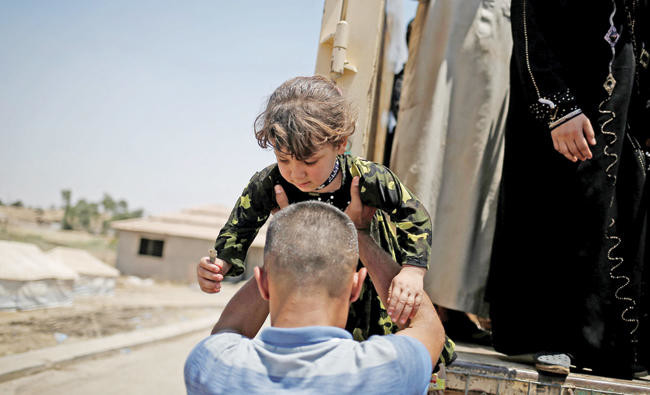
Only a few hundred meters from the heaviest fighting, small groups of civilians gathered, sheltering from the scorching sun more than from mortar rounds falling into the neighborhood.
“We moved to a camp in Hammam Al-Alil when the neighborhood was liberated, but homes were being looted so we came back to protect our property,” said Nabil Hamed Khattab, a 56-year old who did not flinch when a mortar round came crashing down a few blocks away.
Commanders have said the fighting is expected to be very difficult and could last weeks.
Surrounded by Iraqi forces on three sides and blocked on the other by the Tigris River that runs through Mosul, the terrorists are cornered.
Iraqi forces launched a vast operation to retake Mosul in October, seizing the city’s eastern side in January and starting an assault on its western part in February.
The International Rescue Committee, a major aid group operating in Iraq, has warned that already-traumatized civilians risk getting caught up in fierce street fighting. It urged coalition and Iraqi forces to do “everything in their power” to keep civilians safe.
Save the Children warned that some 50,000 children were trapped in the Old City.
“They are running out of food and water, and face violence wherever they turn,” the charity’s Ana Locsin said.
Since the start of the battle to retake Mosul, an estimated 862,000 people have been displaced. Around 195,000 have since returned, mainly to the city’s east.
It was from the Old City’s emblematic Al-Nuri mosque in July 2014 that Daesh chief Abu Bakr Al-Baghdadi made his only public appearance.
He urged Muslims worldwide to move to the group’s “caliphate” straddling Iraq and Syria.
The terrorists have since lost most of the territory they once controlled in the face of US-backed offensives in Iraq and in Syria, where a Kurdish-Arab alliance is advancing on the group’s last Syrian stronghold Raqqa.
It is not clear how many Daesh members remain in Mosul, where many foreign fighters have joined local jihadists since the city was taken.


![]()
Iraq forces push into Mosul Old City, warn Daesh ‘surrender or die’
Iraq forces push into Mosul Old City, warn Daesh ‘surrender or die’
Latest updates


© 2026 SAUDI RESEARCH & PUBLISHING COMPANY, All Rights Reserved And subject to Terms of Use Agreement.